Overview
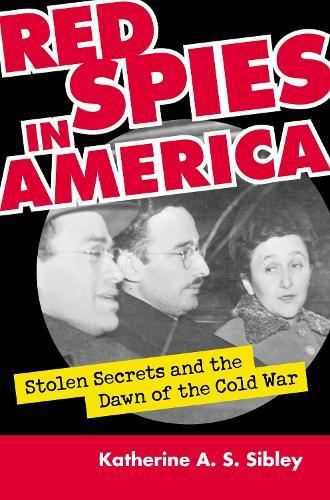
When the United States established diplomatic ties with the Soviet Union in 1933, it did more than normalize relations with the new Bolshevik state - it opened the door to a parade of Russian spies. In the 1930s and 1940s, Soviet engineers and technicians, under the guise of international cooperation, reaped a rich harvest of intelligence from our industrial plants. Factory layouts, aircraft blueprints, fuel formulas - all were grist for the Soviet espionage mill. And that, as Katherine Sibley shows, was just the beginning. While most historians date the onset of the Cold War with American fears of Soviet global domination after World War II, Sibley shows that it actually began during the war itself. The uncovering of atomic espionage in 1943 in particular not only led to increased surveillance of our ostensible Russian allies but also underscored a growing distrust of the Soviet Union. Meticulously documented through exhaustive new research in American and Soviet archives, Sibley's book provides the most detailed study of Soviet military-industrial espionage to date, revealing that the United States knew much more about Soviet operations than previously acknowledged. She tells of spies like Steve Nelson and Arthur Hiskey, who passed on information about the Manhattan Project; moles within the federal government like Nathan Silvermaster; and Soviet agents like Andrei Schevchenko, who pressed defense workers to divulge high tech secrets. At the same time, hundreds of other Red agents went completely undetected. It was only through the revelations of defectors, and the postwar cracking of Soviet codes, that we began to fully understand these breaches in our national security. Sibley describes how our response to this wartime espionage shaped a generation of Red-baiting - triggering loyalty programs, blacklists, and the infamous HUAC hearings - and how it has clouded U.S.-Russian relations down to the present day. She also reviews recent cases - John Walker, Jr., Aldrich Ames, Robert Hanssen - that demonstrate how Russian efforts to gain American secrets continues. For Cold War-watchers and spy aficionados alike, Sibley's work spells out what we actually knew about Communist espionage and suggests how and why that knowledge should also shape our understanding of intelligence in the Age of Terrorism.
Full Product Details
Author: Katherine A.S. Sibley
Publisher: University Press of Kansas
Imprint: University Press of Kansas
Dimensions:
Width: 16.10cm
, Height: 3.20cm
, Length: 23.90cm
Weight: 0.704kg
ISBN: 9780700613519
ISBN 10: 070061351
Pages: 384
Publication Date: 30 November 2004
Audience:
General/trade
,
General
Format: Hardback
Publisher's Status: Out of Print
Availability: Out of stock

Reviews
An excellent history of the ways that the nascent Bolshevik state succeeded in weaving its superb legion of espionage agents into the fabric of a Depression-ridden America. --Wall Street Journal An illuminating investigation of the active and extensive Soviet espionage network that operated in the United States beginning in the 1930s. This fine narrative of Soviet spying and America's response to it portrays the Cold War as an era of national anxiety, which bears unsettling similarities to the current era ushered in by 9/11. --Foreword Magazine An invaluable reference on Soviet espionage and a notable addition to scholarship on the origins of the Cold War. --American Historical Review A page-turner for foreign-affairs historians or students of espionage. --Philadelphia Inquirer Thoughtful, impressively researched. . . . Significantly enhances an understanding of the WWII and Cold War eras and the history of FBI and US counterintelligence. Highly recommended. --Choice A deeply researched and well-written study of Soviet espionage in America's industrial and manufacturing sectors, beginning long before World War II. Delving into newly opened Soviet archives and using many underutilized domestic primary sources, Sibley shows that Soviet spying was quite active, sophisticated, and pervasive even in the 1930s. --Library Journal Sibley has mined the archives on both sides of the Atlantic to present a balanced and perceptive account of how the Cold War began years before the construction of the Iron Curtain. She puts a human face on the contest, showing how Soviet intelligence operatives provoked a massive but belated response from the United States, and how each side adapted to their opponents' moves. --Michael Warner, coeditor of Venona, Soviet Espionage and the American Response An ambitious, important, and well written book that conveys the extraordinary scope of Soviet industrial and scientific espionage. --Harvey Klehr, coauthor of In Denial: Historians, Communism, and Espionage
An ambitious, important, and well written book that conveys the extraordinary scope of Soviet industrial and scientific espionage.
Author Information
Katherine A. S. Sibley is an associate professor of history in the American Studies program at St. Joseph's University in Philadelphia and author of The Cold War and Loans and Legitimacy: The Evolution of Soviet-American Relations, 1919-1933.