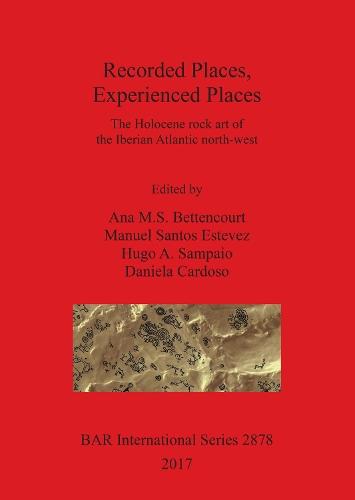
Recorded Places, Experienced Places: The Holocene rock art of the Iberian Atlantic north-west

Author:   Ana M.S Bettencourt ,  Manuel Santos-Estévez ,  Hugo A. Sampaio ,  Daniela Cardoso
Publisher:   BAR Publishing
ISBN:  

9781407314846


Pages:   222
Publication Date:   30 November 2017
Format:   Paperback
Availability:   Available To Order   Availability explained
We have confirmation that this item is in stock with the supplier. It will be ordered in for you and dispatched immediately.

Our Price $163.01 Quantity:  
Add to Cart

Share |

Recorded Places, Experienced Places: The Holocene rock art of the Iberian Atlantic north-west


Overview

This book springs from the compilation of papers and posters presented in 2013 and 2014 at the 2nd and 3rd Enardas Colloquia, entitled 'Living Places, Experienced Places'. The first part, in two chapters, is entitled 'Concepts and tools to study rock art'. The second part, 'From sub-naturalistic to Schematic rock art tradition', discusses various expressions of recorded art in the hinterland area of northwest Iberia, as well as expressions of the schematic art tradition from north-central Portugal. The third part, 'Atlantic tradition rock art' comprises four chapters. The fourth part, 'Other styles', includes five chapters focusing on depictions that the book editors consider distinct from the best-known regional styles.

Full Product Details

Author:   Ana M.S Bettencourt ,  Manuel Santos-Estévez ,  Hugo A. Sampaio ,  Daniela Cardoso
Publisher:   BAR Publishing
Imprint:   BAR Publishing
Weight:   0.885kg
ISBN:  

9781407314846


ISBN 10:   140731484
Pages:   222
Publication Date:   30 November 2017
Audience:   Professional and scholarly ,  Professional & Vocational
Format:   Paperback
Publisher's Status:   Active
Availability:   Available To Order   Availability explained
We have confirmation that this item is in stock with the supplier. It will be ordered in for you and dispatched immediately.

Table of Contents

List of figures and tables Recorded places, experienced places. Some remarks 1. Introduction 2. The book structure Part 1: Concepts and tools to study rock art Chapter 1. Contribution of the magical and religious geography to an anthropology of space. A case study in the north-west of Portugal (Álvaro Campelo) 1. Introduction 2. An anthropology of space 3. The magical and symbolic geography 4. The symbolic space of the Portuguese north-west 4.1. Mountains and boulders 4.2. Springs and water sources 4.3. Forests and places of passage 5. Conclusion Chapter 2. CVARN - Rock Art Virtual Corpus of North-Western Portugal. A multimedia tool to investigate and describe Post-Palaeolithic rock art (Ana M.S. Bettencourt, Emilio Abad-Vidal and Alda Rodrigues) 1. Introduction 2. The database 3. CVARN as a social tool 4. CVARN as a scientific tool 5. Final considerations Part 2: From sub-naturalistic to Schematic rock art tradition Chapter 3. Abstract and sub-naturalistic prehistoric rock art in the Trás-os-Montes and Alto Douro region of Portugal: the case study of the Passadeiro rock shelter - Palaçoulo (Miranda do Douro) (Maria de Jesus Sanches and Joana Castro Teixeira) 1. Introduction and objectives 1.1. Brief recap of 'devil claw' historiography 1.2. The Passadeiro rock shelter 1.3. Objectives 2. Decoding gestures in Passadeiro's panel 1 2.1. Motifs and techniques 2.2. Figurative stratigraphy 2.3. Temporal gesture hypothesis 3. Abstract and sub-naturalistic motifs in Passadeiro: approaching the chronological question 4. Discussion and final remarks Chapter 4. The Lamelas rock art site as a fundamental contributor to the knowledge of post-glacier art in north-western Iberia (Maria de Jesus Sanches and Nuno Coelho Gomes) 1. The rock art site of Lamelas: history of its research and objectives 2. Geographic location and synthetic description of Lamelas rock art site 3. Recording of the site 4. Formal and stratigraphic analysis of Rock A 4.1. The panels 4.2. Recording techniques and figurative stratigraphy 4.3. Motifs and compositions 5. Closing remarks Chapter 5. Rock art of the upper Támega Valley (Galicia, Spain) (Beatriz Comendador Rey and Félix González Insua) 1. Presentation of the study area 1.1. Physical description of the region 1.2. Background 1.3. Description of the archaeological actions and methodologies applied 2. Contextualisation of prehistoric rock art 3. Main rock art sites 3.1. Group of As Cuncas/As Ferradas (Covas Rubias, Santa Baia parish, Vences, Monterrei) 3.2. Group of Penedo das Pisadiñas and Monte Lastredo (Laza) GA32039001 3.3. Group of Penedo do Muro (Sandín, Monterrei, Ourense) GA32050002 4. Comparative analysis 5. Schematic art or Schematic arts? Chapter 6. Rock art places and contexts at Gralheira Massif (central north-west Portugal): a general overview (António Manuel S.P. Silva, Joana N. Leite, Paulo A.P. Lemos and Manuel Valério Figueiredo) 1. Presentation 2. The nucleus of Escariz 2.1. The tombs of Aliviada and Alagoas 2.1.1. Dolmen of Aliviada 1 2.1.2. Alagoas 1 and Alagoas 4 2.2. Selada's rock carvings 3. The nucleus of the lower Paiva River basin 3.1. Fraga Marcada 3.2. Fraga dos Sete Riscos 3.3. Cando's carved stone 3.4. Fraga da Ferradura 3.5. Marca dos Mouros 4. Final remarks Part 3: Atlantic tradition rock art Chapter 7. Galician petroglyphs: distribution patterns in the province of A Coruña (north-west Spain) (Alia Vázquez Martínez, Carlos Rodríguez-Rellán and Ramón Fábregas Valcarce) 1. Introduction 2. Methodology and materials 3. Results 4. Conclusions Chapter 8. The rock engravings of Cova da Bruxa (Galicia, north-west Iberia). A place of reiterated hunting scenes (Josefa Rey Castiñeira, Manuel Antonio Franco Fernández and Jorge Juan Eiroa) 1. Archaeological intervention 2. Repeated representation of hunting 3. Are these really depictions of hunting? 3.1. Scene 1: stalking scene? 3.2. Scene 2: capture of a 10-point stag with net, during the rutting season, in a clearing? 3.3. Scene 3: a stalking scene in the woods or by the water? 3.4. Scene 4: a huntsman and his hound behind the chosen prey? 3.5. Scene 5: a herd of deer; and the ruse of an old deer? 4. Why the hunting theme and not other types of scenes? 5. Final conclusions Chapter 9. The Atlantic rock art of Monte Eiró (Penhalonga, Marco de Canaveses, north-west Portugal). New background to its contextualisation (Luís Sousa) 1. Introduction 2. Physical, environmental and archaeological context 3. Rock art nucleuses 3.1. Monte Eiró I 3.2. Monte Eiró II 3.3. Monte Eiró III 3.4. Monte Eiró IV 3.5. Monte Eiró V 4. Final considerations Chapter 10. Respecting the ancestors? Iron Age life and 4th/3rd millennia BCE rock art within the hillfort of Briteiros (north-west Portugal) (Daniela Cardoso, Ana M.S. Bettencourt and George H. Nash) 1. Introduction 2. The data 3. The Atlantic rock art of Mount São Romão's 4. The Atlantic rock art of Mount São Romão and the Iron Age/Roman period inhabitants of the Briteiros hillfort 5. Towards a

Reviews

Author Information

Ana M. S. Bettencourt is Professor of Archaeology at University of Minho, Braga, Portugal. Her main research interests are burial contexts and practices; rock art; metal depositions and archaeology and tourism, on which subjects she has led several research projects and published numerous books and articles. Manuel Santos-Estévez obtained a PhD in History in 2004 at the University of Santiago de Compostela. His main research focuses on rock art, sculpture and landscape archaeology. Since 2014 he has been a post-doctoral researcher at the Fundação para a Ciência e a Tecnologia (FCT) at the University of Minho. He has directed 50 archaeological projects, and has published a number of papers in international reviews. Hugo Aluai Sampaio holds a PhD in Settlement and Landscape Archaeology and works in the School of Management at the Polytechnic Institute of Cávado and Ave, in Portugal. His research is dedicated to the Bronze Age, focusing on issues related to metallurgy and deposition of metallic objects, funerary practices and contexts, settlement and rock art. He also works in archaeology and cultural heritage. Daniela Cardoso obtained a PhD in rock art in 2015, at the University of Trás-os-Montes and Alto Douro, Portugal. She works at the Sociedade Martins Sarmento in Guimarães, Portugal, where she participates on projects related to rock art and to rock art and tourism. Contributors: Emilio Abad-Vidal, M. Isabel C. Alves, Ana M. Arruda, Ana M.S. Bettencourt, Cláudio Brochado, Álvaro Campelo, Daniela Cardoso, Joana Castro Teixeira, Nuno Coelho Gomes, Beatriz Comendador Rey, Maria de Jesus Sanches, Jorge Juan Eiroa, Ramón Fabregas Valcarce, Antón Fernández Malde, Gonçalo Ferreira, Manuel Antonio Franco Fernández, Félix González Insua, Joana N. Leite, Paulo A.P. Lemos, George H. Nash, Gabriel R. Pereira, Josefa Rey Castiñeira, Alda Rodrigues, Carlos Rodríguez-Rellán, Hugo A. Sampaio, Manuel Santos Estevez, António Manuel S.P. Silva, Isabel S. Silva, Pedro P. Simões, Luís Sousa, Manuel Valério Figueiredo, Alia Vázquez Martínez

Tab Content 6

Author Website:  

Countries Available

All regions
Latest Reading Guide

April RG 26_2


Shopping Cart
Your cart is empty
Shopping cart
Mailing List