Overview
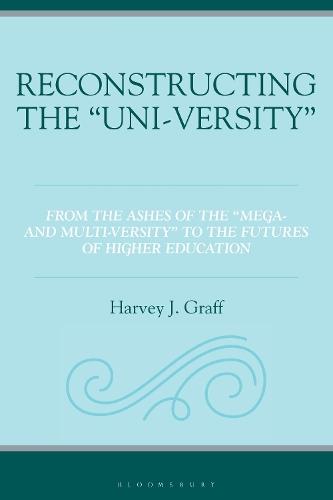
Slogans, myths, and isolated anecdotes are inadequate substitutes for documented history and contextual understanding. Literature on the history of higher education is dominated by ahistorical and contextually ignorant slogans. Seldom acknowledged, in discussions of the “decline” or “failure” of the modern university, is 1) how long it has been going on (at least since the 1960s); and 2) universities’ own complicity in this long, complicated, and contradictory process. Myths intertwine inseparably with slogans to echo yet another “lost cause.” Our collective, as well as individual, pasts provide essential lessons if we know how to read and learn from them. More complicated is imagining a plausible better future for universities. In Reconstructing the “Uni-versity”: From the Ashes of the “Mega- and Multi-versity” to the Futures of Higher Education, Harvey J. Graff, bringing experience from over 50 years as a professor, provides an accurate history of higher education, redefining the issues and terms to establish a new agenda.
Full Product Details
Author: Harvey J. Graff
Publisher: Bloomsbury Publishing Plc
Imprint: Rowman & Littlefield
ISBN: 9781666955095
ISBN 10: 1666955094
Pages: 384
Publication Date: 11 December 2025
Audience:
Professional and scholarly
,
College/higher education
,
Professional & Vocational
,
Postgraduate, Research & Scholarly
Format: Hardback
Publisher's Status: Active
Availability: Manufactured on demand

We will order this item for you from a manufactured on demand supplier.
Reviews
Harvey J. Graff maintains that we will not be able to see the future possibilities of colleges and universities clearly without a sense of the history of higher education. He argues passionately against reform initiatives which seem to be more firmly rooted in meaningless marketing slogans than concrete policies. His vision of a dynamic and humane university, and the reforms needed to make that vision a reality, are at once common sense and a marked departure from current practices. -- Jerry A. Jacobs * Professor of Sociology, University of Pennsylvania *
Harvey J. Graff maintains that we will not be able to see the future possibilities of colleges and universities clearly without a sense of the history of higher education. He argues passionately against reform initiatives which seem to be more firmly rooted in meaningless marketing slogans than concrete policies. His vision of a dynamic and humane university, and the reforms needed to make that vision a reality, are at once common sense and a marked departure from current practices. -- Jerry A. Jacobs * Professor Emeritus of Sociology, University of Pennsylvania * Harvey Graff, a seasoned scholar and newly retired academic, has written a book that should be widely read and discussed. It is not a typical screed deploring the fate of the American university. It is an historically grounded sample; he knows that there is no one university formula that fits all. There was no golden age of American university. What is missing are commentators equipped to speak historically about the fate of different institutions. We have precious few of them now, though every publisher seems to have a title that excoriates what is happening to the American university. There are few histories to inform university and college administrators about their duties and obligations, except perhaps raising money. Very few administrators of higher education are in command of their institutions’ history. Since the 1960s, if not before, there are predictions of the university’s demise. That wrong-headed version is a part of the actual history of students and academics striving to achieve their best with the resources at hand. It is a history fraught with contradictions about which its leaders should be knowledgeable. Read Graff’s account of higher education and make up your own mind. -- Paul Mattingly * Professor Emeritus of History, New York University * A magnificent achievement that transcends the massive and deeply flawed literature on the contemporary university. Harvey Graff has critically mastered that literature and its mode of production, uncovering its glaring ahistoricism and self serving cant. But far more than that, this book is deeply rooted in the realities of today’s universities and colleges. Based on his deep experience, historian’s sensibilities and acute analytic skills, Graff provides the first and only analysis that unites the usually disconnected and often disregarded variables that define the higher education crisis, that is, administration, faculty, curriculum, student life (psychological and economic dimensions) and growth, the relationship of universities to their locations and communities and the political and socio- cultural context at all levels. All are integral parts of the “problem.” But Graff goes further and provides solutions, to reintegrate, to overcome the contradictions, to re imagine the University as first and foremost a place that educates. -- Daniel Orlovsky * Professor and George Bouhe Research Fellow in Russian Studies, Southern Methodist University *
Author Information
Harvey J. Graff is Professor Emeritus of English and History, inaugural Ohio Eminent Scholar in Literacy Studies, and Academy Professor at The Ohio State University.