Overview
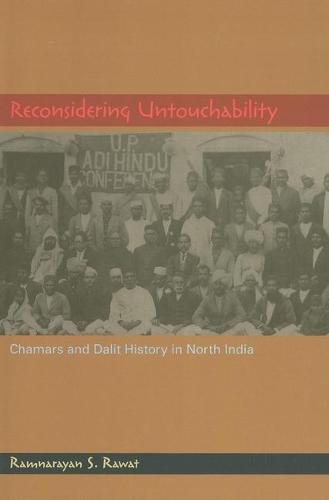
Often identified as leatherworkers or characterized as a criminal caste, Chamars of North India have long been stigmatized as untouchables. In this path-breaking study, Ramnarayan S. Rawat shows that in fact the majority of Chamars have always been agriculturalists, and their association with the ritually impure occupation of leatherworking has largely been constructed through Hindu, colonial, and postcolonial representations of untouchability. Rawat undertakes a comprehensive reconsideration of the history, identity, and politics of this important Dalit group. Using Dalit vernacular literature, local-level archival sources, and interviews in Dalit neighbourhoods, he reveals a previously unrecognized Dalit movement which has flourished in North India from the earliest decades of the 20th century and which has recently achieved major political successes.
Full Product Details
Author: Ramnarayan S. Rawat
Publisher: Indiana University Press
Imprint: Indiana University Press
Weight: 0.499kg
ISBN: 9780253355584
ISBN 10: 0253355583
Pages: 298
Publication Date: 23 March 2011
Audience:
College/higher education
,
Postgraduate, Research & Scholarly
Format: Hardback
Publisher's Status: Unknown
Availability: In Print

Limited stock is available. It will be ordered for you and shipped pending supplier's limited stock.
Reviews
<p> Challenges and revises our understanding of the historical andcontemporary role of dalits in Indian society. A pathbreaking book that rightfullyrestores the historical agency of and gives voice to dalits in north India. --Anand A. Yang, University of Washington--Anand A. Yang, University of Washington
<p>Rawat's Reconsidering Untouchability is a valuable addition to [the] recent tradition of caste interpretation... [He] elicits from the history of the Chamars of... Uttar Pradesh a historiographical and sociological position which is both viable and distinctive, identifies new departures for a history of 'untouchability' itself, and defends the position from challenges. --Ssheej Hegde, Central University Hyderabad H-Asia, H-Net Reviews (01/01/2012)
<p> Challenges and revises our understanding of the historical andcontemporary role of dalits in Indian society. A pathbreaking book that rightfullyrestores the historical agency of and gives voice to dalits in north India. --Anand A. Yang, University of Washington
Rawat's Reconsidering Untouchability is a valuable addition to [the] recent tradition of caste interpretation... [He] elicits from the history of the Chamars of... Uttar Pradesh a historiographical and sociological position which is both viable and distinctive, identifies new departures for a history of 'untouchability' itself, and defends the position from challenges. --Ssheej Hegde, Central University Hyderabad H-Asia, H-Net Reviews (01/01/2012)
Author Information
Ramnarayan S. Rawat is Assistant Professor of History at the University of Delaware.