Awards
- Short-listed for Aventis Prize for Science Books 2003
- Shortlisted for Aventis Prize for Science Books 2003.
Overview
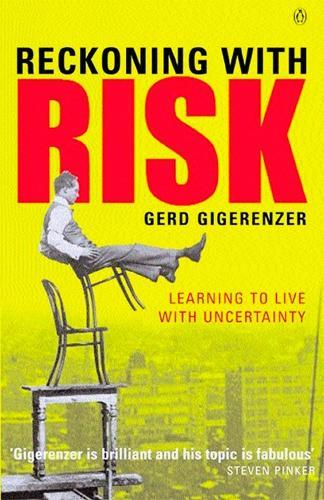
Clear and entertaining, this is an introduction for non-mathematicians. \""This is an important book, full of relevant examples and worrying case histories. By the end of it, the reader has been presented with a powerful set of tools for understanding statistics...anyone who wants to take responsibly for their own medicalchoices should read it\"" - New Scientist However much we crave certainty, we live in an uncertain world. But are we guilty of wildly exaggerating the chances of some unwanted event happening to us? Are ordinary people idiots when reasoning with risk? Far too many of us, argues Gerd Gigerenzer, are hampered by our own innumeracy. Here, he shows us that our difficulties in thinking about numbers can easily be overcome.
Full Product Details
Author: Gerd Gigerenzer
Publisher: Penguin Books Ltd
Imprint: Penguin Books Ltd
Dimensions:
Width: 13.00cm
, Height: 1.80cm
, Length: 19.80cm
Weight: 0.238kg
ISBN: 9780140297867
ISBN 10: 0140297863
Pages: 320
Publication Date: 24 April 2003
Audience:
General/trade
,
General
Format: Paperback
Publisher's Status: Active
Availability: To order

Stock availability from the supplier is unknown. We will order it for you and ship this item to you once it is received by us.
Reviews
This is an important book, full of relevant examples and worrying case histories. By the end of it, the reader has been presented with a powerful set of tools for understanding statistics...anyone who wants to take responsibly for their own medical choices should read it - New Scientist
Most adults consider themselves numerate if they can perform the simple functions of addition, subtraction, multiplication and division. An understanding of the way numbers work is increasingly important as our lives become more and more informed by them; many of the everyday decisions we have to make involve the understanding of complex figures, the news we hear is backed up by statistics, we routinely talk of percentages and ratios in the most casual conversations. However, even those who think they're thoroughly au fait with these techniques can easily be fooled by the misleading presentation of figures, whether through deliberate misrepresentation by cynical politicians or advertisers, or insufficient lucidity on the part of news reporters, doctors, lawyers and other influential individuals. In this book, Gerd Gigerenzer attempts to illuminate this widespread misrepresentation and suggests clear paths of thought to be used when faced with 'incontrovertible' facts derived from spurious mathematics. Gigerenzer is not short of examples to illustrate his case. One, derived from the work of mathematician John Allen Paulos, concerns a TV weather forecaster reporting that there was a 50 percent chance of rain on a Saturday and a 50 percent chance of rain on the Sunday, and concluding that this meant that there was a 100 percent chance of rain that weekend. This kind of functional innumeracy is found again and again, from trivial examples such as the above to those involving crucially important situations such as AIDS testing and mammogram results. This is no mere whine about 'falling standards', but instead points up a general lack of perception in a central area of our lives which materially affects the way we make important decisions. And it's a good read as well; the examples given are interesting stories in themselves and Gigerenzer is a lively narrator who moves smoothly from one chapter to another. Add to this a number of beguilingly simple methods towards clearer thinking and some fascinating sidelines on the nature of probability, and I reckon nine out of ten readers will say their cats enjoyed this book. Probably. (Kirkus UK)
Author Information
Gerd Gigerenzer is Director of the Centre for Adaptive Behaviour and Cognition (ABC) at the Max Planck Institute for Human Development in Berlin and a former Professor of Psychology at the University of Chicago.