|
|
|||
|
||||
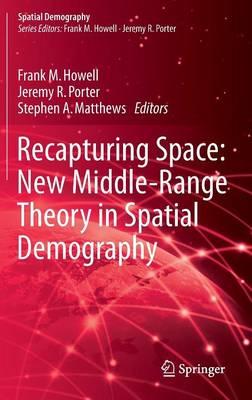
OverviewFull Product DetailsAuthor: Frank M. Howell , Jeremy R. Porter , Stephen A. MatthewsPublisher: Springer International Publishing AG Imprint: Springer International Publishing AG Edition: 1st ed. 2016 Volume: 1 Dimensions: Width: 15.50cm , Height: 2.20cm , Length: 23.50cm Weight: 7.037kg ISBN: 9783319228099ISBN 10: 3319228099 Pages: 379 Publication Date: 13 November 2015 Audience: Professional and scholarly , Professional & Vocational Format: Hardback Publisher's Status: Active Availability: Manufactured on demand We will order this item for you from a manufactured on demand supplier. Table of ContentsIntroduction: Chapter 1. Recapturing Spatial Approaches to Social Science Problems: Frank M. Howell, Jeremy R. Porter and Stephen Mathews.- Part I. Theory, Concept, and Measures: Chapter 2. Challenges of Spatial Thinking: John R. Logan, Brown University.- Chapter 3. Extending the Boundaries of Place: Carlos Siordia and Stephen A. Matthews.- Chapter 4. Using Place-and Person-Based Interventions to Measure Neighborhood Effects: Noli Brazil.- Chapter 5. From aspatial to spatial, from global to local and individual: Are we on the right track to spatialize segregation measures?: David W. Wong.- Chapter 6. Demography Is an Inherently Spatial Science: John R. Weeks.- Part II. Research Practice in Spatial Demography: Chapter 7. Modeling 'Dependence of Relevant Alternatives' in Consumer Choice: A Synthesis From Disparate Literatures: Lee Rivers Mobley and Gloria Bazzoli.- Chapter 8. Bringing Together Spatial Demography and Political Science: Reexamining The Big Sort: David Darmofal and Ryan Strickler.- Part III. Middle Range Theory in Application: Chapter 9. Demography and Democracy: Exploring the linkage between age and voter turnout in Italy with geospatial analysis: Michael Shin and John Agnew.- Chapter 10. A Spatial Decomposition of County Population Growth in the United States: Population Redistribution in the Rural-to-Urban Continuum, 1980-2010: Jeremy R. Porter and Frank M. Howell.- Chapter 11. Socio-spatial holes in the advocacy umbrella: The spatial diffusion of risk and network response among environmental organizations in the Marcellus hydro-fracturing region: Michael Irwin and Erin Pischke.- Chapter 12. American Civic Community over Space and Time: Charles Tolbert, F. Carson Menken, Troy Blanchard and Jing Li.- Chapter 13. Revisiting the Rural Paradox in US Counties with Spatial Durbin Modeling: Tse-Chuan Yang, Aggie J. Noah and Carla Shoff.- Chapter 14. Race, place, and space: Ecosocial theory and spatiotemporal patternsof pregnancy outcomes: Michael R. Kramer.- Chapter 15. Using Nighttime lights Data as a Proxy in Social Scientific Research: Xi Chen.- Chapter 16. Human Migration and Spatial Synchrony: Spatial Patterns in Temporal Trends: Daniel M. Parker.- Part IV. Instruction in Spatial Demography and Concluding Remarks: Chapter 17. Instruction in Spatial Demography: Stephen A. Mathews.- Chapter 18. Concluding Remarks: Developing Spatial Demography: Frank M. Howell, Jeremy R. Porter and Stephen A. Mathews.- Bibliography.ReviewsThis edited volume, the first in Springer's Spatial Demography series, identifies priorities and challenges in the field of spatial demography. ... anyone who reads it from beginning to end will be exposed to much of the core theory as well as a sampling of contemporary tools. (John Casterline, Population and Development Review, Vol. 42 (3), September, 2016) “This edited volume, the first in Springer’s Spatial Demography series, identifies priorities and challenges in the field of spatial demography. … anyone who reads it from beginning to end will be exposed to much of the core theory as well as a sampling of contemporary tools.” (John Casterline, Population and Development Review, Vol. 42 (3), September, 2016) Author InformationTab Content 6Author Website:Countries AvailableAll regions |
||||