|
|
|||
|
||||
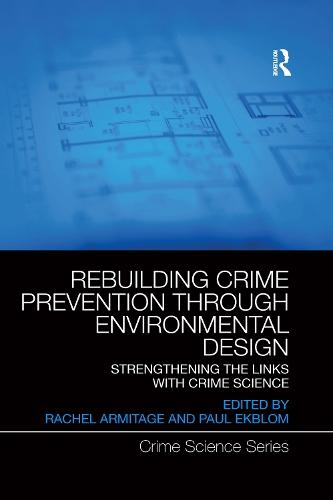
OverviewCrime Prevention Through Environmental Design (CPTED) is a practice-oriented approach to reduce the risk of offences such as burglary and fear of crime by modifying the built environment. In recent years, this approach has been criticised for duplicating terminology and for failing to integrate successfully with other approaches. Rebuilding Crime Prevention Through Environmental Design explores and extends the common ground between CPTED and situational crime prevention – another traditional approach in the field of crime prevention and security – via the latter’s evolution into the field of crime science. Drawing on international research to develop new interdisciplinary perspectives, this volume explores how situational crime prevention and environmental criminological theories relate to those of Crime Prevention Through Environmental Design and considers how crime science can be reformulated to merge different approaches, or at least articulate them better. Rebuilding Crime Prevention Through Environmental Design will appeal to students, applied academic researchers and practitioners who wish to deepen their understanding and contribute in turn to the ongoing revitalisation of the field. Full Product DetailsAuthor: Rachel Armitage , Paul EkblomPublisher: Taylor & Francis Ltd Imprint: Routledge Weight: 0.530kg ISBN: 9780367661250ISBN 10: 036766125 Pages: 266 Publication Date: 30 September 2020 Audience: College/higher education , Tertiary & Higher Education , Undergraduate Format: Paperback Publisher's Status: Active Availability: In Print This item will be ordered in for you from one of our suppliers. Upon receipt, we will promptly dispatch it out to you. For in store availability, please contact us. Table of Contents"1. Introduction Paul Ekblom and Rachel Armitage 2. Moving home as a flight from crime: residential mobility as a cause and consequence of crime and a challenge to Crime Prevention Through Environmental Design Michelle Rogerson and Ken Pease OBE 3. ""Why my house?"" – exploring the influence of residential housing design on burglar decision making Rachel Armitage and Chris Joyce 4. Using guardianship and Situational Crime Prevention (SCP) to strengthen Crime Prevention Through Environmental Design (CPTED) Danielle M. Reynald and Mateja Mihinjac 5. Sharpening up CPTED – towards an ontology based on crime science and ecology Paul Ekblom 6. Simulating CPTED: computational agent-based models of crime and environmental design Daniel Birks and Joseph Clare 7. Simulation of dependencies between armed response vehicles and CPTED measures in counter-terrorism resource allocation Hervé Borrion, Octavian Ciprian Bordeanu and Sonia Toubaline 8. Crime Prevention Through Environmental Design (CPTED) in Malaysia: development of a tool to measure CPTED implementation in residential settings Massoomeh Hedayati Marzbali, Aldrin Abdullah and Mohammad Javad Maghsoodi Tilaki 9. How to ruin CPTED Ward A. Adams, Eric S. McCord and Marcus Felson 10. A decade developing the delivery of CPTED across Greater Manchester Leanne Monchuk 11. Less crime, more vibrancy, by design Marcus Willcocks, Paul Ekblom and Adam Thorpe 12. Conclusion Rachel Armitage and Paul Ekblom"ReviewsAuthor InformationRachel Armitage is Professor of Criminology within the School of Human and Health Sciences at the University of Huddersfield, UK. Paul Ekblom is Emeritus Professor of Design Against Crime at Central Saint Martins, University of the Arts London, UK; and Visiting Professor at both UCL and the University of Huddersfield, UK. Tab Content 6Author Website:Countries AvailableAll regions |
||||