|
|
|||
|
||||
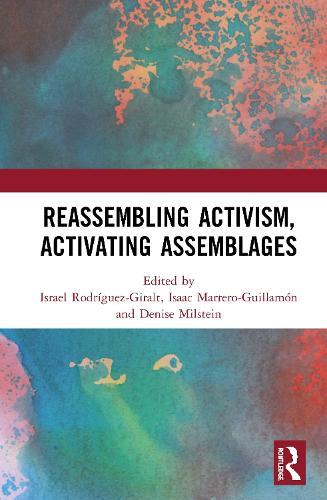
OverviewFull Product DetailsAuthor: Israel Rodríguez-Giralt , Isaac Marrero-Guillamón , Denise MilsteinPublisher: Taylor & Francis Ltd Imprint: Routledge Weight: 0.380kg ISBN: 9780367336103ISBN 10: 0367336103 Pages: 110 Publication Date: 15 October 2019 Audience: College/higher education , Tertiary & Higher Education , Undergraduate Format: Hardback Publisher's Status: Active Availability: In Print This item will be ordered in for you from one of our suppliers. Upon receipt, we will promptly dispatch it out to you. For in store availability, please contact us. Table of ContentsIntroduction: Reassembling activism, activating assemblages 1. Welcoming sound: the case of a noise complaint in the weekly assembly of el Campo de Cebada 2. The syntax of social movements: jam, boxes and other anti-mafia assemblages 3. We are all foreigners in an analogue world: cyber-material alliances in contesting immigration control in Stockholm’s metro system 4. The materiality of data transparency and the (re)configuration of environmental activism in the Brazilian Amazon 5. Bringing animals within political communities: the citizens/swans association that fractured Chile’s environmental framework 6. Down to earth social movements: an interview with Bruno LatourReviewsAuthor InformationIsrael Rodríguez-Giralt is a Senior Researcher at the Internet Interdisciplinary Institute at the Universitat Oberta de Catalunya, Spain. His research connects the study of Social Movements with Science and Technology Studies. He has studied the role of technoscience in environmental activism and the politics of embodied knowledge within disability activism. His current research focuses on technoscientific activism and new forms of social experimentation, mobilization, and public engagement, particularly in disaster situations. Isaac Marrero-Guillamón is a Lecturer in Anthropology at Goldsmiths, University of London, UK. His work examines the relationship between aesthetics and politics; more specifically the ways in which activism, artistic practice, and cultural artefacts may contribute to the production of new conditions of possibility for collectives. He has explored this question ethnographically, through the study of urban (Barcelona, London) and eco-artistic (Fuerteventura) controversies. Denise Milstein is a Lecturer in Sociology at Columbia University, USA. Her work develops a relational, historically informed perspective at the intersection of art, politics, and the environment. Her current projects examine the evolution of relationships between and among the changing environment – natural and human built – and local communities, artists, and scientists in New York City and in Tierra del Fuego (through the Ensayos nomadic research program). She is most interested in the dynamics that link cultural shifts and social change. Tab Content 6Author Website:Countries AvailableAll regions |
||||