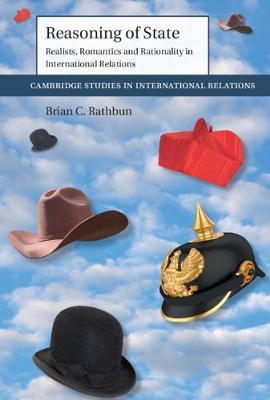
Full Product Details
Author: Brian C. Rathbun (University of Southern California)
Publisher: Cambridge University Press
Imprint: Cambridge University Press
Volume: 149
Dimensions:
Width: 15.20cm
, Height: 1.80cm
, Length: 22.80cm
Weight: 0.510kg
ISBN: 9781108446181
ISBN 10: 1108446183
Pages: 350
Publication Date: 14 February 2019
Audience:
Professional and scholarly
,
Professional & Vocational
Format: Paperback
Publisher's Status: Active
Availability: Available To Order

We have confirmation that this item is in stock with the supplier. It will be ordered in for you and dispatched immediately.
Reviews
Rathbun's argument that many decision-makers are not Realists, but rather are Romantics is original, important, and well supported by analysis and evidence. The result is an important challenge to what is generally believed and even those who are not convinced will need to grapple with it. Robert Jervis, author of How Statesmen Think Brian Rathbun has written a superb book about rationality and romantics in international politics. He asks the important question - when are leaders rational - and looks at the differences across leaders. Leaders are rational and intuitive at different times, but some are typically more of one than the other most of the time. This book changes our understanding of the dynamics of decision making. Janice Gross Stein, Munk School of Global Affairs, University of Toronto.
Advance praise: 'Rathbun's argument that many decision-makers are not Realists, but rather are Romantics is original, important, and well supported by analysis and evidence. The result is an important challenge to what is generally believed and even those who are not convinced will need to grapple with it.' Robert Jervis, author of How Statesmen Think Advance praise: 'Brian C. Rathbun has written a superb book about rationality and romantics in international politics. He asks the important question - when are leaders rational - and looks at the differences across leaders. Leaders are rational and intuitive at different times, but some are typically more of one than the other most of the time. This book changes our understanding of the dynamics of decision making.' Janice Gross Stein, Munk School of Global Affairs, University of Toronto.
Advance praise: 'Rathbun's argument that many decision-makers are not Realists, but rather are Romantics is original, important, and well supported by analysis and evidence. The result is an important challenge to what is generally believed and even those who are not convinced will need to grapple with it.' Robert Jervis, author of How Statesmen Think Advance praise: 'Brian C. Rathbun has written a superb book about rationality and romantics in international politics. He asks the important question - when are leaders rational - and looks at the differences across leaders. Leaders are rational and intuitive at different times, but some are typically more of one than the other most of the time. This book changes our understanding of the dynamics of decision making.' Janice Gross Stein, Munk School of Global Affairs, University of Toronto. `Rathbun's argument that many decision-makers are not Realists, but rather are Romantics is original, important, and well supported by analysis and evidence. The result is an important challenge to what is generally believed and even those who are not convinced will need to grapple with it.' Robert Jervis, author of How Statesmen Think 'Brian C. Rathbun has written a superb book about rationality and romantics in international politics. He asks the important question - when are leaders rational - and looks at the differences across leaders. Leaders are rational and intuitive at different times, but some are typically more of one than the other most of the time. This book changes our understanding of the dynamics of decision making.' Janice Gross Stein, Munk School of Global Affairs, University of Toronto
Author Information
Brian C. Rathbun is a Professor in the School of International Relations at the University of Southern California. He is the author of Partisan Interventions (2004), Trust in International Cooperation (2012) and Diplomacy's Value (2014), which won the best book award from the Diplomatic Studies Section of the International Studies Association. He has published articles in journals, such as International Organization, World Politics, International Security and International Studies Quarterly, among others.