Overview
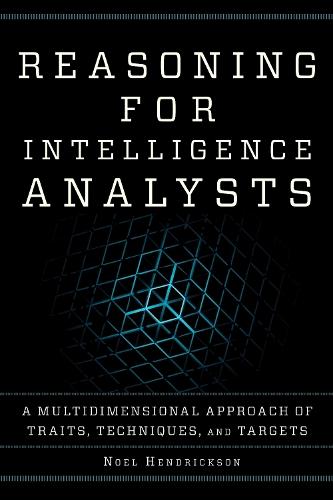
The goal of Reasoning for Intelligence Analysts is to address the three distinct dimensions of an analyst’s thinking: the person of the analyst (their traits), the processes they use (their techniques), and the problems they face (their targets). Based on a decade of academic research and university teaching in a program for aspiring intelligence analysts, this multidimensional approach will help the reader move beyond the traditional boundaries of accumulating knowledge or critical thinking with techniques to assess the unique targets of reasoning in the information age. This approach is not just a set of techniques, but covers all elements of reasoning by discussing the personal, procedural, and problem-specific aspects. It also addresses key challenges, such as uncertain data, irrelevant or misleading information, indeterminate outcomes, and significance for clients through an extensive examination of hypothesis development, causal analysis, futures exploration, and strategy assessment. Both critical and creative thinking, which are essential to reasoning in intelligence, are integrated throughout. Structured around independently readable chapters, this text offers a systematic approach to reasoning a long with an extensive toolkit that will serve the needs of both students and intelligence professionals.
Full Product Details
Author: Noel Hendrickson
Publisher: Bloomsbury Publishing Plc
Imprint: Rowman & Littlefield
Dimensions:
Width: 17.60cm
, Height: 2.20cm
, Length: 25.70cm
Weight: 0.735kg
ISBN: 9781442272316
ISBN 10: 1442272317
Pages: 356
Publication Date: 29 March 2018
Audience:
College/higher education
,
Tertiary & Higher Education
Format: Paperback
Publisher's Status: Active
Availability: In Print

This item will be ordered in for you from one of our suppliers. Upon receipt, we will promptly dispatch it out to you. For in store availability, please contact us.
Reviews
Dr. Hendrickson's book is a very much needed how-to for analysts, and their managers, who in this data-rich and tool-driven environment have too often lost the most important analytic skill: the ability to reason clearly. Hendrickson has developed a new vision specifically for the challenges facing intelligence analysis in applying reasoning to intelligence, in particular in futures analysis. This book should become a standard text for course on Logical Argumentation in Intelligence Analysis; I will use it in mine. -- Barry A. Zulauf Ph.D, Georgetown University Graduate Program in Applied Intelligence Focusing a philosopher's eye on the challenges inherent in producing effective intelligence analysis in the age of information, Noel Hendrickson has crafted an important work that dissects the process of reasoning and how to apply it to the varying analytical methods currently in use. His study discusses the unique aspects and qualities that go into producing well-reasoned analytical products, and how to develop, refine and present them. Meant for aspiring and veteran analysts, as well as the academic community, this book makes a significant contribution to the growing body of literature about intelligence analysis and methodologies. -- Gregory Moore, Director, Center for Intelligence Studies, Notre Dame College
Dr. Hendrickson's book is a very much needed how-to for analysts, and their managers, who in this data-rich and tool-driven environment have too often lost the most important analytic skill: the ability to reason clearly. Hendrickson has developed a new vision specifically for the challenges facing intelligence analysis in applying reasoning to intelligence, in particular in futures analysis. This book should become a standard text for course on Logical Argumentation in Intelligence Analysis; I will use it in mine.--Barry A. Zulauf Ph.D, Georgetown University Graduate Program in Applied Intelligence Focusing a philosopher's eye on the challenges inherent in producing effective intelligence analysis in the age of information, Noel Hendrickson has crafted an important work that dissects the process of reasoning and how to apply it to the varying analytical methods currently in use. His study discusses the unique aspects and qualities that go into producing well-reasoned analytical products, and how to develop, refine and present them. Meant for aspiring and veteran analysts, as well as the academic community, this book makes a significant contribution to the growing body of literature about intelligence analysis and methodologies.--Gregory Moore, Director, Center for Intelligence Studies, Notre Dame College
"Dr. Hendrickson's book is a very much needed ""how-to"" for analysts, and their managers, who in this data-rich and tool-driven environment have too often lost the most important analytic skill: the ability to reason clearly. Hendrickson has developed a new vision specifically for the challenges facing intelligence analysis in applying reasoning to intelligence, in particular in futures analysis. This book should become a standard text for course on Logical Argumentation in Intelligence Analysis; I will use it in mine. -- Barry A. Zulauf Ph.D, Georgetown University Graduate Program in Applied Intelligence Focusing a philosopher's eye on the challenges inherent in producing effective intelligence analysis in the age of information, Noel Hendrickson has crafted an important work that dissects the process of reasoning and how to apply it to the varying analytical methods currently in use. His study discusses the unique aspects and qualities that go into producing well-reasoned analytical products, and how to develop, refine and present them. Meant for aspiring and veteran analysts, as well as the academic community, this book makes a significant contribution to the growing body of literature about intelligence analysis and methodologies. -- Gregory Moore, Director, Center for Intelligence Studies, Notre Dame College"
Dr. Hendrickson's book is a very much needed ""how-to"" for analysts, and their managers, who in this data-rich and tool-driven environment have too often lost the most important analytic skill: the ability to reason clearly. Hendrickson has developed a new vision specifically for the challenges facing intelligence analysis in applying reasoning to intelligence, in particular in futures analysis. This book should become a standard text for course on Logical Argumentation in Intelligence Analysis; I will use it in mine. -- Barry A. Zulauf Ph.D, Georgetown University Graduate Program in Applied Intelligence Focusing a philosopher's eye on the challenges inherent in producing effective intelligence analysis in the age of information, Noel Hendrickson has crafted an important work that dissects the process of reasoning and how to apply it to the varying analytical methods currently in use. His study discusses the unique aspects and qualities that go into producing well-reasoned analytical products, and how to develop, refine and present them. Meant for aspiring and veteran analysts, as well as the academic community, this book makes a significant contribution to the growing body of literature about intelligence analysis and methodologies. -- Gregory Moore, Director, Center for Intelligence Studies, Notre Dame College
Author Information
Noel Hendrickson is associate professor and a founding faculty member of the Intelligence Analysis Program at James Madison University. He earned a PhD in Philosophy from the University of Wisconsin-Madison, and has over a decade of experience teaching reasoning methods to aspiring intelligence analysts.