Overview
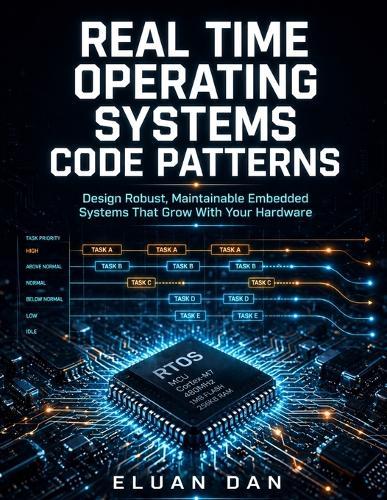
What separates an embedded engineer who ships reliable firmware from one who spends nights chasing intermittent crashes? It is not how fast they can write code. It is whether they think in patterns. Most engineers who adopt an RTOS get the primitives - tasks, queues, semaphores, timers - but never receive the architectural blueprint for assembling them into software that is correct, maintainable, and timing-safe under real operating conditions. Your system still has priority inversions that only surface under load, stack overflows that appear in the field but never in the lab, timer callbacks that silently stall the entire scheduler, and a watchdog that proves nothing because it is kicked from a SysTick ISR. These are not beginner mistakes. They are the exact bugs that experienced engineers introduce when they apply RTOS primitives without a structural framework. Real Time Operating Systems Code Patterns gives you that framework. Sixteen chapters of battle-tested, production-grade patterns - from task architecture and scheduling strategy through multi-core synchronization, power management, and field-proof fault recovery - each explained with the mechanics of why the pattern works, not just how to paste it in. Every pattern comes with annotated C code targeting the FreeRTOS API and three graduated exercises to cement what you have learned. Inside this book you will find: Master task design: periodic, event-driven, gatekeeper, and state machine patterns that eliminate shared-state bugs plaguing monolithic superloop migrations Understand scheduling rigorously: Rate Monotonic Analysis, Earliest Deadline First trade-offs, and aperiodic server patterns grounded in real WCET measurements Synchronize without fear: mutexes with Priority Inheritance, Priority Ceiling Protocol emulation, spinlocks on dual-core targets, and event group barriers - with every pitfall named and solved Build resilient systems: multi-task liveness watchdogs, five-level fault escalation ladders, task restart supervisors, and HardFault capture that survives a field reset Optimize with data: windowed CPU profiling, context switch overhead measurement, cache-friendly struct layouts for Cortex-M7, and response-time analysis that turns schedulability into a verified claim Scale and port cleanly: OSAL and BSP abstraction layers, FreeRTOS-to-Zephyr migration patterns, dual-bank OTA bootloaders, and multi-core SMP versus AMP architectural decisions for ESP32 and RP2040 Written for engineers who already build embedded systems and want to build them better, this book bridges the gap between RTOS documentation and production firmware. Every pattern is derived from real failure modes in shipping products. The RTOS platform comparison appendix covering FreeRTOS, Zephyr, ThreadX, and RT-Thread, the 94-term glossary, and the three-page pattern quick-reference card ensure this is a resource you will return to throughout your engineering career - not just for your first RTOS project. Your firmware deserves an architecture it can grow into - grab your copy today and start building embedded systems that ship, hold up in the field, and scale with your product.
Full Product Details
Author: Eluan Dan
Publisher: Independently Published
Imprint: Independently Published
Dimensions:
Width: 21.60cm
, Height: 1.60cm
, Length: 27.90cm
Weight: 0.712kg
ISBN: 9798195130428
Pages: 306
Publication Date: 01 May 2026
Audience:
General/trade
,
General
Format: Paperback
Publisher's Status: Active
Availability: Available To Order

We have confirmation that this item is in stock with the supplier. It will be ordered in for you and dispatched immediately.