Overview
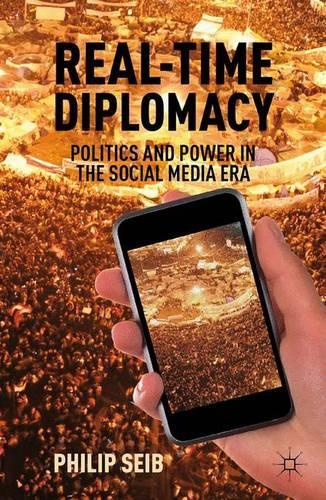
In light of the events of 2011, Real-Time Diplomacy examines how diplomacy has evolved as media have gradually reduced the time available to policy makers. It analyzes the workings of real-time diplomacy and the opportunities for media-centered diplomacy programs that bypass governments and directly engage foreign citizens.
Full Product Details
Author: P. Seib
Publisher: Palgrave Macmillan
Imprint: Palgrave Macmillan
Dimensions:
Width: 15.20cm
, Height: 1.10cm
, Length: 22.90cm
Weight: 0.454kg
ISBN: 9780230339439
ISBN 10: 0230339433
Pages: 199
Publication Date: 14 May 2012
Audience:
Professional and scholarly
,
Professional & Vocational
Format: Paperback
Publisher's Status: Active
Availability: In Print

This item will be ordered in for you from one of our suppliers. Upon receipt, we will promptly dispatch it out to you. For in store availability, please contact us.
Reviews
Carefully researched and written, this is a valuable study of the role of the changing global media environment on political behavior, including a discussion of the 2011 Arab world uprisings and the diplomatic challenges that both popular movements and media developments present to many governments, including ours. At a time when pundits and commentators offer differing theories on these events, the author gives us a balanced, sober and insightful account that provides specialists with new ways of thinking, and general audiences with a valuable overview. This book will be assigned reading for my students. - William A. Rugh, former US ambassador, visiting professor, Fletcher School of Law and Diplomacy, Tufts University, and author of Arab Mass Media Real-Time Diplomacy not only draws readers into the compelling narratives of personal sacrifice and collective risk during the Arab Spring, but it provides the broader context needed to really understand the political impact and implications of technology diffusion. Seib is an authority on public diplomacy, and his latest book is real-time social science at its best. Most important, for the policy makers, journalists, and interested public who don't want to just be spectators to current events, this book offers insight into the long-term digital media trends that will shape international relations in the years ahead. - Philip N. Howard, professor of Communication, University of Washington Real-Time Diplomacy is far more than an authoritative guide to understanding the role of social media in the Arab Awakening of 2011. It is about why and how new communication technologies have forever changed the relationship between politicians and publics. This book is simply unmissable reading for policy makers, informed citizens, and political activists to navigating the global networked politics of the 21st century. - Cristina Archetti, lecturer in Politics and Media, University of Salford
"""Carefully researched and written, this is a valuable study of the role of the changing global media environment on political behavior, including a discussion of the 2011 Arab world uprisings and the diplomatic challenges that both popular movements and media developments present to many governments, including ours. At a time when pundits and commentators offer differing theories on these events, the author gives us a balanced, sober and insightful account that provides specialists with new ways of thinking, and general audiences with a valuable overview. This book will be assigned reading for my students."" - William A. Rugh, former US ambassador, visiting professor, Fletcher School of Law and Diplomacy, Tufts University, and author of Arab Mass Media ""Real-Time Diplomacy not only draws readers into the compelling narratives of personal sacrifice and collective risk during the Arab Spring, but it provides the broader context needed to really understand the political impact and implications of technology diffusion. Seib is an authority on public diplomacy, and his latest book is real-time social science at its best. Most important, for the policy makers, journalists, and interested public who don't want to just be spectators to current events, this book offers insight into the long-term digital media trends that will shape international relations in the years ahead."" - Philip N. Howard, professor of Communication, University of Washington ""Real-Time Diplomacy is far more than an authoritative guide to understanding the role of social media in the Arab Awakening of 2011. It is about why and how new communication technologies have forever changed the relationship between politicians and publics. This book is simply unmissable reading for policy makers, informed citizens, and political activists to navigating the global networked politics of the 21st century."" - Cristina Archetti, lecturer in Politics and Media, University of Salford ""This isall crucial perspective for budding diplomats. While they become aware of the acceleration of events enabled by social media, they need to also remember the dangers of acting without a fuller sense of what's going on."" Dallas Morning News 'Real-Time Diplomacy: Politics and Power in the Social Media Era offers several excellent contributions to bridge the practice of diplomacy with theories of technology and media change...It does so with the aid of carefully parsed stories from across the globe and history...[Seib shows that] the Arab Spring is important not in its isolation as a rare and important moment in recent history but rather in its integration with global networks of civil society and non-state actors...With several points of entry for students, theorists, and practitioners, Real-Time Diplomacy is well-timed and very necessary...The narratives traced in the analysis do the difficult work of detailing points of network convergence with new forms of political mobilization.' International Journal of Communication"
<p> Carefully researched and written, this is a valuable study of the role of the changing global media environment on political behavior, including a discussion of the 2011 Arab world uprisings and the diplomatic challenges that both popular movements and media developments present to many governments, including ours. At a time when pundits and commentators offer differing theories on these events, the author gives us a balanced, sober and insightful account that provides specialists with new ways of thinking, and general audiences with a valuable overview. This book will be assigned reading for my students. - William A. Rugh, former US ambassador, visiting professor, Fletcher School of Law and Diplomacy, Tufts University, and author of Arab Mass Media Real-Time Diplomacy not only draws readers into the compelling narratives of personal sacrifice and collective risk during the Arab Spring, but it provides the broader context needed to really understand the political impact and implications of technology diffusion. Seib is an authority on public diplomacy, and his latest book is real-time social science at its best. Most important, for the policy makers, journalists, and interested public who don't want to just be spectators to current events, this book offers insight into the long-term digital media trends that will shape international relations in the years ahead. - Philip N. Howard, professor of Communication, University of Washington Real-Time Diplomacy is far more than an authoritative guide to understanding the role of social media in the Arab Awakening of 2011. It is about why and how new communication technologies have forever changed the relationship between politicians and publics. This book is simply unmissable reading for policy makers, informed citizens, and political activists to navigating the global networked politics of the 21st century. - Cristina Archetti, lecturer in Politics and Media, University of Salford
Author Information
PHILIP SEIB Professor of Journalism and Public Diplomacy and of International Relations at the University of Southern California, USA, and director of USC's Center on Public Diplomacy.