Overview
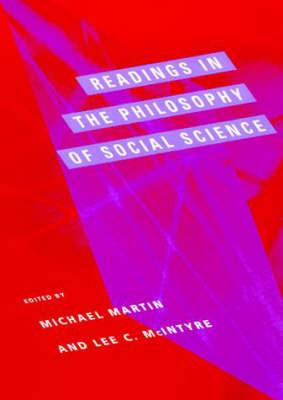
This anthology offers a selection of readings, plus three specially commissioned articles that encompass a broad range of topics in the field. The introductions to each section provide a map through the discipline. Covering the major areas in the discipline, including debates about explanation, methodological individualism, and the special sciences, this text could serve as a source for scholarship in the field. It could also be used as the basis for a course. The commissioned articles are: ""Taylor on Interpretation and the Sciences of Man"" by Michael Martin; ""Microfoundations of Marxism"" by D. Little; and ""Evidential Constraints: Pragmatic Empiricism in Archaeology"" by A. Wylie.
Full Product Details
Author: Michael Martin , Lee McIntyre (Center for Philosophy and History of Science)
Publisher: MIT Press Ltd
Imprint: MIT Press
Dimensions:
Width: 17.80cm
, Height: 3.50cm
, Length: 25.40cm
Weight: 1.338kg
ISBN: 9780262631518
ISBN 10: 0262631512
Pages: 814
Publication Date: 22 March 1994
Recommended Age: From 18
Audience:
College/higher education
,
Professional and scholarly
,
Undergraduate
,
Postgraduate, Research & Scholarly
Format: Paperback
Publisher's Status: Out of Stock Indefinitely
Availability: In Print 
Limited stock is available. It will be ordered for you and shipped pending supplier's limited stock.
Table of Contents
"Part 1 Introduction: are the social sciences really inferior?, Fritz Machlup; what would an adequate philosophy of social science look like?, Brian Fay and J. Donald Moon. Part 2 Explanation, prediction and laws: the function of general laws in history, Carl G. Hempel; the theory of complex phenomena, F.A. Hayek; a possible distinction between traditional scientific disciplines and the study of human behaviour, Michael Scriven; psychology as philosophy, Donald Davidson; general laws and explaining human behaviour, Brian Fay; defending laws in the social sciences, Harold Kincaid; complexity and social scientific laws, Lee C. McIntyre; reflexive predictions, George D. Romanos. Part 3 Interpretation and meaning: human nature and human history, R.G. Collingwood; the rationale of actions, William Dray; interpretation and the sciences of man, Charles Taylor; thick description - toward an interpretive theory of culture, Clifford Geertz; hermeneutics and the hypothetico-deductive method, Dagfinn Follesdal; another look at the doctrine of Verstehen, Jane Roland Martin; Taylor on interpretation and the sciences of man, Michael Martin. Part 4 Rationality: some problems about rationality, Steven Lukes; the status of rationality assumptions in interpretation and in the explanation of action, Dagfinn Follesdal; the nature and scope of rational-choice explanation, Jon Elster; the principle of charity and the problem of irrationality (translation and the problem of irrationality), David K. Henderson. Part 5 Functional explanation: the logic of functional analysis, Carl G. Hempel; function and cause, R.P. Dore; functional explanation - in Marxism, G.A. Cohen, in social science, Jon Elster; assessing functional explanations in the social sciences, Harold Kincaid. Part 6 Reductionism, individualism and holism: social facts, Emile Durkheim; historical explanation in the social sciences, J.W.N. Watkins; methodological individualism reconsidered, Steven Lukes; methodological individualism and social explanation, Richard W. Miller; microfoundations of Marxism, Daniel Little; reduction, explanation and individualism, Harold Kincaid; social science and the mental, Alan J. Nelson. Part 7 Objectivity and values: ""objectivity"" in social science and social policy, Max Weber; neutrality in political science, Charles Taylor; the value-oriented bias of social inquiry, Ernest Nagel; the philosophical importance of the Rosenthal effect, Michael Martin; psychology constructs the female, Naomi Weisstein; reasoning about ourselves - feminist methodology in the social sciences, Alison Wylie; a method for critical research, Donald E. Comstock. Part 8 Problems of the special sciences: the methodology of positive economics, Milton Friedman; if economics isn't science, what is it?, Alexander Rosenberg; actions, reasons and causes, Donald Davidson; special sciences (or the disunity of science as a working hypothesis), Jerry Fodor. (Part contents)."
Reviews
Author Information
Michael Martin is Professor of Philosophy at Boston University. Lee McIntyre is a Research Fellow at the Center for Philosophy and History of Science at Boston University. He is the author of Dark Ages: The Case for a Science of Human Behavior and Post-Truth, both published by the MIT Press.
Tab Content 6
Author Website:
Countries Available
All regions
|