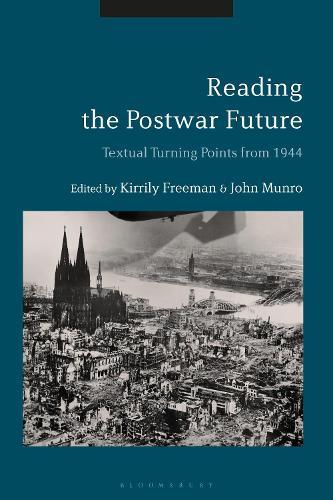
Overview
This original collection explores a number of significant texts produced in 1944 that define that year as a textual turning point when overlapping and diverging visions of a new world emerged. The questions posed at that moment, about capitalism, race, empire, nation and cultural modernity gave rise to debates that defined the global politics of their era and continue to delineate our own. Highlighting the goals, agendas and priorities that emerged for artists, intellectuals and politicians in 1944, Reading the Postwar Future rethinks the intellectual history of the 20th century and the way 1944’s texts shaped the contours of the postwar world. This is essential reading for any student or scholar of the intellectual, political, economic and cultural history of the postwar era.
Full Product Details
Author: Kirrily Freeman (Associate Professor of History, Saint Mary's University, Canada) , John Munro (Associate Professor of History, Birmingham University, UK)
Publisher: Bloomsbury Publishing PLC
Imprint: Bloomsbury Academic
Dimensions:
Width: 15.40cm
, Height: 1.80cm
, Length: 23.20cm
Weight: 0.400kg
ISBN: 9781350196353
ISBN 10: 1350196355
Pages: 256
Publication Date: 17 June 2021
Audience:
College/higher education
,
Tertiary & Higher Education
Format: Paperback
Publisher's Status: Active
Availability: Manufactured on demand 
We will order this item for you from a manufactured on demand supplier.
Table of Contents
Introduction, Kirrily Freeman (Saint Mary's University, Canada) Representations 1. Remastering the soundtrack of a clash of titans: Polanyi’s The Great Transformation and Hayek’s The Road to Serfdom, Radhika Desai (University of Manitoba, Canada) 2. Dialectic of Enlightenment: Origin stories of Western Marxism, Michael D’Arcy (Saint Francis Xavier University, Canada) 3. Britain, Europe, and the borders of markets: TS Eliot and F. Hayek on postwar internationalism Luke Foster (University of Chicago, USA) Decolonizations 4. “Meet the new empire, same as the old empire”: Visions and realities of French imperial policy in 1944, Sarah Frank (University of St. Andrews, UK) 5. “Village Life and How to Improve It”: Textual routes of community development in the late British empire, Radhika Natarajan (Reed College, USA) 6. Capitalism and Slavery as a decolonial text: Looking back to look forward, Ajay Parasram (Dalhousie University, Canada) Reconstructions 7. Projecting gender and emotion in 1944 Japan: Young women and affect in Kurosawa Akira's The Most Beautiful, Chikako Nagayama (Nagoya University, Japan) 8. 1944: The launch of the Allied film campaign for civilian relief, Suzanne Langlois (Glendon College, York University, Canada) 9. Champions of dignity? The 1944 Democratic Party Platform, Katherine Rye Jewell (Fitchburg State University, USA) Emancipations 10. Looking backward and forward from African America in 1944: WEB du Bois’ “My Evolving Program for Negro Freedom”, Chike Jeffers (Dalhousie University, Canada) 11. Back to the future in Howard Fast’s Freedom Road, Alan Wald (University of Michigan, USA) 12. “Serve the People:” An Exemplary Chinese Socialist Text of 1944, Rebecca E. Karl (New York University, USA) Conclusion, John Munro (University of Birmingham, UK) Index
Reviews
[Kirrily Freeman and John Munro] are to be commended on a judicious selection and on their choice of a novel frame through which to examine a significant historical moment. * E-International Relations * This outstanding collection of essays engages with a variety of texts, broadly conceived, that mark the distinct character of 1944. It is an interdisciplinary and international volume that assesses the way in which the selected texts set out the crisis constituted by '1944' and examines their visions for a postwar world that went beyond what had preceded it. The scope and range of the contributions is exciting, intriguing, and innovative. The conversations between the chapters, which the volume curates around the themes of representation, decolonization, reconstruction, and emancipation, are truly thought-provoking. * Gurminder K Bhambra, Professor of Postcolonial and Decolonial Studies, University of Sussex, UK * There are few moments in human history when alternative futures seem genuinely possible. As Reading the Postwar Future shows, 1944 was such a moment. This fascinating collection of essays about a wide range of thinkers who wrote original works in 1944, from libertarians like Friedrich Hayek to Marxists like Howard Fast, illustrates that 1944 is a year worth returning to time and again as we seek to rethink our own future. * Andrew Hartman, Professor of History, Illinois State University, USA * Engaging a diverse array of texts published in 1944, the essays in this volume convincingly make the case for the ways that the looming end of World War II and the as yet undecided character of the new world order engendered competing and expansive visions of the postwar future. As the institutional settlements of 1945 are fracturing, Reading the Postwar Future will be an indispensable guide to our own predicaments. * Adom Getachew, Neubauer Family Assistant Professor of Political Science and the College, University of Chicago, USA *
[Kirrily Freeman and John Munro] are to be commended on a judicious selection and on their choice of a novel frame through which to examine a significant historical moment. * E-International Relations * This outstanding collection of essays engages with a variety of texts, broadly conceived, that mark the distinct character of 1944. It is an interdisciplinary and international volume that assesses the way in which the selected texts set out the crisis constituted by ‘1944’ and examines their visions for a postwar world that went beyond what had preceded it. The scope and range of the contributions is exciting, intriguing, and innovative. The conversations between the chapters, which the volume curates around the themes of representation, decolonization, reconstruction, and emancipation, are truly thought-provoking. * Gurminder K Bhambra, Professor of Postcolonial and Decolonial Studies, University of Sussex, UK * There are few moments in human history when alternative futures seem genuinely possible. As Reading the Postwar Future shows, 1944 was such a moment. This fascinating collection of essays about a wide range of thinkers who wrote original works in 1944, from libertarians like Friedrich Hayek to Marxists like Howard Fast, illustrates that 1944 is a year worth returning to time and again as we seek to rethink our own future. * Andrew Hartman, Professor of History, Illinois State University, USA * Engaging a diverse array of texts published in 1944, the essays in this volume convincingly make the case for the ways that the looming end of World War II and the as yet undecided character of the new world order engendered competing and expansive visions of the postwar future. As the institutional settlements of 1945 are fracturing, Reading the Postwar Future will be an indispensable guide to our own predicaments. * Adom Getachew, Neubauer Family Assistant Professor of Political Science and the College, University of Chicago, USA *
Author Information
Kirrily Freeman is Associate Professor of History at Saint Mary's University, in Halifax, Canada. Her publications include Bronzes to Bullets: Vichy and the Destruction of French Public Statuary, 1940-1944 (2009). John Munro is Lecturer of US History at the University of Birmingham, UK. His publications include The Anticolonial Front: The African American Freedom Struggle and Global Decolonization, 1945-1960 (2017).
Tab Content 6
Author Website:
Countries Available
All regions
|