Overview
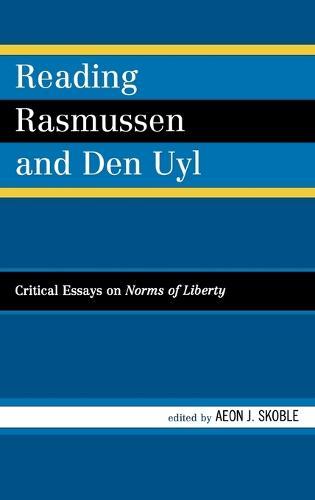
Douglas B. Rasmussen and Douglas J. Den Uyl's recent book Norms of Liberty: A Perfectionist Basis for Non-Perfectionist Politics (Penn State University Press, 2005) is being received in philosophy and political theory as an important and original defense of liberalism. The book offers a neo-Aristotelian ethic of human flourishing as a basis for a liberal conception of human rights. One of the authors' central contentions is that a key problem for any (liberal) political philosophy is how to establish a political/legal order which in principle does not require that any one person or group's well-being be given structured preference over that of any other. This companion volume, an interpretive and critical reader, features essays from both philosophers and political scientists, as well as an omnibus reply by Rasmussen and Den Uyl. Norms of Liberty makes challenging arguments about key issues, which makes a multi-disciplinary reader a valuable asset for both students and scholars. Reading Rasmussen and Den Uyl is designed both to explicate the book's arguments and to explore possible objections.
Full Product Details
Author: Sue Collins ,
Douglas J. Den Uyl ,
Edwin England ,
Timothy Fuller
Publisher: Bloomsbury Publishing Plc
Imprint: Lexington Books
Dimensions:
Width: 16.10cm
, Height: 2.50cm
, Length: 24.00cm
Weight: 0.531kg
ISBN: 9780739126929
ISBN 10: 073912692
Pages: 238
Publication Date: 19 June 2008
Audience:
Professional and scholarly
,
Professional & Vocational
Format: Hardback
Publisher's Status: Active
Availability: In Print

This item will be ordered in for you from one of our suppliers. Upon receipt, we will promptly dispatch it out to you. For in store availability, please contact us.
Reviews
Aeon J. Skoble has done a masterful job in assembling a provocative anthology of critically reflective essays on Norms of Liberty, one of the most important defenses of neo-Aristotelian liberalism ever written. This terrific volume highlights the significance to contemporary political philosophy of Rasmussen and Den Uyl's superb work. -- Sciabarra, Chris Matthew Reading Rasmussen and Den Uyl is a rich dialectic, with expansive reach into multiple aspects of liberalism, while sustaining a focus on the important contribution made by Norms of Liberty. That book shaped new contours for the development of liberalism while uncovering roots deep in the past. Reading Rasmussen and Den Uyl engages numerous thinkers and the authors in a joint project of articulating some of the most important future directions of argument. -- Jonathan Jacobs This book is an outstanding collection of essays mostly focusing on Den Uyl and Rasmussen's key contention that a neo-Aristotelian ethics of flourishing provides the basis for a political doctrine which precludes the political promotion of human flourishing. The analyses of human flourishing and of how an appeal to it can or cannot support classical liberal conclusions are powerful and insightful. -- Eric Mack It is high time that these two indefatigable, bright students of human community life receive the attention paid them in this fine collection of comments and criticisms. Maybe this group of respectful essays, with their close scrutiny of Norms of Liberty, will eventually lead to the book's ideas having the impact they deserve to make. -- Machan, Tibor R.
Reading Rasmussen and Den Uyl is a rich dialectic, with expansive reach into multiple aspects of liberalism, while sustaining a focus on the important contribution made by Norms of Liberty . That book shaped new contours for the development of liberalism while uncovering roots deep in the past. Reading Rasmussen and Den Uyl engages numerous thinkers and the authors in a joint project of articulating some of the most important future directions of argument.--Jonathan Jacobs
Reading Rasmussen and Den Uyl is a rich dialectic, with expansive reach into multiple aspects of liberalism, while sustaining a focus on the important contribution made by Norms of Liberty. That book shaped new contours for the development of liberalism while uncovering roots deep in the past. Reading Rasmussen and Den Uyl engages numerous thinkers and the authors in a joint project of articulating some of the most important future directions of argument.--Jonathan Jacobs
Author Information
Aeon J. Skoble is professor of philosophy and chair of the Department of Philosophy at Bridgewater State College.