Overview
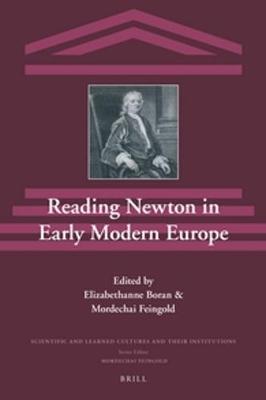
Reading Newton in Early Modern Europe investigates how Sir Isaac Newton’s Principia was read, interpreted and remodelled for a variety of readerships in eighteenth-century Europe. The editors, Mordechai Feingold and Elizabethanne Boran, have brought together papers which explore how, when, where and why the Principia was appropriated by readers in Italy, Spain, the Netherlands, England and Ireland. Particular focus is laid on the methods of transmission of Newtonian ideas via university textbooks and popular works written for educated laymen and women. At the same time, challenges to the Newtonian consensus are explored by writers such as Marius Stan and Catherine Abou-Nemeh who examine Cartesian and Leibnizian responses to the Principia. Eighteenth-century attempts to remodel Newton as a heretic are explored by Feingold, while William R. Newman draws attention to vital new sources highlighting the importance of alchemy to Newton. Contributors are: Catherine Abou-Nemeh, Claudia Addabbo, Elizabethanne Boran, Steffen Ducheyne, Moredechai Feingold, Sarah Hutton, Juan Navarro-Loidi, William R. Newman, Luc Peterschmitt, Anna Marie Roos, Marius Stan, and Gerhard Wiesenfeldt.
Full Product Details
Author: Elizabethanne A. Boran ,
Mordechai Feingold
Publisher: Brill
Imprint: Brill
Volume: 19
Dimensions:
Width: 15.50cm
, Height: 2.70cm
, Length: 23.50cm
Weight: 0.702kg
ISBN: 9789004336643
ISBN 10: 9004336648
Pages: 368
Publication Date: 15 June 2017
Audience:
Professional and scholarly
,
Professional & Vocational
Format: Hardback
Publisher's Status: Active
Availability: Manufactured on demand

We will order this item for you from a manufactured on demand supplier.
Reviews
This is a well-balanced collection that will be of great value to Newtonian scholars. Summing up: Recommended. Graduate students, researchers, and faculty. M. Dickinson, Maine Maritime Academy. In: Choice Connect, Vol. 55, No. 5 (January 2018).
This is a well-balanced collection that will be of great value to Newtonian scholars. Summing up: Recommended. Graduate students, researchers, and faculty. M. Dickinson, Maine Maritime Academy. In: Choice Connect, Vol. 55, No. 5 (January 2018). This is a collection that includes a number of important papers, and it should not be overlooked by anyone with a serious interest in Newton or in eighteenth-century Newtonianism. John Henry, University of Edinburgh (emeritus). In: Isis, Vol. 110, No. 1 (March 2019), pp. 168-169. The volume Reading Newton in Early Modern Europe is an exemplary treatment of how revolutionary science becomes de rigeur, through its introduction, opposition to, and eventual overtaking of the preexisting paradig, in this brilliant composite study of how Newton's mathematical and physical theories changed the nature of science, as taught and understood in early modern Europe. Cheryl Kayahara-Bass, Oshawa, ON. In: Sixteenth Century Journal, Vol. 50, No. 2 (Summer 2019), pp. 557-560.
“This is a well-balanced collection that will be of great value to Newtonian scholars. Summing up: Recommended. Graduate students, researchers, and faculty.” M. Dickinson, Maine Maritime Academy. In: Choice Connect, Vol. 55, No. 5 (January 2018). “This is a collection that includes a number of important papers, and it should not be overlooked by anyone with a serious interest in Newton or in eighteenth-century Newtonianism.” John Henry, University of Edinburgh (emeritus). In: Isis, Vol. 110, No. 1 (March 2019), pp. 168–169. “The volume Reading Newton in Early Modern Europe is an exemplary treatment of how revolutionary science becomes de rigeur, through its introduction, opposition to, and eventual overtaking of the preexisting paradig, in this brilliant composite study of how Newton’s mathematical and physical theories changed the nature of science, as taught and understood in early modern Europe.” Cheryl Kayahara-Bass, Oshawa, ON. In: Sixteenth Century Journal, Vol. 50, No. 2 (Summer 2019), pp. 557–560.
Author Information
Elizabethanne Boran, Ph. D. (1996), Trinity College, Dublin, is Librarian of the Edward Worth Library, Dublin. She is the editor of The Correspondence of James Ussher, 1600-1656, 3 vols (Dublin, 2015) and Aldines at the Edward Worth Library (Dublin, 2015). Mordechai Feingold is Professor of History at Caltech. He is the editor of the journals Erudition and the republic of Letters (Brill) and History of Universities (Oxford). He is the author of a number of books, including The Mathematicians’ Apprenticeship: Science, Universities and Society in England, 1560-1640 (1984); The Newtonian Moment: Isaac Newton and the Making of Modern Culture (2004); and Newton and the Origin of Civilization (2013), written with Jed Buchwald.