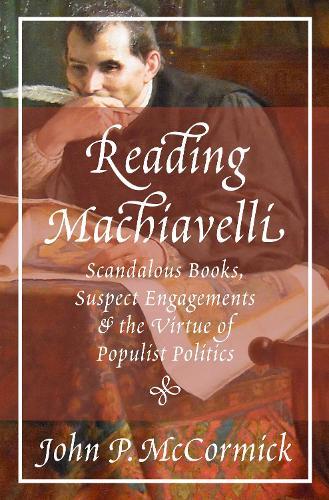
Full Product Details
Author: John P. McCormick
Publisher: Princeton University Press
Imprint: Princeton University Press
ISBN: 9780691183503
ISBN 10: 0691183503
Pages: 288
Publication Date: 09 October 2018
Audience:
General/trade
,
Professional and scholarly
,
General
,
Professional & Vocational
Format: Hardback
Publisher's Status: Active
Availability: Temporarily unavailable

The supplier advises that this item is temporarily unavailable. It will be ordered for you and placed on backorder. Once it does come back in stock, we will ship it out to you.
Language: English
Reviews
In the last decade, perhaps no scholar has done more to transform Machiavelli's image than John McCormick. In his new book, McCormick exposes the prejudices that prevented Straussians and neo-republicans from acknowledging Machiavelli's commitment to popular empowerment and elaborates a new grand narrative, in which Machiavelli (and neither Rousseau nor Spinoza) stands as the major early-modern source of contemporary democracy. Combining sharp close readings with an exceptional sensitivity to long-range historical trends, Reading Machiavelli offers a rare example of what intellectual history and political theory can be when practiced at the highest level. --Gabriele Pedull�, author of Machiavelli in Tumult Distinct from other approaches to Machiavelli, this impressive book places class and class conflict at the fore. Given the political moment and the continued discussion of inequality and demagoguery, Reading Machiavelli is timely and important. It will surely have a major impact in political theory and political science more broadly, as well as in intellectual history, political philosophy, and the study of early modern Europe. --Daniel Kapust, University of Wisconsin-Madison This provocative, effective, and subtly argued book demonstrates Machiavelli's consistent advocacy of a new form of muscular populist politics in three of his major works. It also shows in detail how and why major interpretive schools of Machiavelli's political thought have either missed or deliberately obscured the radical extent of this hard-edged populism. Reading Machiavelli will generate substantive, constructive debate. --Mark Jurdjevic, York University, Glendon John McCormick is a brilliant reader of Machiavelli's rhetorical twists and turns, and skewering of conventional pieties. In Reading Machiavelli, McCormick defends his provocative interpretation of Machiavelli as a democratic theorist, while dismantling competing interpretations by Leo Strauss, J.G.A. Pocock, Quentin Skinner, and others. This book will interest not only historians of political thought and early modernists of all stripes, but also contemporary political theorists. --Victoria Kahn, University of California, Berkeley With a level of ingenuity and determination equal to that of his Straussian opponents, John McCormick finds a radical populist soul in the Machiavellian corpus. He distances his reading, not just from the conservative, Straussian construal, but also from the Cambridge interpretation that makes the Florentine a hero for progressive neo-republicans. This is political theory by other, historical means. But both the history and the theory are worthy of close attention and they will certainly command it. --Philip Pettit, author of Just Freedom
In the last decade, perhaps no scholar has done more to transform Machiavelli's image than John McCormick. In his new book, McCormick exposes the prejudices that prevented Straussians and neo-republicans from acknowledging Machiavelli's commitment to popular empowerment and elaborates a new grand narrative, in which Machiavelli (and neither Rousseau nor Spinoza) stands as the major early-modern source of contemporary democracy. Combining sharp close readings with an exceptional sensitivity to long-range historical trends, Reading Machiavelli offers a rare example of what intellectual history and political theory can be when practiced at the highest level. -Gabriele Pedulla, author of Machiavelli in Tumult Distinct from other approaches to Machiavelli, this impressive book places class and class conflict at the fore. Given the political moment and the continued discussion of inequality and demagoguery, Reading Machiavelli is timely and important. It will surely have a major impact in political theory and political science more broadly, as well as in intellectual history, political philosophy, and the study of early modern Europe. -Daniel Kapust, University of Wisconsin-Madison This provocative, effective, and subtly argued book demonstrates Machiavelli's consistent advocacy of a new form of muscular populist politics in three of his major works. It also shows in detail how and why major interpretive schools of Machiavelli's political thought have either missed or deliberately obscured the radical extent of this hard-edged populism. Reading Machiavelli will generate substantive, constructive debate. -Mark Jurdjevic, York University, Glendon John McCormick is a brilliant reader of Machiavelli's rhetorical twists and turns, and skewering of conventional pieties. In Reading Machiavelli, McCormick defends his provocative interpretation of Machiavelli as a democratic theorist, while dismantling competing interpretations by Leo Strauss, J.G.A. Pocock, Quentin Skinner, and others. This book will interest not only historians of political thought and early modernists of all stripes, but also contemporary political theorists. -Victoria Kahn, University of California, Berkeley With a level of ingenuity and determination equal to that of his Straussian opponents, John McCormick finds a radical populist soul in the Machiavellian corpus. He distances his reading, not just from the conservative, Straussian construal, but also from the Cambridge interpretation that makes the Florentine a hero for progressive neo-republicans. This is political theory by other, historical means. But both the history and the theory are worthy of close attention and they will certainly command it. -Philip Pettit, author of Just Freedom
""A Choice Outstanding Academic Title of the Year"" ""This analysis should be essential to any comprehensive treatment of the Florentine’s thought.""---R. Heineman, Choice
Author Information
John P. McCormick is professor of political science at the University of Chicago. His books include Weimar Thought (Princeton) and Machiavellian Democracy.