Overview
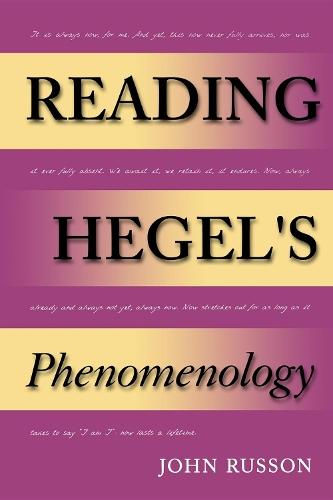
In Reading Hegel's Phenomenology, John Russon uses the theme of reading to clarify the methods, premises, evidence, reasoning, and conclusions developed in Hegel's seminal text. Russon's approach facilitates comparing major sections and movements of the text, and demonstrates that each section of Phenomenology of Spirit stands independently in its focus on the themes of human experience. Along the way, Russon considers the rich relevance of Hegel's philosophy to understanding other key Western philosophers, such as Aristotle, Descartes, Kant, Husserl, Heidegger, and Derrida. Major themes include language, embodiment, desire, conscience, forgiveness, scepticism, law, ritual, multiculturalism, existentialism, deconstruction, and absolute knowing. An important companion to contemporary Hegel studies, this book will be of interest to all students of Hegel's philosophy.
Full Product Details
Author: John Russon
Publisher: Indiana University Press
Imprint: Indiana University Press
Dimensions:
Width: 15.60cm
, Height: 2.40cm
, Length: 23.50cm
Weight: 0.485kg
ISBN: 9780253216922
ISBN 10: 0253216923
Pages: 320
Publication Date: 19 October 2004
Audience:
Professional and scholarly
,
Professional & Vocational
Format: Paperback
Publisher's Status: Active
Availability: In Print

This item will be ordered in for you from one of our suppliers. Upon receipt, we will promptly dispatch it out to you. For in store availability, please contact us.
Reviews
Russon's book differs in two ways from other commentaries on Hegel's Phenomenology of Spirit. First, Russon (Univ. of Guelph) considers only the arguments in that text, rather than discussing its literary allusions or historical context. Second, Russon provides independent studies of the arguments in each section of Hegel's text. Whereas it is generally claimed that any part of Hegel's Phenomenology of Spirit can only be comprehended by understanding the part it plays in the text as a whole, Russon instead tries to investigate the arguments of the individual sections on their own terms. One might think that a disadvantage of Russon's approach would be the difficulty of addressing questions about whether Hegel's Phenomenology of Spirit has an overall trajectory and structure. Even if that is correct, however, an examination of the details of the arguments in each section compensates. The 15 chapters each focus on a section of Hegel's book, making this an excellent resource in a course on Hegel's Phenomenology of Spirit. Summing Up: Highly recommended. Upper--level undergraduates through faculty/researchers. J. M. Fritzman, Lewis and Clark College , CHOICE
""Russon's book differs in two ways from other commentaries on Hegel's Phenomenology of Spirit. First, Russon (Univ. of Guelph) considers only the arguments in that text, rather than discussing its literary allusions or historical context. Second, Russon provides independent studies of the arguments in each section of Hegel's text. Whereas it is generally claimed that any part of Hegel's Phenomenology of Spirit can only be comprehended by understanding the part it plays in the text as a whole, Russon instead tries to investigate the arguments of the individual sections on their own terms. One might think that a disadvantage of Russon's approach would be the difficulty of addressing questions about whether Hegel's Phenomenology of Spirit has an overall trajectory and structure. Even if that is correct, however, an examination of the details of the arguments in each section compensates. The 15 chapters each focus on a section of Hegel's book, making this an excellent resource in a course on Hegel's Phenomenology of Spirit. Summing Up: Highly recommended. Upper--level undergraduates through faculty/researchers."" J. M. Fritzman, Lewis and Clark College , CHOICE
Russon's book differs in two ways from other commentaries on Hegel's Phenomenology of Spirit. First, Russon (Univ. of Guelph) considers only the arguments in that text, rather than discussing its literary allusions or historical context. Second, Russon provides independent studies of the arguments in each section of Hegel's text. Whereas it is generally claimed that any part of Hegel's Phenomenology of Spirit can only be comprehended by understanding the part it plays in the text as a whole, Russon instead tries to investigate the arguments of the individual sections on their own terms. One might think that a disadvantage of Russon's approach would be the difficulty of addressing questions about whether Hegel's Phenomenology of Spirit has an overall trajectory and structure. Even if that is correct, however, an examination of the details of the arguments in each section compensates. The 15 chapters each focus on a section of Hegel's book, making this an excellent resource in a course on Hegel's Phenomenology of Spirit. Summing Up: Highly recommended. Upper-level undergraduates through faculty/researchers.J. M. Fritzman, Lewis and Clark College , 2005jun CHOICE The 15 chapters each focus on a section of Hegel's book, making this an excellent resource in a course on Hegel's Phenomenology of Spirit. Summing Up: Highly recommended. Upper-level undergraduates through faculty/researchers. -Choice
Author Information
John Russon is Associate Professor of Philosophy at the University of Guelph. He is author of Human Experience: Philosophy, Neurosis, and the Elements of Everyday Life.