Overview
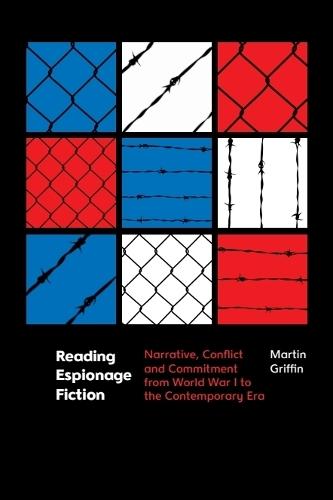
Reading Espionage Fiction: Narrative, Conflict and Commitment from World War I to the Contemporary Era probes the ways in which the struggles and loyalties of political modernity have been portrayed in the espionage story over the course of the twentieth and twenty-first centuries. Reading works by authors such as Somerset Maugham, Helen MacInnes, John le Carre, Sam E. Greenlee and Gerald Seymour as popular literature deserving of sustained attention, this book shows how these narratives have both created a modern genre and, at the same time, sought an escape from its limitations. Martin Griffin takes up the importance of plot and character and argues that, in this branch of fiction, the personal has always and ever been political.
Full Product Details
Author: Martin Griffin (Associate Professor in the Department of English, University of Tennessee)
Publisher: Edinburgh University Press
Imprint: Edinburgh University Press
ISBN: 9781399520805
ISBN 10: 1399520806
Pages: 200
Publication Date: 31 January 2026
Audience:
College/higher education
,
Postgraduate, Research & Scholarly
Format: Paperback
Publisher's Status: Forthcoming
Availability: Not yet available

This item is yet to be released. You can pre-order this item and we will dispatch it to you upon its release.
Language: English
Reviews
Reading Espionage Fiction by Griffin (Univ. of Tennessee) is an excellent study of espionage fiction from WWI to the modern era. Griffin explores ideas about plot and plotting, the spy as the embodiment of international war on a small scale, and most importantly, a reading of espionage fiction as literature rather than mere genre fiction. As Griffin puts it, his book is ""an experiment in thinking beyond genre but without ignoring its legacy or affordances"" (p. 5). To that end, he eschews populist authors like Ian Fleming and Robert Ludlum to focus on literary authors like W. Somerset Maugham, John le Carré, and Gerald Seymour. There are chapters on English nationalism in WW I, the interwar fiction that seemed to prophecy WW II, the playful postmodern novels that stretch the genre to its limits, and the experiences of African Americans and women in espionage fiction. Griffin's most effective argument is that spy fiction exposes, on a narrative level, the political ideologies that cause large-scale conflict. Griffin's book is a rich survey of espionage fiction and its literary and political dimensions. Summing Up: Highly recommended. --L. D. Mosher, Normandale Community College ""CHOICE"" Interrogating the ""ranking system"" of genre fiction, Martin Griffin's superb, original study of the cloak-and-dagger worlds forged by an array of authors and literary texts--spy thriller exemplars Maugham and le Carré vis-à-vis MacNiece's poetry and DeLillo's postmodernism--is destined to retrace literary criticism's quest for the imagined sleeper agent. --Gary Edward Holcomb, author of Claude McKay, Code Name Sasha: Queer Black Marxism and the Harlem Renaissance This nuanced study of carefully-selected works emphasises the importance of narrative plot, unsettles the boundaries of genre, and highlights the complexity of political undercurrents in the literature of espionage. --Conor McCarthy, author of Outlaws and Spies: Legal Exclusion in Law and Literature
This nuanced study of carefully-selected works emphasises the importance of narrative plot, unsettles the boundaries of genre, and highlights the complexity of political undercurrents in the literature of espionage. -- Conor McCarthy, author of Outlaws and Spies: Legal Exclusion in Law and Literature Interrogating the ""ranking system"" of genre fiction, Martin Griffin’s superb, original study of the cloak-and-dagger worlds forged by an array of authors and literary texts—spy thriller exemplars Maugham and le Carré vis-à-vis MacNiece’s poetry and DeLillo’s postmodernism—is destined to retrace literary criticism’s quest for the imagined sleeper agent. -- Gary Edward Holcomb, author of Claude McKay, Code Name Sasha: Queer Black Marxism and the Harlem Renaissance Reading Espionage Fiction by Griffin (Univ. of Tennessee) is an excellent study of espionage fiction from WWI to the modern era. Griffin explores ideas about plot and plotting, the spy as the embodiment of international war on a small scale, and most importantly, a reading of espionage fiction as literature rather than mere genre fiction. As Griffin puts it, his book is “an experiment in thinking beyond genre but without ignoring its legacy or affordances” (p. 5). To that end, he eschews populist authors like Ian Fleming and Robert Ludlum to focus on literary authors like W. Somerset Maugham, John le Carré, and Gerald Seymour. There are chapters on English nationalism in WW I, the interwar fiction that seemed to prophecy WW II, the playful postmodern novels that stretch the genre to its limits, and the experiences of African Americans and women in espionage fiction. Griffin’s most effective argument is that spy fiction exposes, on a narrative level, the political ideologies that cause large-scale conflict. Griffin’s book is a rich survey of espionage fiction and its literary and political dimensions. Summing Up: Highly recommended. -- L. D. Mosher, Normandale Community College * CHOICE *
Author Information
Martin Griffin is Associate Professor in the Department of English at the University of Tennessee. He is the author of Ashes of the Mind: War and Memory in Northern Literature, 1865–1900 (2009), co-author of Narrative, Identity, and the Map of Cultural Policy: Once Upon a Time in a Globalized World with Constance DeVereaux (2013), and co-editor of Stories of Nation: Fictions, Politics, and the American Experience with Christopher Hebert (2017).