Overview
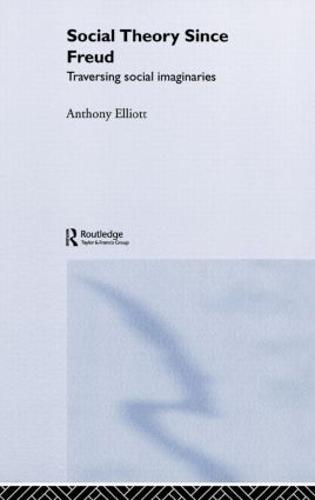
In this compelling book, Anthony Elliott traces the rise of psychoanalysis from the Frankfurt School to postmodernism. Examining how pathbreaking theorists such as Adorno, Marcuse, Lacan and Lyotard have deployed psychoanalysis to politicise issues like desire, sexuality, repression and identity, Elliott assesses the gains and losses arising from this appropriation of psychoanalysis in social theory and cultural studies. Moving from the impact of the Culture Wars and recent Freud-bashing to contemporary debates in social theory, feminism and postmodernism, Elliott argues for a new alliance between sociological and psychoanalytic perspectives. Drawing in particular from the thought of key contemporary psychoanalytic thinkers such as Julia Kristeva, Jean Laplanche and Cornelius Castoriadis, Social Theory Since Freud opens the way for a new approach to the creativity of action.
Full Product Details
Author: Anthony Elliott (University of Kent at Canterbury, UK)
Publisher: Taylor & Francis Ltd
Imprint: Routledge
Dimensions:
Width: 15.60cm
, Height: 1.70cm
, Length: 23.40cm
Weight: 0.520kg
ISBN: 9780415271646
ISBN 10: 0415271649
Pages: 200
Publication Date: 22 July 2004
Audience:
College/higher education
,
College/higher education
,
Tertiary & Higher Education
,
Undergraduate
Format: Hardback
Publisher's Status: Active
Availability: In Print

This item will be ordered in for you from one of our suppliers. Upon receipt, we will promptly dispatch it out to you. For in store availability, please contact us.
Reviews
'Anthony Elliott is quickly emerging as a one-person industry, intent in all his writings to demonstrate both the relevance and the importance of psychoanalytic theory for social analysis.' - Thesis Eleven<br><br>'Anthony Elliott has once again provided a lucid and critical examination of the relationship between psychoanalysis and social theory. While many writers are still catching up with Lacan's work, Elliott explains the major advances to be found in post-Lacanian theory, and shows how it offers a new view of subjectivity and the 'imagination' attuned to the complexities of contemporary social life.' - Stephen Frosh, Birkbeck College, London<br><br>'Comprehensive and challenging, Social Theory Since Freud explores major developments in western thought since Freud mapped out the unconscious. It is an authoritative synopsis of the Frankfurt School, Castoriadis, Lacan, Laplanche and Kristeva. In pursuing the legacy of Freud, Anthony Elliott shows convincingly that the imagination is central to rethinking the relationship between social theory and psychoanalysis.' - Bryan Turner, Cambridge University
'Anthony Elliott is quickly emerging as a one-person industry, intent in all his writings to demonstrate both the relevance and the importance of psychoanalytic theory for social analysis.' - Thesis Eleven <br>'Anthony Elliott has once again provided a lucid and critical examination of the relationship between psychoanalysis and social theory. While many writers are still catching up with Lacan's work, Elliott explains the major advances to be found in post-Lacanian theory, and shows how it offers a new view of subjectivity and the 'imagination' attuned to the complexities of contemporary social life.' - Stephen Frosh, Birkbeck College, London <br>'Comprehensive and challenging, Social Theory Since Freud explores major developments in western thought since Freud mapped out the unconscious. It is an authoritative synopsis of the Frankfurt School, Castoriadis, Lacan, Laplanche and Kristeva. In pursuing the legacy of Freud, Anthony Elliott shows convincingly that the imagination isa
Author Information
Anthony Elliott is Professor of Social and Political Theory at the University of the West of England, where he is Director of the Centre for Critical Theory.