Overview
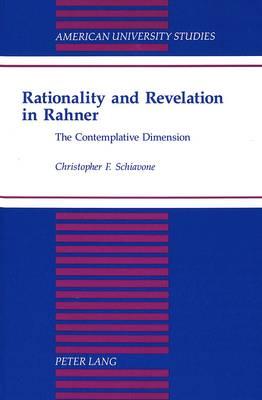
The ancient problem of working out the relationship between reason and revelation has assumed a new form in the contemporary context as philosophers debate the very concept of rationality. The present study argues that the conception of rationality operative in the thought of the twentieth-century Catholic theologian Karl Rahner, provides a viable language and framework for dealing with the problem in its contemporary form. In Rahner's thought - which is neither discontinuous with the Aristotelian-Thomistic tradition nor oblivious to the contributions and questions of post-Enlightenment thought - the complementarity of reason and revelation is grounded in a more primitive unity which is encountered and experienced in contemplative living and thinking.
Full Product Details
Author: Christopher F Schiavone
Publisher: Peter Lang Publishing Inc
Imprint: Peter Lang Publishing Inc
Volume: 169
Weight: 0.620kg
ISBN: 9780820423425
ISBN 10: 0820423424
Pages: 316
Publication Date: 01 October 1994
Audience:
Professional and scholarly
,
Professional & Vocational
Format: Hardback
Publisher's Status: Active
Availability: Available To Order

We have confirmation that this item is in stock with the supplier. It will be ordered in for you and dispatched immediately.
Reviews
'Rationality and Revelation in Rahner: The Contemplative Dimension' makes an important and challenging contribution to a conversation, still in its formativestages, between the Christian philosophical tradition and the most compelling voices of 'post-modern' discourse... By drawing our attention to mystery as the central dynamic of both Rahner's conception of the human person and of his understanding of revelation, Schiavone enables us to recognize the promise, but also the limits, of the role that Rahner might have to play in this conversation. Perhaps most valuable is Schiavone's insightful retrieval of the roots of the so-called 'contemplative dimension' of Rahner's thought in its richly diverse relation to the Christian tradition and his careful attempt to situate it in relation to the philosophical project of Heidegger's early work. There emerges a vector of questioning which carries, through Rahner, into the center of the contemporary discussion of 'Christian Philosophy', the exigency of which must remind us of a similar conversation, perhaps too polite a word, in thirteenth-century Europe. (Frank Ambrosio, Georgetown University)
Author Information
The Author: Christopher F. Schiavone is a Roman Catholic priest and an assistant professor of Philosophy at St. John's Seminary in Boston. He pursued graduate studies in Theology at St. John's Seminary and received his Ph.D. in Philosophy at Georgetown University in Washington, D.C. In addition to significant work in pastoral ministry, he has lectured on the relationship between Christianity and culture and has served as a media consultant on the topic of prime-time television as an art form.