Overview
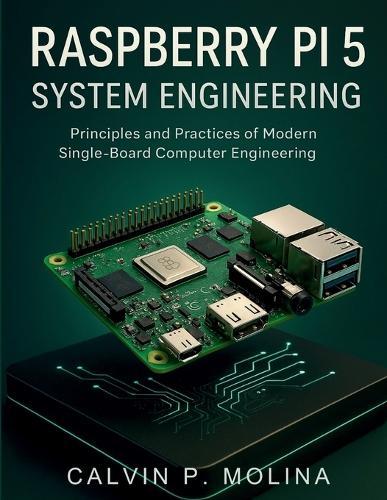
Are you just looking for another Raspberry Pi guide... or are you looking for a system-level understanding that actually changes how you design, deploy, and think about single-board computers? RASPBERRY PI 5 SYSTEM ENGINEERING by Calvin P. Molina isn't written for someone who wants a weekend project. It's written for you if you've ever asked: Why does performance drop under sustained load? What really happens during boot? How do memory architecture and cache behavior affect my application? Can this board survive 24/7 industrial deployment? What design trade-offs am I making without realizing it? If those questions sound familiar, this book was written for you. This Isn't a Beginner's Walkthrough -- It's a System-Level Blueprint Most books about single-board computers focus on quick setup instructions and simple projects. That's useful at the start. But what happens when you move beyond experimentation? When uptime matters? When performance, reliability, and security become non-negotiable? This book takes a different approach. It treats the Raspberry Pi 5 not as a hobby device, but as a complete engineered system -- from silicon architecture to firmware, operating system behavior, kernel internals, device drivers, memory management, networking, storage optimization, power delivery, and thermal engineering. Instead of asking, *""How do I install the OS? It asks, *""What exactly happens during the boot chain, and how can I control it?"" Instead of saying, ""Just plug in storage."" It explains how different storage interfaces impact latency, throughput, wear, and system reliability. From Silicon Capabilities to Real-World Deployment Have you ever wondered what actually sits beneath the abstraction layers? This book dives into: CPU microarchitecture and execution models Memory hierarchy, cache coherency, and bandwidth constraints Hardware acceleration and multimedia pipelines PCIe, NVMe, and high-speed expansion Real-time scheduling and deterministic system design Secure boot, system hardening, and threat modeling Power architecture and thermal limits under sustained workloads Watchdog timers, redundancy strategies, and graceful degradation Designed for Engineers, Developers, and Serious Builders Are you building: An edge computing node? A network appliance? An industrial monitoring system? A secure embedded controller? A data acquisition platform? A scalable fleet deployment? Then you already know that copying tutorials isn't enough. This book walks you through system engineering principles that apply to production environments: How to design for 24/7 reliability How to optimize performance without sacrificing stability How to manage thermal constraints before throttling becomes a problem How to architect updates and rollback strategies How to plan for long-term support and hardware lifecycle A Holistic System Engineering Perspective What makes this book different is its mindset. Every topic is connected. Hardware decisions affect firmware. Firmware affects kernel behavior. Kernel behavior affects application performance. Application design influences power consumption and thermal load. Instead of treating these layers as isolated topics, this book shows you how they interact. You'll learn to think in terms of: * Trade-offs * Failure modes * Bottlenecks * Latency paths * Resource contention * Deployment constraints That shift in perspective is what separates experimentation from engineering.
Full Product Details
Author: Calvin P Molina
Publisher: Independently Published
Imprint: Independently Published
Volume: 2
Dimensions:
Width: 21.60cm
, Height: 1.50cm
, Length: 27.90cm
Weight: 0.640kg
ISBN: 9798250387248
Pages: 274
Publication Date: 01 March 2026
Audience:
General/trade
,
General
Format: Paperback
Publisher's Status: Active
Availability: Available To Order

We have confirmation that this item is in stock with the supplier. It will be ordered in for you and dispatched immediately.