Overview
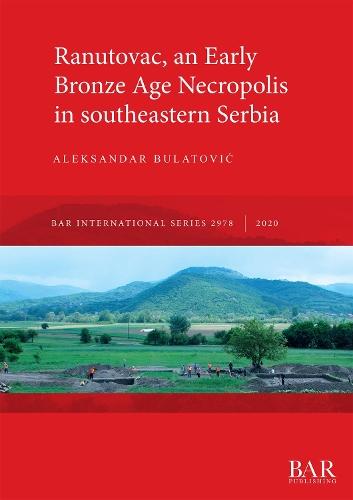
This volume presents the finds from an Early Bronze Age necropolis in the Juzna Morava Basin in the heart of the Balkans holding exclusively incinerated deceased. A total of 21 deceased were registered in the same number of graves, distributed in three segments. The remains of the deceased, along with grave goods, were covered by a small circular stone construction (c. 1 m) and then with a bigger circular stone structure between 1.5 and 3 m. The grave goods comprised fragmented or completely preserved vessels of which ember containers were the most specific. Besides a traditional archaeological approach to the topic, such as studies of necropolis architecture, burial rites, grave goods, and absolute dates, the book contains two analytical reports which approach the topic from a multidisciplinary perpspective. The first one (Filipovic, Filatova) analyses the remains of wood from the pyre and the second one (Gajic et al.) deals with the physical-chemical composition of pottery from the necropolis.
Full Product Details
Author: Aleksandar Bulatovic
Publisher: BAR Publishing
Imprint: BAR Publishing
Weight: 0.530kg
ISBN: 9781407356907
ISBN 10: 1407356909
Pages: 133
Publication Date: 30 April 2020
Audience:
Professional and scholarly
,
Professional & Vocational
Format: Paperback
Publisher's Status: Active
Availability: Available To Order

We have confirmation that this item is in stock with the supplier. It will be ordered in for you and dispatched immediately.
Reviews
{\rtf1\fbidis\ansi\ansicpg1252\deff0\deflang2057{\fonttbl{\f0\fswiss\fprq2\fcharset0 Calibri;}{\f1\fnil\fcharset0 Verdana;}} \viewkind4\uc1\pard\ltrpar\sa160\sl252\slmult1\f0\fs22\lquote The material from the cemetery at Ranutovac is new, and important in forming links to other sites in Serbia and Macedonia. Chronologically and culturally it confirms relationships within southern Serbia hitherto broadly assumed without proof.\rquote Professor H. Arthur Bankoff, CUNY\par \pard\ltrpar\f1\fs17\par }
{\rtf1\fbidis\ansi\ansicpg1252\deff0\deflang2057{\fonttbl{\f0\fswiss\fprq2\fcharset0 Calibri;}{\f1\fnil\fcharset0 Verdana;}} \viewkind4\uc1\pard\ltrpar\sa160\sl252\slmult1\f0\fs22\lquote The material from the cemetery at Ranutovac is new, and important in forming links to other sites in Serbia and Macedonia. Chronologically and culturally it confirms relationships within southern Serbia hitherto broadly assumed without proof.\rquote Professor H. Arthur Bankoff, CUNY\par \pard\ltrpar\f1\fs17\par }
Author Information
Aleksandar Bulatovic is a full-time professor at the Institute of Archaeology in Belgrade, Serbia. His main scholarly interests focus on cultural transmission between Central Balkan communities during the Copper and the Bronze Ages, ritual and spiritual life of prehistoric and early historic population in the Central Balkans, and determining a chronology of the Metal Ages.