Overview
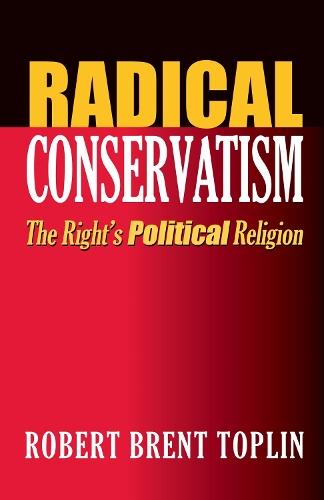
What goes by the description of """"conservatism"""" these days is a far cry from its past incarnations. Forget the legacy of moderate conservatism promoted by Dwight Eisenhower. Today's conservatism, according to Robert Brent Toplin, has taken a decidedly radical turn. Toplin offers an intriguing critique of this fast-growing movement that resembles religious fundamentalism - a rigid true believer's mindset that dismisses opposing views and leaves almost no room for dialogue. Toplin observes that the right's orthodox approach represents a significant rejection of the more open-minded and practical outlook that characterized both liberal and conservative politics in earlier years. Toplin considers three major subgroups within radical conservatism: stealth libertarians, who espouse free markets and small government; culture warriors, who crusade for morality and """"values;"""" and hawkish nationalists, who favor military solutions in foreign affairs. He points out that, whatever their differences, these groups manage to unite behind a common loathing. Conservatives demonize liberals, blaming them for almost everything they dislike in American life. But, as Toplin shows, their view of """"liberals"""" has little to do with reality, for it treats everyone from the center to the far-left as a liberal and equates liberal ideas with extremism. When Americans talk about radical conservatism, they usually think of strident commentators on radio and television such as Rush Limbaugh, Sean Hannity, and Ann Coulter. Toplin offers a much broader picture of the radical, fundamentalist mentality. He shows that a religion-like approach to political ideas can also be found in the thinking of prominent scholars, journalists, and public officials such as Milton Friedman, William F. Buckley, Irving Kristol, Allan Bloom, George Will, Fred Barnes, William J. Bennett, and Ronald Reagan. Toplin finds political fundamentalism at work, too, in media outlets like the Fox News Network and the Wall Street Journal and at think tanks such as the Heritage Foundation, the American Enterprise Institute, and the Cato Institute. Offering a roadmap of the radical right's emergence over the past half century, Toplin reveals how enthusiasm for a conservative """"faith"""" helped to erect a bully pulpit in an increasingly powerful political church.
Full Product Details
Author: Robert Brent Toplin
Publisher: University Press of Kansas
Imprint: University Press of Kansas
Dimensions:
Width: 16.10cm
, Height: 2.80cm
, Length: 23.10cm
Weight: 0.629kg
ISBN: 9780700614875
ISBN 10: 0700614877
Pages: 296
Publication Date: 20 September 2006
Audience:
College/higher education
,
Professional and scholarly
,
Undergraduate
,
Postgraduate, Research & Scholarly
Format: Hardback
Publisher's Status: Active
Availability: Manufactured on demand

We will order this item for you from a manufactured on demand supplier.
Reviews
-Toplin's superbly argued book offers an important corrective to the lazy conventional wisdom that contemporary 'conservatives' are typical of the type that has historically laid claim to the term. Rather, as Toplin illustrates over and over, they are 'faith-based' radicals, who need to be understood on their own terms.---Eric Alterman, author of What Liberal Media? The Truth about Bias and the News -A vigorous and well-documented critique of the ruling assumptions and intellectual arguments of many of the leading figures among American conservatives. It will spark debate from Toplin's targets and supply ammunition for critics of dogmatic thinking on the right. Lively and hard-hitting, it also provides students with the basis for many stimulating exchanges in and out of the classroom.---Lewis Gould, author of Grand Old Party: A History of the Republicans
Toplin's superbly argued book offers an important corrective to the lazy conventional wisdom that contemporary 'conservatives' are typical of the type that has historically laid claim to the term. Rather, as Toplin illustrates over and over, they are 'faith-based' radicals, who need to be understood on their own terms. --<b>Eric Alterman</b>, author of <i>What Liberal Media? The Truth about Bias and the News</i> A vigorous and well-documented critique of the ruling assumptions and intellectual arguments of many of the leading figures among American conservatives. It will spark debate from Toplin's targets and supply ammunition for critics of dogmatic thinking on the right. Lively and hard-hitting, it also provides students with the basis for many stimulating exchanges in and out of the classroom. --<b>Lewis Gould</b>, author of <i>Grand Old Party: A History of the Republicans</i>
Toplin's superbly argued book offers an important corrective to the lazy conventional wisdom that contemporary 'conservatives' are typical of the type that has historically laid claim to the term. Rather, as Toplin illustrates over and over, they are 'faith-based' radicals, who need to be understood on their own terms. -- Eric Alterman A vigorous and well-documented critique of the ruling assumptions and intellectual arguments of many of the leading figures among American conservatives. It will spark debate from Toplin's targets and supply ammunition for critics of dogmatic thinking on the right. Lively and hard-hitting, it also provides students with the basis for many stimulating exchanges in and out of the classroom. -- Lewis Gould �Toplin's superbly argued book offers an important corrective to the lazy conventional wisdom that contemporary �conservatives� are typical of the type that has historically laid claim to the term. Rather, as Toplin illustrates over and over, they are 'faith-based' radicals, who need to be understood on their own terms.�--Eric Alterman, author of What Liberal Media? The Truth about Bias and the News �A vigorous and well-documented critique of the ruling assumptions and intellectual arguments of many of the leading figures among American conservatives. It will spark debate from Toplin's targets and supply ammunition for critics of dogmatic thinking on the right. Lively and hard-hitting, it also provides students with the basis for many stimulating exchanges in and out of the classroom.�--Lewis Gould, author of Grand Old Party: A History of the Republicans Toplin's superbly argued book offers an important corrective to the lazy conventional wisdom that contemporary 'conservatives' are typical of the type that has historically laid claim to the term. Rather, as Toplin illustrates over and over, they are 'faith-based' radicals, who need to be understood on their own terms. --Eric Alterman, author of What Liberal Media? The Truth about Bias and the News A vigorous and well-documented critique of the ruling assumptions and intellectual arguments of many of the leading figures among American conservatives. It will spark debate from Toplin's targets and supply ammunition for critics of dogmatic thinking on the right. Lively and hard-hitting, it also provides students with the basis for many stimulating exchanges in and out of the classroom. --Lewis Gould, author of Grand Old Party: A History of the Republicans
A vigorous and well-documented critique of the ruling assumptions and intellectual arguments of many of the leading figures among American conservatives. It will spark debate from Toplin's targets and supply ammunition for critics of dogmatic thinking on the right. Lively and hard-hitting, it also provides students with the basis for many stimulating exchanges in and out of the classroom. -- Lewis Gould
Toplin's superbly argued book offers an important corrective to the lazy conventional wisdom that contemporary 'conservatives' are typical of the type that has historically laid claim to the term. Rather, as Toplin illustrates over and over, they are 'faith-based' radicals, who need to be understood on their own terms. --Eric Alterman, author of What Liberal Media? The Truth about Bias and the News A vigorous and well-documented critique of the ruling assumptions and intellectual arguments of many of the leading figures among American conservatives. It will spark debate from Toplin's targets and supply ammunition for critics of dogmatic thinking on the right. Lively and hard-hitting, it also provides students with the basis for many stimulating exchanges in and out of the classroom. --Lewis Gould, author of Grand Old Party: A History of the Republicans
"""Toplin's superbly argued book offers an important corrective to the lazy conventional wisdom that contemporary 'conservatives' are typical of the type that has historically laid claim to the term. Rather, as Toplin illustrates over and over, they are 'faith-based' radicals, who need to be understood on their own terms.""--Eric Alterman, author of What Liberal Media? The Truth about Bias and the News ""A vigorous and well-documented critique of the ruling assumptions and intellectual arguments of many of the leading figures among American conservatives. It will spark debate from Toplin's targets and supply ammunition for critics of dogmatic thinking on the right. Lively and hard-hitting, it also provides students with the basis for many stimulating exchanges in and out of the classroom.""--Lewis Gould, author of Grand Old Party: A History of the Republicans"
Author Information
Robert Brent Toplin is professor of history at the University of North Carolina at Wilmington and the author of numerous books including Reel History: In Defense of Hollywood (see page 44) and Michael Moore's Fahrenheit 9/11: How One Film Divided a Nation (see page 29).