Overview
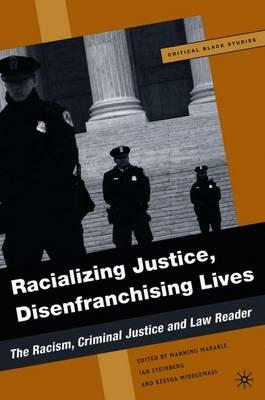
African Americans today face a systemic crisis of mass underemployment, mass imprisonment, and mass disfranchisement. This comprehensive reader makes clear to students the mutual constitution of these three crises.
Full Product Details
Author: M. Marable ,
K. Middlemass ,
I. Steinberg
Publisher: Palgrave USA
Imprint: Palgrave Macmillan
Dimensions:
Width: 15.20cm
, Height: 2.00cm
, Length: 22.90cm
Weight: 0.589kg
ISBN: 9781403977670
ISBN 10: 1403977674
Pages: 387
Publication Date: 09 October 2007
Audience:
College/higher education
,
Professional and scholarly
,
Postgraduate, Research & Scholarly
,
Professional & Vocational
Format: Paperback
Publisher's Status: Active
Availability: Awaiting stock

The supplier is currently out of stock of this item. It will be ordered for you and placed on backorder. Once it does come back in stock, we will ship it out for you.
Reviews
In the midst of astounding educational, economic, and professional advancement for millions of African Americans, there has been an equally astounding growth in the number of incarcerated and otherwise criminalized blacks in this country. This collection of essays draws on scholarship and experience, and from the academy and the streets, to explore the historical and political roots of this infuriating and agonizing trend. This book arms the community of scholars, law enforcement, and activists with the information we need to work our way out of this mess. <br>--Henry Louis Gates, Jr., Alphonse Fletcher University Professor, Harvard University Through a stimulating variety of writings, from scholarly analysis to literary expression to personal testimony, Racializing Justice offers a searing picture of the major social crisis of our time---mass and disproportionate imprisonment, and its effects not just on African-Americans but on all Americans. It reveals this crisis n
In the midst of astounding educational, economic, and professional advancement for millions of African Americans, there has been an equally astounding growth in the number of incarcerated and otherwise criminalized blacks in this country. This collection of essays draws on scholarship and experience, and from the academy and the streets, to explore the historical and political roots of this infuriating and agonizing trend. This book arms the community of scholars, law enforcement, and activists with the information we need to work our way out of this mess. - Henry Louis Gates, Jr., Alphonse Fletcher University Professor, Harvard University Through a stimulating variety of writings, from scholarly analysis to literary expression to personal testimony, Racializing Justice offers a searing picture of the major social crisis of our time - -mass and disproportionate imprisonment, and its effects not just on African-Americans but on all Americans. It reveals this crisis not as an array of unintended, reactive effects, but as a set of governmental policies that are either deliberate about or or recklessly indifferent toward their heartbreaking consequences. From parentless children to smashed hopes for economic improvement to de facto life sentences of civic disenfranchisement, contemporary American incarceration policies inflict wounds that far overwhelm the short-term public safety gains they supposedly accomplish. And these writings collectively and passionately argue that these polices and consequences are suspiciously consistent with a multi-centuries' American history of the entanglement of criminal justice institutions and racial inequality. - Robert Weisberg, Edwin E. Huddleson, Jr. Professor of Law, Stanford University This volume brings together a wide range of scholarship tackling the problem of racialized criminal justice. In its breadth and depth, this text provides valuable insight to students and practitioners as we try to make sense of the institutional relationships between the criminal justice system, education, health care, employment, and housing. Indeed, the scope of the problemspresented in this volume suggests that thinking of these as primarily criminal justice issues obscures a much larger set of problems that implicates a much larger set of issues. We cannot make sense of the explosion in the criminal justice system without considering race and how other institutions, such as education, must be linked to criminal justice. We are experiencing a racialized definition, asorting process that does bode well for society or democracy. What we see is a complex interweave of forces which mutually reinforce each other in a bounded web of causation. I hope that these essays will help stimulate a much broader, and much needed, discussion about race and criminal justice in American society. - John A. Powell, Executive Director of the Kirwan Institute for the Study of Race and Ethnicity, Ohio State University
In the midst of astounding educational, economic, and professional advancement for millions of African Americans, there has been an equally astounding growth in the number of incarcerated and otherwise criminalized blacks in this country. This collection of essays draws on scholarship and experience, and from the academy and the streets, to explore the historical and political roots of this infuriating and agonizing trend. This book arms the community of scholars, law enforcement, and activists with the information we need to work our way out of this mess. <br>--Henry Louis Gates, Jr., Alphonse Fletcher University Professor, Harvard University Through a stimulating variety of writings, from scholarly analysis to literary expression to personal testimony, Racializing Justice offers a searing picture of the major social crisis of our time---mass and disproportionate imprisonment, and its effects not just on African-Americans but on all Americans. It reveals this crisis not as an array of unintended, reactive effects, but as a set of governmental policies that are either deliberate about or or recklessly indifferent toward their heartbreaking consequences. From parentless children to smashed hopes for economic improvement to de facto life sentences of civic disenfranchisement, contemporary American incarceration policies inflict wounds that far overwhelm the short-term public safety gains they supposedly accomplish. And these writings collectively and passionately argue that these polices and consequences are suspiciously consistent with a multi-centuries' American history of the entanglement of criminal justice institutions and racial inequality. --Robert Weisberg, Edwin E. Huddleson, Jr. Professor of Law, Stanford University This volume brings together a wide range of scholarship tackling the problem of racialized criminal justice. In its breadth and depth, this text provides valuable insight to students and practitioners as we try to make sense of the institu
In the midst of astounding educational, economic, and professional advancement for millions of African Americans, there has been an equally astounding growth in the number of incarcerated and otherwise criminalized blacks in this country. This collection of essays draws on scholarship and experience, and from the academy and the streets, to explore the historical and political roots of this infuriating and agonizing trend. This book arms the community of scholars, law enforcement, and activists with the information we need to work our way out of this mess. <br>--Henry Louis Gates, Jr., Alphonse Fletcher University Professor, Harvard University Through a stimulating variety of writings, from scholarly analysis to literary expression to personal testimony, Racializing Justice offers a searing picture of the major social crisis of our time---mass and disproportionate imprisonment, and its effects not just on African-Americans but on all Americans. It reveals this crisis not as an array of unintended, reactive effects, but as a set of governmental policies that are either deliberate about or or recklessly indifferent toward their heartbreaking consequences. From parentless children to smashed hopes for economic improvement to de facto life sentences of civic disenfranchisement, contemporary American incarceration policies inflict wounds that far overwhelm the short-term public safety gains they supposedly accomplish. And these writings collectively and passionately argue that these polices and consequences are suspiciously consistent with a multi-centuries' American history of the entanglement of criminal justice institutions and racial inequality. --Robert Weisberg, Edwin E.Huddleson, Jr. Professor of Law, Stanford University This volume brings together a wide range of scholarship tackling the problem of racialized criminal justice. In its breadth and depth, this text provides valuable insight to students and practitioners as we try to make sense of the institutional relationships between the criminal justice system, education, health care, employment, and housing. Indeed, the scope of the problems presented in this volume suggests that thinking of these as primarily criminal justice issues obscures a much larger set of problems that implicates a much larger set of issues. We cannot make sense of the explosion in the criminal justice system without considering race and how other institutions, such as education, must be linked to criminal justice. We are experiencing a racialized definition, a sorting process that does bode well for society or democracy. What we see is a complex interweave of forces which mutually reinforce each other in a bounded web of causation. I hope that these essays will help stimulate a much broader, and much needed, discussion about race and criminal justice in American society. <br>--John A. Powell, Executive Director of the Kirwan Institute for the Study of Race and Ethnicity, Ohio State University
Author Information
MANNING MARABLE is Professor of History and Political Science, Director, Institute for Research in African American Studies, Columbia University, USA.