Overview
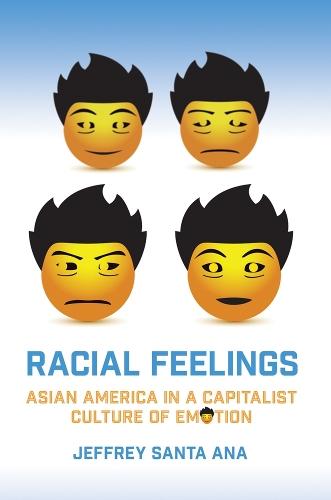
In Racial Feelings, Jeffrey Santa Ana examines how Asian American narratives communicate and critique—to varying degrees—the emotions that power the perception of Asians as racially different. Santa Ana explores various forms of Asian American cultural production, ranging from literature and graphic narratives to film and advertising, to illuminate the connections between global economic relations and the emotions that shape aspirations for the good life. He illustrates his argument with examples including the destitute Filipino immigrant William Paulinha, in Han Ong's Fixer Chao, who targets his anger on the capitalist forces of objectification that racially exploit him, and Nan and Pingpin in Ha Jin's A Free Life, who seek happiness and belonging in America. Racial Feelings addresses how Asian Americans both resist and rely on stereotypes in their writing and art work. In addition, Santa Ana investigates how capitalism shapes and structures an emotional discourse that represents Asians as both economic exemplars and threats.
Full Product Details
Author: Jeffrey Santa Ana
Publisher: Temple University Press,U.S.
Imprint: Temple University Press,U.S.
Dimensions:
Width: 15.20cm
, Height: 2.50cm
, Length: 22.90cm
Weight: 0.408kg
ISBN: 9781439911938
ISBN 10: 1439911932
Pages: 272
Publication Date: 12 June 2015
Audience:
Professional and scholarly
,
Professional & Vocational
Format: Paperback
Publisher's Status: Active
Availability: In Print

This item will be ordered in for you from one of our suppliers. Upon receipt, we will promptly dispatch it out to you. For in store availability, please contact us.
Reviews
""[Santa Ana] makes a critical contribution to the recent body of scholarship on emotion specifically addressing race and ethnicity.... Racial Feelings provides thoughtful, meticulous readings of texts by artists of Asian descent, and these readings are situated in Asian American history and cultural studies and Marxist and materialist theory.""--MELUS “Jeffrey Santa Ana’s Racial Feelings is an engaging and generative study that significantly enhances our understanding of Asian American cultural politics by mapping the complex convergence of affect and political economy that has made and remade Asian America. With its focus on how Asian American cultural texts make legible the intersections of capitalist development and affective subject formation, Racial Feelings illuminates how it feels to be economically constituted, and in doing so provides an immensely useful critical framework for appreciating the capacities and implications of Asian American critique across diverse contexts.” -Victor Bascara, University of California, Los Angeles “Racial Feelings addresses the emotions created by capitalism in Asian American and Asian mixed-race subjects. That capitalism can produce feelings is an intellectually exciting argument. Santa Ana is a meticulous researcher who illuminates the affective process of belonging in America in his careful investigation of literature, graphic narratives, and advertising by and about Asian Americans. He points out the discrepancies between Asian Americans who are created and contained by capitalism as national models while also held at arm’s length as potential threats in their global, capitalist efficiency. His fascinating arguments include those about marketing multiculturalism, the matter of race in the notion of ‘feeling ancestral,’ and how ethnic remembering grates against corporate/capitalist post-racialism. Santa Ana’s careful work unearths what really was quite visible and palpable all along.”-Monica Chiu, author of Scrutinized! Surveillance in Asian North American Literature
[Santa Ana] makes a critical contribution to the recent body of scholarship on emotion specifically addressing race and ethnicity... Racial Feelings provides thoughtful, meticulous readings of texts by artists of Asian descent, and these readings are situated in Asian American history and cultural studies and Marxist and materialist theory. --MELUS Jeffrey Santa Ana's Racial Feelings is an engaging and generative study that significantly enhances our understanding of Asian American cultural politics by mapping the complex convergence of affect and political economy that has made and remade Asian America. With its focus on how Asian American cultural texts make legible the intersections of capitalist development and affective subject formation, Racial Feelings illuminates how it feels to be economically constituted, and in doing so provides an immensely useful critical framework for appreciating the capacities and implications of Asian American critique across diverse contexts. -Victor Bascara, University of California, Los Angeles Racial Feelings addresses the emotions created by capitalism in Asian American and Asian mixed-race subjects. That capitalism can produce feelings is an intellectually exciting argument. Santa Ana is a meticulous researcher who illuminates the affective process of belonging in America in his careful investigation of literature, graphic narratives, and advertising by and about Asian Americans. He points out the discrepancies between Asian Americans who are created and contained by capitalism as national models while also held at arm's length as potential threats in their global, capitalist efficiency. His fascinating arguments include those about marketing multiculturalism, the matter of race in the notion of 'feeling ancestral,' and how ethnic remembering grates against corporate/capitalist post-racialism. Santa Ana's careful work unearths what really was quite visible and palpable all along. -Monica Chiu, author of Scrutinized! Surveillance in Asian North American Literature
Racial Feelings addresses the emotions created by capitalism in Asian American and Asian mixed-race subjects. That capitalism can produce feelings is an intellectually exciting argument. Santa Ana is a meticulous researcher who illuminates the affective process of belonging in America in his careful investigation of literature, graphic narratives, and advertising by and about Asian Americans. He points out the discrepancies between Asian Americans who are created and contained by capitalism as national models while also held at arm s length as potential threats in their global, capitalist efficiency. His fascinating arguments include those about marketing multiculturalism, the matter of race in the notion of feeling ancestral, and how ethnic remembering grates against corporate/capitalist post-racialism. Santa Ana s careful work unearths what really was quite visible and palpable all along. Monica Chiu, author of Scrutinized! Surveillance in Asian North American Literature
Author Information
Jeffrey Santa Ana is Associate Professor of English at Stony Brook University.