Overview
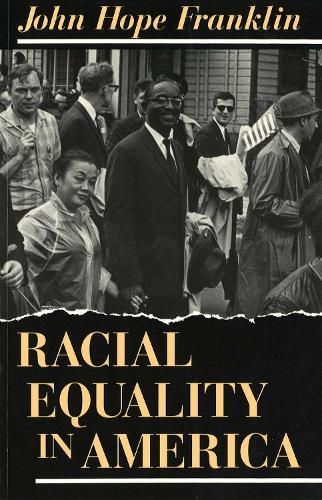
This is a forceful meditation on the persistent disparity between the goal of racial equality in America and the facts of discrimination. Presented as the prestigious Jefferson Lecture in the Humanities, """"Racial Equality in America"""" traces America's history of racial inequality. In a strong critique of Thomas Jefferson, Franklin shows that this spokesman for democracy did not include African Americans among those """"created equal"""". Franklin chronicles the events of the 19th century that solidified inequality in America and shows how emancipation dealt only with slavery, not with inequality. In the 20th century, America finally confronted the fact that equality is indivisible: that it must not be divided so that it is extended to some at the expense of others. Once this indivisibility is accepted, Franklin charges, America faces the monumental task of overcoming its long heritage of inequality. Nearly 20 years after this book was first published, that task has fallen to yet another generation. """"Racial Inequality in America"""" offers a powerful reminder that our history is more than a record of idealised democratic traditions and institutions. It is a message to Americans, calling upon them to know their history and themselves.
Full Product Details
Author: John Hope Franklin
Publisher: University of Missouri Press
Imprint: University of Missouri Press
Edition: New edition
Dimensions:
Width: 13.30cm
, Height: 1.10cm
, Length: 21.60cm
Weight: 0.188kg
ISBN: 9780826209122
ISBN 10: 0826209122
Pages: 136
Publication Date: 01 November 1993
Audience:
College/higher education
,
General/trade
,
Undergraduate
,
Postgraduate, Research & Scholarly
Format: Paperback
Publisher's Status: Active
Availability: Awaiting stock

The supplier is currently out of stock of this item. It will be ordered for you and placed on backorder. Once it does come back in stock, we will ship it out for you.
Reviews
<p> The best, perhaps the best possible, encapsulation in so few pages of the history of black-white relations. --Choice
The best, perhaps the best possible, encapsulation in so few pages of the history of black-white relations. --Choice The best, perhaps the best possible, encapsulation in so few pages of the history of black-white relations. --Choice The best, perhaps the best possible, encapsulation in so few pages of the history of black-white relations. --Choice
What Franklin considers here, in his Jefferson Lecture, is the historical persistence of inequality in America, the insidious belief in black inferiority that has permeated interracial relationships, supported segregation policies, and perpetuated the myth that equality is divisible. Again and again - in establishing the priorities of the Founding Fathers, the preoccupations of the abolitionists, and the partisan motives of politicians - he demonstrates how often the legal status of black people has been relegated to another legislative session, another generation. In recalling the limited impact of emancipation, the seesaw of opportunities during the two world Wars, and the civil rights movement of the '50s and '60s, he reminds us that callous Social policies have had violent consequences and insists that equality is indivisible despite the practices of the past. What is striking is neither the accumulation of supportive detail nor the forceful observations which Franklin (and others) have offered before but the sober, distinctive manner of his argument and the inescapable logic of his assertion that equality is a principle essential to the shaping of our future. An articulate statement well grounded in historical fact. (Kirkus Reviews)
<p>"The best, perhaps the best possible, encapsulation in so few pages of the history of black-white relations."--Choice
Author Information
John Hope Franklin is the author of many books, including The Color Line: Legacy for the Twenty-First Century, From Slavery to Freedom: A History of Negro Americans, and the highly acclaimed biography George Washington Williams. With more than ninety honorary degrees and dozens of other awards and honors, Franklin is the James B. Duke Professor Emeritus of History and, from 1985 to 1992, was Professor of Legal History in the Law School at Duke University.