Overview
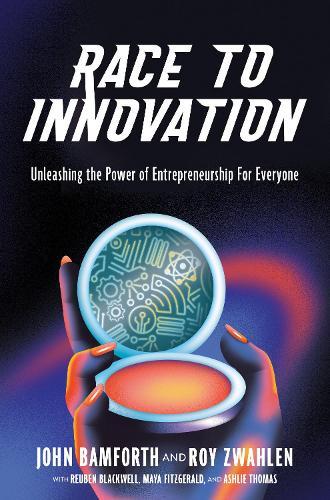
Innovation does not have to be a zero-sum game. A high tide of new ideas and ingenuity raises all ships. For thousands of years, innovators from diverse communities have changed the world for the better—you will hear some of their stories here. Yet, traditionally, entrepreneurship and innovation spaces are dominated by majority groups. We can do much better. This is an opportunity for us all. Race to Innovation weaves together stories of diverse innovators of the past, interviews with today’s innovation greats, and lived experiences in the innovation industry and personal entrepreneurship. Together, we prove that when we fully engage and empower more perspectives in the right way, we create opportunities that change our world for the better, not just socially, but also economically. Leveraging our differences can help us make a difference—not just in how we all live together, but in how we all thrive together. We propose five principles that can help anyone seeking to leverage difference and thrive: Recognize Potential – entrepreneurship and innovation is premised on the discovery of under-appreciated, overlooked market opportunities. Marginalized entrepreneurs, communities and market needs represent potential with outsized return on investment opportunities. This is reflected in the hidden history and powerful present of Black entrepreneurship. Power of Enclaves – every entrepreneur’s journey is hard, but mainstream entrepreneurs benefit from social and psychological support, networks and connections, and an unwritten playbook for success that minority entrepreneurs do not have ready access to. Enclaves, including neighborhoods, friends and family, churches, colleges (especially HBCUs), networking groups, supportive investment funds, are more valuable than most realize and create preconditions for later success. Enable ownership – the premise of wealth generation is ownership. Well-paying corporate and professional positions may be less risky and more socially acceptable (especially for first-generation college graduates), and can lead to individual and family prosperity, but they will not likely produce game-changing wealth. Only ownership does that. As even Michael Jordan can attest. Unique Lens – Back to those overlooked, underserved market needs… diverse entrepreneurs and innovators have a unique lens on such opportunities. And often, they are scalable to larger markets. Accelerate Transformative Change – Every startup and innovation benefits from fuel applied to the fire at the right time. This can come from connections, pilots, investment, mentorship, a complementary team, partnership… as well as from boot camps, accelerators, and venture studios. The goal is to seize opportunities, grow, and build value at an accelerated pace. And that speeds up the impact on markets and communities, too.
Full Product Details
Author: John Phillip Bamforth , Roy Stanford Zwahlen , Reuben Blackwell , Maya Fitzgerald
Publisher: Ideapress Publishing
Imprint: Vicara Books
ISBN: 9781646871858
ISBN 10: 1646871855
Pages: 200
Publication Date: 18 November 2025
Audience:
General/trade
,
General
Format: Hardback
Publisher's Status: Active
Availability: Available To Order 
We have confirmation that this item is in stock with the supplier. It will be ordered in for you and dispatched immediately.
Table of Contents
Reviews
""A blueprint for more effective entrepreneurship.""—KIRKUS REVIEWS “Race to Innovation is more than a book about business, it’s a call to action. At a time when America faces a growing innovation deficit, this powerful work challenges us to confront the systemic barriers that keep too many people, especially Black entrepreneurs, locked out of opportunity. Let this book inspire you to think differently, lead boldly, and invest in the brilliance that exists in every corner of our society.” —WILLIAM HEATH, Former Group VP at Eli Lilly and Chief Scientific Officer at Persephoni BioPartners “Passion for innovation and equity shines through in Race to Innovation. I found it both eye-opening and affirming—a reminder that if we want real impact, we must back overlooked innovators with more than words. I’m proud to support this important message.” —SIMONE GRAPINI-GOODMAN, Chief Marketing Officer, American Diabetes Association “In an era marked by unprecedented global and technological transformation, the imperative to translate the best ideas into action swiftly has never been greater. Yet, one of the most underappreciated catalysts of breakthrough innovation is diversity—particularly its role in enabling non-linear, cross-disciplinary thinking. This timely and insightful book offers a critical contribution to our understanding of how diverse perspectives drive meaningful progress in healthcare innovation and beyond. I am honored to endorse its message.” —RENARD CHARITY, Growth Strategy Advisor to leading healthcare innovators and Managing Partner at Fletcher Spaght, Inc. “We are standing at the edge of a new epoch—where innovation is no longer confined to labs or lecture halls but is becoming a dynamic, interconnected ecosystem that shapes every facet of our lives. This is more than a transition; it is a convergence of exponential technologies, reimagined education, and the urgent demands of a rapidly changing world. The global challenges we face—whether in energy, AI governance, or breakthroughs in biotechnology—require a new generation of scientists, systems thinkers, and creative problem-solvers. This realization has deepened my conviction that innovation is not just a discipline—it is the foundation of the future. To meet the moment, we must reimagine how innovation is taught, scaled, and shared, developing agile, tech-enabled, and forward-looking approaches that anticipate and adapt to the needs of the next two decades.” —NAKIA MELECIO, PhD, Senior Research Faculty, Georgia Institute of Technology and Director of National Science Foundation I-Corps Southeast Hub “Race to Innovation is a clear, inspiring look at how smart ideas and teamwork can spark innovation and entrepreneurship in communities often missed. It’s a great read for anyone who cares about making progress that matters.” —KATHLEEN SEBELIUS, Former US Secretary of Health and Human Services “Race to Innovation is a timely and insightful exploration of how diversity, resilience, and bold thinking drive true progress. This book challenges conventional norms and offers a powerful road map for leaders, entrepreneurs, and changemakers who want to create lasting impact in today’s rapidly evolving world. It’s not just a call to innovate—it’s a call to lead with intention and purpose. A must-read for anyone serious about shaping the future.” —JOEL WIGGINS, Founder of Wiggins Institute of Entrepreneurship and Life Development “Race to Innovation is a compelling exploration of how entrepreneurship can be a powerful catalyst for economic equity and societal transformation. It acknowledges the hidden history of Black entrepreneurship and systemic barriers to success in America. Bamforth and Zwahlen expertly blend historical context with modern strategies, revealing the untapped potential of Black innovators as drivers of progress. This book is a call to action for leaders to rethink how they invest in diverse talent and ideas— not just as a moral imperative, but as a powerful engine for growth.” —DANIELLE NEVELES-MCGRATH, Chief Impact Officer, Humana Foundation “This book captures the themes of innovation through stories of grit that show entrepreneurship is not just about money, but also about courage. The free market is the best ‘even playing field’ we have, and Race to Innovation makes clear that our opportunity is to look for and invest in the entrepreneurial spirit in founders of all types. If we do, all our communities benefit from new, innovative, successful enterprises. Read this book!” —MARCUS WHITNEY, Founder and Managing Partner, Jumpstart Nova “Race to Innovation moved me deeply. It is a story of passion and purpose weaved together to honor the dreams, the grit, and the genius of Black entrepreneurs—many like the ones I grew up with—whose stories are too often overlooked or merely untold. It challenges us to reimagine what’s possible when access and opportunity intersect. As an educator and entrepreneur, I found it both emotionally powerful and intellectually necessary.” —BERNARD BELL, Executive Director of the Shuford Program in Entrepreneurship “Race to Innovation provides a unique view into how, in history as well as current times, differences in culture, race, and experiences often produce tremendous value. The concepts the authors share, along with the proof points throughout the many real examples, make a compelling case for why we must all embrace the power of diversity. This book proves that when done right, diversity is clearly a catalyst for success.” —TONY EZELL, EVP and President of the Americas, BD “This book is a vital guide for anyone working to transform opportunity into commercial success—and it makes one thing clear: Diversity isn’t optional; it’s a strategic advantage. Drawing from deep experience across startups, academia, and industry, Race to Innovation illustrates how inclusive participation fuels stronger ideas, broader market relevance, and better outcomes. It’s a pragmatic, no-nonsense playbook for building innovation pipelines that reflect the full spectrum of talent and lived experience. If you care about unleashing innovation, you should care about who gets to innovate.” —DOUG SPEIGHT, Chief Executive Officer of AxNano, Inc. and Co-Founder of Alcom Capital Partners, LLC
Author Information
JOHN PHILLIP BAMFORTH came of age in the 60s and 70s in the northwest of England. His hometown of Wigan could not have been more white and blue collar. Wigan is an old coal mining town, forged in the industrial revolution, founded on a hard-nosed, straightforward culture brought to life in George Orwell’s book “The Road to Wigan Pier” and best personified by its championship winning rugby team. Growing up, John had no idea how “white” his world was. Most of his encounters with people of color were infused by a level of casual, demeaning and dehumanizing racism across his community that still shocks him today. His world opened up, as it does for many, when he went off to college at the University of Bath and later to graduate school at Aston University in Birmingham. He began to make friends with people from an array of backgrounds and developed a deep, life-long interest in other cultures and subcultures which has enriched his academic, professional and personal journey through life. With a PhD in neuropharmacology, John joined Eli Lilly in 1989, and focused on building global brands and leading highly engaged and diverse teams. He emigrated to the U.S. in 2001. After retiring from Eli Lilly, he returned to academia to lead Eshelman Innovation at the University of North Carolina, Chapel Hill. This institute is focused on translating the brightest and best ideas on campus into products and services that impact patients. ROY STANFORD ZWAHLEN grew up an Army brat. At a time when many career military officers studied Russian, Roy’s father studied Arabic. As a result, Roy spent most of his formative years in the Middle East in Jordan, Turkey, Kuwait and Syria. In this great crossroads of history, civilization, commerce, religion, language and politics, he was exposed to a diversity of cultures that is hard to find in other corners of the world. His educational experience was similarly diverse and unusual. Though taught in American schools abroad, his schools were filled with a mix of local students and the children of diplomats from around the world. His daily exposure to different cultures, languages, ideas and people shaped his experience of life. His periodic returns to the U.S. were both exciting and disorienting. Extracted from a mosaic of celebrated cultures, he encountered the challenging need to navigate subtle and not-so-subtle racial and ethnic barriers and divisions in schools. While the Middle East was no paradise, he found that his America had a ways to go to live up to the ideals taught to him by his veteran father and veteran grandfathers. At Brigham Young University, he experienced another kind of disorientation when he became immersed for the first time in his own majority religious culture. While he shared a faith with this community, he did not find much commonality with his life experiences or his global view of culture and diversity. This was not unusual for Roy; just unexpected and he loved it. He was drawn to the opportunity of multicultural societies found in subjects like political science, economics, and international affairs studying the history of racism, finance of the Ottoman Empire, and the political history of South Asia. After earning his law degree at George Mason School of Law, he specialized in intellectual property, international trade, public health and economic development. He spent the first half of his career conducting think-tank activities representing the biotech industry advising state, national, and international bodies. After advising governments and industry on best-in-class technology innovation and entrepreneurism development economic models and policy for biotech, he decided to roll up his sleeves and build a model from the ground up. As the Chief Strategy Officer for Eshelman Innovation, he’s responsible for building and managing strategy, governance, and operations.
Tab Content 6
Author Website:
Countries Available
All regions
|