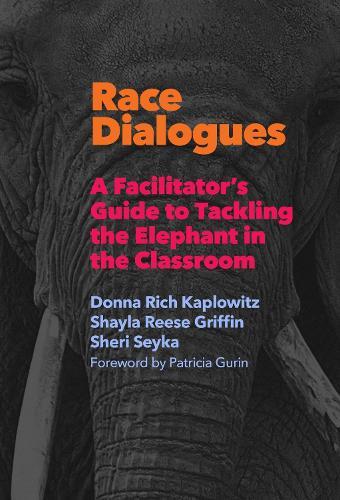
Race Dialogues: A Facilitator's Guide to Tackling the Elephant in the Classroom

Author:   Donna Rich Kaplowitz ,  Shayla Reese Griffin ,  Sheri Seyka ,  Patricia Gurin
Publisher:   Teachers' College Press
ISBN:  

9780807761304


Pages:   240
Publication Date:   03 May 2019
Format:   Paperback
Availability:   Temporarily unavailable   Availability explained
The supplier advises that this item is temporarily unavailable. It will be ordered for you and placed on backorder. Once it does come back in stock, we will ship it out to you.

Our Price $69.30 Quantity:  
Add to Cart

Share |

Race Dialogues: A Facilitator's Guide to Tackling the Elephant in the Classroom


Overview

Drawing on decades of research and examples from their own practices, the authors provide best practices in race dialogue facilitation. Through concrete lesson plans and hands-on material, both experienced and novice facilitators can immediately use this inclusive and wide-ranging curriculum in a variety of classrooms, work spaces, and organizations with diverse participants.

Full Product Details

Author:   Donna Rich Kaplowitz ,  Shayla Reese Griffin ,  Sheri Seyka ,  Patricia Gurin
Publisher:   Teachers' College Press
Imprint:   Teachers' College Press
Dimensions:   Width: 17.50cm , Height: 1.00cm , Length: 25.40cm
Weight:   0.337kg
ISBN:  

9780807761304


ISBN 10:   0807761303
Pages:   240
Publication Date:   03 May 2019
Audience:   Professional and scholarly ,  Professional & Vocational
Format:   Paperback
Publisher's Status:   Active
Availability:   Temporarily unavailable   Availability explained
The supplier advises that this item is temporarily unavailable. It will be ordered for you and placed on backorder. Once it does come back in stock, we will ship it out to you.

Table of Contents

Contents Foreword Patricia Gurin ix Acknowledgments xiii Introduction 1 Scope and Content 2 Dialogue: A Tool for Creating a Participatory Democracy 3 Note 4 1. Why Is There a Need for Race Dialogues? A Brief Primer on Race in The United States 5 What Is Race? It’s Complicated 6 Why Does Race Matter? Understanding Racism  9 Racial Inequality in Education  11 Conclusion 15 Notes 15 2. What Is Intergroup Dialogue? 17 Where Did Dialogue Come From? 20 What the Research Shows 20 Intergroup Dialogue Models 21 Our Research Findings 22 Conclusion 24 3. Setting Up an Inclusive Dialogue Space 25 Dialogue Nuts and Bolts 25 Preparing for Dialogue: Key Concepts and Activities 27 Conclusion 36 Note 37 4. Dialogue Facilitation: A Science and an Art 38 Facilitating a Dialogue vs. Teaching: A Freirean Model of Education 39 The Role of the Facilitator 40 Facilitation Training and Facilitator Models 40 What Good Facilitators Do 43 What Good Facilitators Do Not Do 51 Conclusion 52 5. The Power of Sharing Stories  54 The Importance of Storytelling 54 Vulnerability 54 Multiple Ways of Knowing 55 Expect and Name Emotion 55 Find Learning Edges 57 Connecting Personal Experiences with Structural Inequalities 57 Conclusion 61 6. Asking Good Questions and Responding to Participant Comments  62 Asking Better Questions 62 Responding to Participant Comments 67 Conclusion 71 7. Co-facilitation  73 Selecting Co-facilitators 74 Best Practices in Co-facilitation 76 Debrief Prompts for Facilitators 79 Conclusion 79 8. Encountering Conflict and Resistance  81 Why Is There Resistance? 82 Preparing for Pushback 86 The Art of the Apology 91 Conclusion 93 9. Responding to Conflict and Resistance  95 Immediate Response  95 Concrete Actions  101 When There Is Disruptive Behavior 102 Conclusion 104 10.Managing Resistance Among Different Stakeholders—Our Story: A Case Study  106 Program Development 106 Resistance 107 The Big Lesson Learned 112 11. Race Dialogues Curriculum  113 Dialogue Structure 114 How to Structure a Dialogue Session 114 Debriefing 117 Participant Journal  118 Grouping 118 Time Constraints 119 A Note for High School Educators 120 Lesson 1: Why Are We Talking About Race? 121 Lesson 2: How Do We Engage in Dialogues About Race? 124 Lesson 3:Developing Group Norms 131 Lesson 4:The History of Racism 136 Lesson 5: Understanding Social Identities  140 Lesson 6: Interpersonal Racism and Microaggressions 146 Lesson 7: Individual Racism: Implicit Bias and Cycle of Socialization 151 Lesson 8: Exploring Group Privilege and Oppression 156 Lesson 9: Institutional Racism 161 Lesson 10: Caucus Groups and Fishbowls 164 Lesson 11: Hot Topics 167 Lesson 12: Allyhood I—Interrupting Individual Racism 169 Lesson 13: Allyhood II—How to Be an Aspiring Ally 175 Lesson 14: Adjourning the Dialogue  177 Conclusion 180 Appendix A. Social Justice Concepts 183 Appendix B. Icebreakers/Community Builders 187 Appendix C. Closing Activities 190 Appendix D. Values List 192 Appendix E. Facilitator Feedback Form 193 Appendix F. Privilege Walk Statements 194 Appendix G. PASK: Facilitator Personal Assessment Chart 196 Appendix H. The PALS Approach 198 Appendix I. Videos 200 References 203 Index 212 About the Authors 223

Reviews

An extraordinary, timely, and unreservedly recommended addition to school district, college, and university library Teacher Education instructional reference collections. --Midwest Book Review


An extraordinary, timely, and unreservedly recommended addition to school district, college, and university library Teacher Education instructional reference collections. --Midwest Book Review As a college professor and consultant who specializes in teaching others how to engage in or facilitate conversations about race inside and outside the classroom, I find Race Dialogues: A Facilitator's Guide to Tackling the Elephant in the Classroom to be an essential resource in my tool-kit. Despite empirical evidence of pervasive racial inequality in the United States, White America continues to cling fiercely to an ethic of colorblindness, an ideology that functions to rationalize and perpetuate racial injustice. These issues have become even more visible within the current political climate where President Trump and other leaders have made overtly racist and xenophobic statements, leading to a rise in racially motivated hate crimes on and off college campuses. Thus, the ability to effectively facilitate conversations about race/ism is an urgently needed skill for educators and racial equity consultants. However, the training that K-12 teachers and college professors receive focuses primarily on content knowledge, not on how to deliver this knowledge effectively. The strategies and techniques provided in Race Dialogues can help fill this professional development gap for persons who wish to become better skilled at facilitating conversations about race within multiracial settings. --Teachers College Record


Author Information

Donna Rich Kaplowitz is the co-director of the Program on Intergroup Relations at the University of Michigan. Shayla Reese Griffin is the equity, diversity, and school culture consultant for the Washtenaw Intermediate School District in Michigan. Sheri Seyka is a public education teacher in East Lansing, Michigan with 22 years of teaching experience.

Tab Content 6

Author Website:  

Countries Available

All regions
Latest Reading Guide

NOV RG 20252


Shopping Cart
Your cart is empty
Shopping cart
Mailing List