Overview
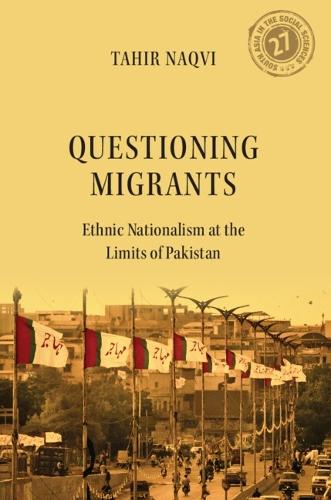
The Muhajir Qaumi Movement (MQM), propelled by ethnic violence and led by university students with lower-middle-class backgrounds, transformed the cities of the southern Pakistani province of Sindh into an ethnic majoritarian stronghold at the unlikely height of a military dictatorship. The more novelaspect of the MQM's platform was it demand for the recognition of Muhajirs as a separate, 'oppressed nationality' within Pakistan. Questioning Migrants is a granular historical and ethographic study of the MQM's capacity to think beyond the exlusivism of Muhajir nationalism toward its contingency and toward a more plural and subaltern framing of the universal. It speaks to significant themes in Pakistan Studies: the legacies of Partition, the rise of the martial state, and the dynamics of urbanization and democracy.
Full Product Details
Author: Tahir H. Naqvi (Trinity University, Texas)
Publisher: Cambridge University Press
Imprint: Cambridge University Press
ISBN: 9781009492300
ISBN 10: 1009492306
Pages: 220
Publication Date: 23 January 2025
Audience:
General/trade
,
General
Format: Hardback
Publisher's Status: Active
Availability: Manufactured on demand

We will order this item for you from a manufactured on demand supplier.
Reviews
'Tahir Naqvi opens up new venues of conceptual and methodological thinking about nationalism, ethnicity, and postcolonial imagination of the 'MQM' as a politics and as a political party in Pakistan. Immersive and thought-provoking, Questioning Migrants is a compelling work to understand the forces shaping modern Pakistani nationalisms and Karachi as a unique megacity in the world.' Manan Ahmed, Columbia University 'Questioning Migrants tells the story of those Urdu-speaking migrants from north India who settled in Karachi after 1947. The book traces the history of how these migrants appropriate transcendental Muslim values and eventually form the political party the Muhajir Qaumi Movement. In doing this, Naqvi opens new direction of inquiry and research in Pakistani studies by providing innovative, original, and excellent analysis of the formation of a centralizing Pakistani state structure and its relationship to the 'refugee' question. Grounded in meticulous research, the book's intellectually stellar argument will change our approach to Pakistan's postcolonial history.' Kamran Asdar Ali, The University of Texas at Austin 'Questioning Migrants offers a fresh understanding of ethnic nationalism in Pakistan. It shows that the Muhajirs, the post-Partition migrants from north and central India to Pakistan, are not defined by prior linguistic or ethnic origins. Instead, the book explains that they emerged as an ethnic group in the wake of decolonization as exemplary national subjects of Pakistan, willing to sacrifice for Muslim nationalism and distinguishing itself from the provincialist politics of other linguistic and ethnic groups. With superb ethnography and sophisticated theorizing, the book brings into view how the Muhajirs and their MQM movement grew in the turbulent space of mass migration, urbanization, and politics to both affirm the 'national' and question it from within with non-elitist politics from below.' Gyan Prakash, Princeton University 'The trajectory of the Muttahida Qaumi Movement (MQM), previously the Muhajir Qaumi Movement, is surely an object lesson for our fractured present of nations and nationalisms that operate exclusively through self-authorization. This book is highly recommended reading for those interested in the state of Pakistan, South Asia, and indeed the world.' Naveeda Khan, Johns Hopkins University
Author Information
Tahir Naqvi teaches in the Department of Sociology and Anthropology at Trinity University, San Antonio, USA.