Awards
- Nominated for J. David Greenstone Book Prize 2016
- Nominated for Jerry Bentley Prize 2016
- Nominated for Robert Jervis and Paul Schroeder Best Book Award 2016
- Nominated for Woodrow Wilson Foundation Award 2016
Overview
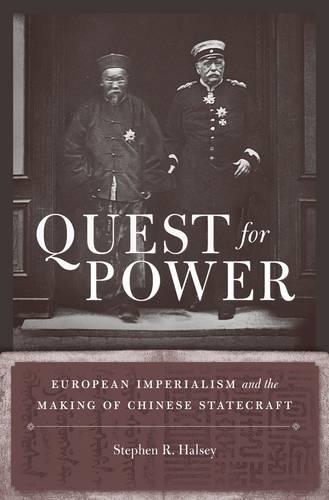
China's history in the nineteenth and early twentieth centuries has often been framed as a long coda of imperial decline, played out during its last dynasty, the Qing. Quest for Power presents a sweeping reappraisal of this narrative. Stephen Halsey traces the origins of China's great-power status in the twentieth century to this era of supposed decadence and decay. Threats from European and Japanese imperialism and the growing prospect of war triggered China's most innovative state-building efforts since the Qing dynasty's founding in the mid-1600s. Through a combination of imitation and experimentation, a new form of political organization took root in China between 1850 and 1949 that shared features with modern European governments. Like them, China created a military-fiscal state to ensure security in a hostile international arena. The Qing Empire extended its administrative reach by expanding the bureaucracy and creating a modern police force. It poured funds into the military, commissioning ironclad warships, reorganizing the army, and promoting the development of an armaments industry. State-built telegraph and steamship networks transformed China's communication and transportation infrastructure. Increasingly, Qing officials described their reformist policies through a new vocabulary of sovereignty-a Western concept that has been a cornerstone of Chinese statecraft ever since. As Halsey shows, the success of the Chinese military-fiscal state after 1850 enabled China to avoid wholesale colonization at the hands of Europe and Japan and laid the foundation for its emergence as a global power in the twentieth century.
Full Product Details
Author: Stephen R. Halsey
Publisher: Harvard University Press
Imprint: Harvard University Press
Dimensions:
Width: 15.60cm
, Height: 2.80cm
, Length: 23.50cm
Weight: 0.635kg
ISBN: 9780674425651
ISBN 10: 0674425650
Pages: 360
Publication Date: 12 October 2015
Audience:
Professional and scholarly
,
College/higher education
,
Professional and scholarly
,
Professional & Vocational
,
Tertiary & Higher Education
Format: Hardback
Publisher's Status: Active
Availability: Out of stock

The supplier is temporarily out of stock of this item. It will be ordered for you on backorder and shipped when it becomes available.
Reviews
A bold argument about modern Chinese statecraft that finds the nineteenth-century Chinese state successful in forging a military fiscal state worthy of comparison with familiar European examples of modern national state formation. In contrast to recent American scholarship seeking to put China into the broader African and Asian world of European colonialism, the author argues the political significance of China not becoming a formal colony, and offers a fresh account and challenging interpretation about the origins of the modern Chinese state.--R. Bin Wong, author of Before and Beyond Divergence
A bold argument about modern Chinese statecraft that finds nineteenth-century China successful in forging a military-fiscal state worthy of comparison with familiar European examples of modern national state formation. In contrast to recent American scholarship seeking to put China into the broader African and Asian world of European colonialism, the author argues the political significance of China not becoming a formal colony, and offers a fresh account and challenging interpretation about the origins of the modern Chinese state.--R. Bin Wong, co-author of <i>Before and Beyond Divergence</i>
This is an outstanding new study of Imperial China's relationship with the Western powers in the middle of the nineteenth century. Halsey offers surprisingly fresh data, many from the local archives, and shows that the conventional story of China's meek 'response' to the West is extremely one-sided. The book convincingly demonstrates that the Chinese authorities, at the center as well as at the local level, had a rather sophisticated understanding of the international situation and took the initiative to undertake administrative and political reforms to cope with the situation. -- Akira Iriye, editor of <i>Global Interdependence</i> A bold argument about modern Chinese statecraft that finds nineteenth-century China successful in forging a military-fiscal state worthy of comparison with familiar European examples of modern national state formation. In contrast to recent American scholarship seeking to put China into the broader African and Asian world of European colonialism, the author argues the political significance of China not becoming a formal colony, and offers a fresh account and challenging interpretation about the origins of the modern Chinese state. -- R. Bin Wong, co-author of <i>Before and Beyond Divergence</i>
Author Information
Stephen R. Halsey is Associate Professor of History at the University of Miami.