Overview
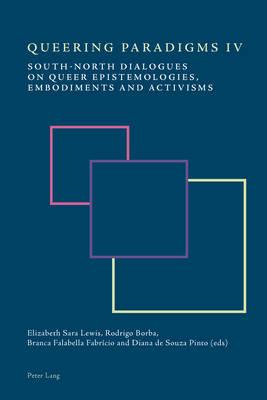
South-North Dialogues on Queer Epistemologies, Embodiments and Activisms is composed of research presented at the fourth international Queering Paradigms Conference (QP4), held in Rio de Janeiro, Brazil. In line with the QP project ethos of bringing together diverse epistemological and geographical allegiances, this volume intends to contribute to building a queer postcolonial critique of the current politics of queer activism and of queer knowledge production and circulation. However, rather than perpetuating the North-South dichotomy, the papers gathered here are an effort to establish global dialogues that crisscross those axes, as well as attempts at queering epistemologies, socio-political bonds, and bodies, embodiments and identities. They endeavour to trouble unequal geographies of knowledge – namely the North as an exporter of theories and the South as their importer; the North as a producer of knowledge and the South as its object of study – hosting enormous potential for reinvention.
Full Product Details
Author: Bee Scherer ,
Sara Elizabeth Lewis ,
Rodrigo Borba ,
Branca Falabella Fabrício
Publisher: Peter Lang AG, Internationaler Verlag der Wissenschaften
Imprint: Peter Lang AG, Internationaler Verlag der Wissenschaften
Edition: New edition
Volume: 4
Dimensions:
Width: 15.00cm
, Height: 2.30cm
, Length: 22.50cm
Weight: 0.580kg
ISBN: 9783034318235
ISBN 10: 3034318235
Pages: 400
Publication Date: 08 October 2014
Audience:
Professional and scholarly
,
Professional & Vocational
Format: Paperback
Publisher's Status: Active
Availability: Out of stock

The supplier is temporarily out of stock of this item. It will be ordered for you on backorder and shipped when it becomes available.
Language: Portuguese
Author Information
Elizabeth Sara Lewis is Professor of Linguistics, Portuguese Language, Teaching and Writing at the Federal University of the State of Rio de Janeiro (UNIRIO). Her research interests include social inequality, identity, queer linguistics and queer translation studies. Rodrigo Borba is Professor of English Language and Applied Linguistics at the Federal University of Rio de Janeiro (UFRJ). His research interests include language, discourse, gender and sexuality, and queer linguistics. Branca Falabella Fabricio is Professor of English Language and Applied Linguistics at the Federal University of Rio de Janeiro (UFRJ). Her research interfaces queer literacies, sociolinguistics and text trajectories on the web. Diana de Souza Pinto is a researcher and professor in the Social Memory Graduate Program at the Federal University of the State of Rio de Janeiro (UNIRIO). Her recent research focuses on developing an interdisciplinary approach to the study of inmates' discourse in mental institutions and prisons.