Overview
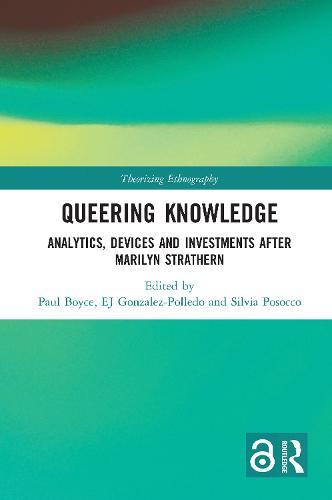
This volume draws on the significance of the work of Marilyn Strathern in respect of its potential to queer anthropological analysis and to foster the reimagining of the object of anthropology. The authors examine the ways in which Strathern’s varied analytics facilitate the construction of alternative forms of anthropological thinking, and greater understanding of how knowledge practices of queer objects, subjects and relations operate and take effect. Queering Knowledge offers an innovative collection of writing, bringing about queer and anthropological syntheses through Strathern’s oeuvre. It will be relevant to scholars from anthropology as well as a number of other disciplines, including gender, sexuality and queer studies. *Winner of the 2020 Ruth Benedict Prize for Outstanding Edited Volume*
Full Product Details
Author: Paul Boyce ,
E.J. Gonzalez-Polledo ,
Silvia Posocco
Publisher: Taylor & Francis Ltd
Imprint: Routledge
Weight: 0.400kg
ISBN: 9780367777418
ISBN 10: 036777741
Pages: 208
Publication Date: 01 April 2021
Audience:
College/higher education
,
Tertiary & Higher Education
Format: Paperback
Publisher's Status: Active
Availability: In Print

This item will be ordered in for you from one of our suppliers. Upon receipt, we will promptly dispatch it out to you. For in store availability, please contact us.
Reviews
As one of the world's most influential (and generous) anthropologists, Marilyn Strathern has made major contributions to our understanding of gender and knowledge. The contributors to this stellar volume extend Strathern's thought into queer anthropology in a range of insightful ways, challenging the reduction of 'queer' to antinormativity or sexual diversity. In keeping with Strathern's own approach, each chapter weaves together anthropological theory and ethnographic data to provide a new vision of 'queer anthropology' itself. - Tom Boellstorff, University of California, Irvine Queering Knowledge offers a radical and refreshing sideways look at both anthropology and queer theory. The book draws on Strathern's work to queer queer, most particularly through her concepts of the merographic, the post-plural, and scale. Through a range of ethnographic and theoretical approaches, the essays move beyond the core queer foci of subjects and identities and into queer kinship, geopolitics, a reworking of gender and feminist interventions, and a queering of ethnography. This is a timely critical analysis of how knowledge is generated; it is a welcome addition to both anthropological and queer theory; it also provides important fresh reflections on the contemporary politics of post-plural life. - Sarah Green, University of Helsinki This outstanding collection focuses on the significance of Marilyn Strathern's theoretical insights to the field of queer anthropology as it exists, and as it might be productively reimagined. In their excellent introduction, the book's editor's neatly move away from a focus on 'gendered' and 'queer' subjectivities, typically imagined, and toward an exploration of how Strathernian concepts can reframe the objects and aims of a queer analytic. [...] The collection's ten chapters hold together as a cohesive project, offering insights to readers of queer anthropology, science studies, and the humanities. - The Association for Queer Anthropology
As one of the world's most influential (and generous) anthropologists, Marilyn Strathern has made major contributions to our understanding of gender and knowledge. The contributors to this stellar volume extend Strathern's thought into queer anthropology in a range of insightful ways, challenging the reduction of 'queer' to antinormativity or sexual diversity. In keeping with Strathern's own approach, each chapter weaves together anthropological theory and ethnographic data to provide a new vision of 'queer anthropology' itself. - Tom Boellstorff, University of California, Irvine Queering Knowledge offers a radical and refreshing sideways look at both anthropology and queer theory. The book draws on Strathern's work to queer queer, most particularly through her concepts of the merographic, the post-plural, and scale. Through a range of ethnographic and theoretical approaches, the essays move beyond the core queer foci of subjects and identities and into queer kinship, geopolitics, a reworking of gender and feminist interventions, and a queering of ethnography. This is a timely critical analysis of how knowledge is generated; it is a welcome addition to both anthropological and queer theory; it also provides important fresh reflections on the contemporary politics of post-plural life. - Sarah Green, University of Helsinki This outstanding collection focuses on the significance of Marilyn Strathern's theoretical insights to the field of queer anthropology as it exists, and as it might be productively reimagined. In their excellent introduction, the book's editor's neatly move away from a focus on 'gendered' and 'queer' subjectivities, typically imagined, and toward an exploration of how Strathernian concepts can reframe the objects and aims of a queer analytic. [...] The collection's ten chapters hold together as a cohesive project, offering insights to readers of queer anthropology, science studies, and the humanities. - The Association for Queer Anthropology
Author Information
Paul Boyce is Senior Lecturer in the Anthropology and International Development at the University of Sussex, UK. He works at intersections of anthropological theory and global health research and is currently preparing a monograph – Sexualities, HIV and Ethnograpghy: Sexual Worldings and Queer Misrecognitions in India. His recent co-edited book is entitled Researching Sex and Sexualities. E.J. Gonzalez-Polledo is a lecturer in the Anthropology Department at Goldsmiths, University of London, UK. Gonzalez-Polledo’s research interests encompass gender transition; health, the biosciences and biosociality; and digital infrastructures. Gonzalez-Polledo is currently developing two major research projects on synthetic biology and biohacking, and forensic bioinformation. Silvia Posocco is Senior Lecturer in the Department of Psychosocial Studies, Birkbeck, University of London, UK. Posocco’s research focuses on gender, sexuality, violence, life and death. Current projects include a monograph on transnational adoptions circuits in the aftermath of war in Guatemala and new research on forensic biorepositories, bioinformation and evidence.