|
|
|||
|
||||
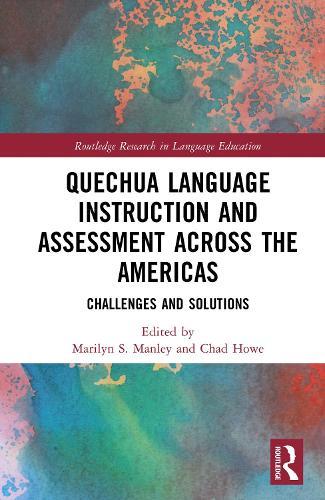
OverviewFull Product DetailsAuthor: Marilyn S. Manley , Chad HowePublisher: Taylor & Francis Ltd Imprint: Routledge Weight: 0.570kg ISBN: 9781032741789ISBN 10: 1032741783 Pages: 208 Publication Date: 24 February 2026 Audience: College/higher education , Professional and scholarly , Tertiary & Higher Education , Professional & Vocational Format: Hardback Publisher's Status: Active Availability: Manufactured on demand We will order this item for you from a manufactured on demand supplier. Table of ContentsPart I: Looking to the future of Quechua language instruction Chapter 1: Introduction: Looking to the future for Quechua language instruction and assessment Marilyn S. Manley and Chad Howe Chapter 2: Quechua beyond the Andes: Teaching and learning Indigenous languages in the United States Américo Mendoza-Mori Chapter 3: The history and development of intercultural bilingual education in Ancash, Peru Félix Julca-Guerrero and Laura Nivin-Vargas Part II: Decolonizing Quechua language teaching and proficiency testing Chapter 4: De-Westernizing grammar in the Quechua language classroom Chad Howe and Bethany Bateman Chapter 5: On Speaking Amazonian Kichwa authentically: Dilemmas for IRIS and ACTFL evaluative tools Janis B. Nuckolls and Tod Swanson Chapter 6: Assessing Quechua by its own standards: Adapting the ACTFL OPI Proficiency Guidelines Elvia Andía Grágeda and Marilyn S. Manley Part III: Authenticity vs. standardization in Quechua language learning materials Chapter 7: Which Kichwa? Teaching Indigenous languages and working with and against dominant language ideologies in a small-scale textbook in Ecuador Nicholas Limerick Chapter 8: Heritage learners count: A Focus on language instruction for the revitalization of Southern Quechua Marilyn S. Manley, Carlos Molina-Vital, and Alana DeLoge Part IV: Conclusion Chapter 9: Reflections Pedro Ovio Plaza MartínezReviewsThis volume is a groundbreaking contribution to Indigenous language education, addressing the challenges and possibilities of Quechua instruction and assessment across the Americas. By blending historical perspectives, decolonial approaches, and practical solutions, it provides a vital resource for educators, linguists, and policymakers committed to sustaining Quechua into the future. Serafín M. Coronel-Molina, Professor, Indiana University Bloomington, USA An important volume on Indigenous language pedagogy and revitalization, bringing both seasoned and newer voices to the full array of Quechua teaching, learning, and assessment practices and proficiency in the US and the Andes. A cogent and supremely practical response to UNESCO's 2021 call for action on behalf of Indigenous language users and stakeholders. Nancy H. Hornberger, Professor Emerita, University of Pennsylvania, USA An innovative and stimulating account of Quechua language teaching in its Andean homelands and among Andeans living in the US. Based on first hand research, the authors emphasize the need for culturally sustaining pedagogies, decolonial approaches, non-Westernised grammatical descriptions, and language-appropriate assessment tools, when teaching such an under-represented Indigenous language across a wide social field. Rosaleen Howard, Professor Emerita, Newcastle University, UK Author InformationMarilyn S. Manley is Professor of Spanish and Chairperson of the Department of World Languages at Rowan University, where she teaches Quechua. She is the co-editor of Quechua expressions of stance and deixis, in Brill’s Studies in the Indigenous Languages of the Americas book series, 11, Leiden: Brill (2015). Chad Howe is Professor of Spanish and Director of the Latin American and Caribbean Studies Institute at the University of Georgia. He is the author of The Spanish Perfects (2013, Palgrave Macmillan) and co-editor of Lingüística de Corpus / The Routledge Handbook of Spanish Corpus Linguistics (2022, Routledge). Tab Content 6Author Website:Countries AvailableAll regions |
||||