Overview
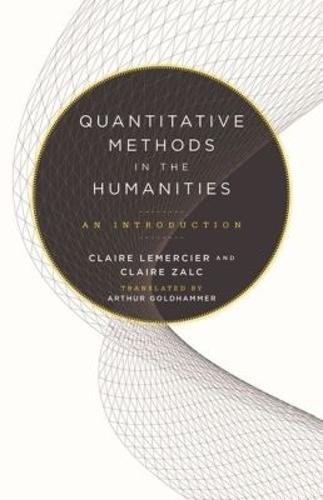
This timely and lucid guide is intended for students and scholars working on all historical periods and topics in the humanities and social sciences-especially for those who do not think of themselves as experts in quantification, """"big data,"""" or """"digital humanities."""" The authors reveal quantification to be a powerful and versatile tool, applicable to a myriad of materials from the past. Their book, accessible to complete beginners, offers detailed advice and practical tips on how to build a dataset from historical sources and how to categorize it according to specific research questions. Drawing on examples from works in social, political, economic, and cultural history, the book guides readers through a wide range of methods, including sampling, cross-tabulations, statistical tests, regression, factor analysis, network analysis, sequence analysis, event history analysis, geographical information systems, text analysis, and visualization. The requirements, advantages, and pitfalls of these techniques are presented in layperson's terms, avoiding mathematical terminology. Conceived primarily for historians, the book will prove invaluable to other humanists, as well as to social scientists looking for a nontechnical introduction to quantitative methods. Covering the most recent techniques, in addition to others not often enough discussed, the book will also have much to offer to the most seasoned practitioners of quantification.
Full Product Details
Author: Claire Lemercier ,
Claire Zalc ,
Arthur Goldhammer
Publisher: University of Virginia Press
Imprint: University of Virginia Press
Dimensions:
Width: 15.20cm
, Height: 1.00cm
, Length: 22.80cm
Weight: 0.292kg
ISBN: 9780813942698
ISBN 10: 0813942691
Pages: 184
Publication Date: 30 March 2019
Audience:
Professional and scholarly
,
Professional & Vocational
Format: Paperback
Publisher's Status: Active
Availability: In Print

This item will be ordered in for you from one of our suppliers. Upon receipt, we will promptly dispatch it out to you. For in store availability, please contact us.
Language: English
Reviews
There are so many untapped opportunities for historians to use quantitative methods, but very few guides to help them use these methods well. This book meets an urgent need for concise, accessible, and rigorous texts on quantitative history. It is a text that will last--it presents fundamental concepts in such a way that they will not be quickly dated as tools and questions change. --Caitlin C. Rosenthal, University of California, Berkeley, author of Accounting for Slavery: Masters and Management
""There are so many untapped opportunities for historians to use quantitative methods, but very few guides to help them use these methods well. This book meets an urgent need for concise, accessible, and rigorous texts on quantitative history. It is a text that will last--it presents fundamental concepts in such a way that they will not be quickly dated as tools and questions change."" --Caitlin C. Rosenthal, University of California, Berkeley, author of Accounting for Slavery: Masters and Management Claire Lemercier and Claire Zalc belong to this rare category of historians who show how quantitative methods can and should be used to build new bridges between history, the social sciences and humanities. At a time when disciplinary entrenchment is as lively as ever, this is refreshing. This book provides a great illustration of their approach. A must-read. --Thomas Piketty, École des Hautes Études en Sciences Sociales and Paris School of Economics, author of Capital in the Twenty-First Century Lemercier and Zalc have crafted a wonderfully luminous and congenial primer to quantitative methods construed, not as the Grail, but as a pragmatic, supple and enriching approach to interpretation as well as to the administration of proof. It presents possible solutions to a multiplicity of very different questions that stimulate thinking about how to capture and fathom the past and to probe issues in myriad disciplines in the humanities and the social sciences. --Steven Laurence Kaplan, Cornell University This instructive guide is replete with successes and cautionary tales and rich in examples for further study. It is an invitation to employ quantitative methods to stimulate different approaches to historical study. -- ""CHOICE""
This instructive guide is replete with successes and cautionary tales and rich in examples for further study. It is an invitation to employ quantitative methods to stimulate different approaches to historical study. --CHOICE Claire Lemercier and Claire Zalc belong to this rare category of historians who show how quantitative methods can and should be used to build new bridges between history, the social sciences and humanities. At a time when disciplinary entrenchment is as lively as ever, this is refreshing. This book provides a great illustration of their approach. A must-read. --Thomas Piketty, Ecole des Hautes Etudes en Sciences Sociales and Paris School of Economics, author of Capital in the Twenty-First Century Lemercier and Zalc have crafted a wonderfully luminous and congenial primer to quantitative methods construed, not as the Grail, but as a pragmatic, supple and enriching approach to interpretation as well as to the administration of proof. It presents possible solutions to a multiplicity of very different questions that stimulate thinking about how to capture and fathom the past and to probe issues in myriad disciplines in the humanities and the social sciences. --Steven Laurence Kaplan, Cornell University There are so many untapped opportunities for historians to use quantitative methods, but very few guides to help them use these methods well. This book meets an urgent need for concise, accessible, and rigorous texts on quantitative history. It is a text that will last--it presents fundamental concepts in such a way that they will not be quickly dated as tools and questions change. --Caitlin C. Rosenthal, University of California, Berkeley, author of Accounting for Slavery: Masters and Management
Author Information
Claire Lemercier is Research Professor of History at the Center for the Sociology of Organizations, Paris. Claire Zalc is Research Professor of History at the Institute for Early Modern and Modern History, Paris. Arthur Goldhammer is an affiliate of the Center for European Studies at Harvard University and a member of the editorial board of French Politics, Culture, and Society.