Overview
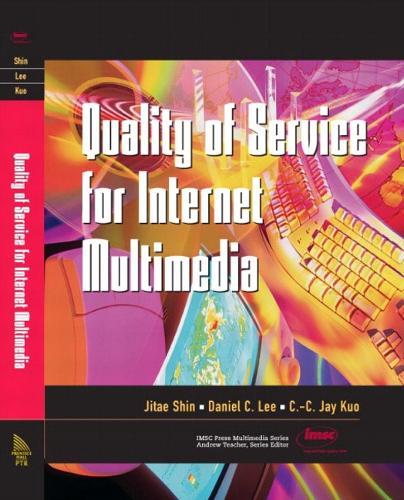
Continuous media applications have exceptionally stringent QoS requirements, and QoS for multimedia will remain a challenge well into the future. The solution begins with service-differentiated networks capable of providing appropriate grades of service to each application. This book takes the next step, showing how continuous media applications and QoS-enabled networks can interact, and offering a leading-edge framework in which applications and the network can cooperatively optimize end-to-end QoS. Coverage includes: New video-categorization schemes for assigning video-packet-to-network differentiated service classes Adaptive packet-forwarding mechanisms that improve cooperation between multimedia applications and networks Dynamic QoS mapping-control schemes that let DiffServ networks deliver variable media streams with consistent quality Fine-Grained Scalable MPEG-4-based video streamingoseamlessly integrating rate adaptation, prioritized packetization, and loss-based differential forwarding Joint-source-network approach: layered video combining application-level UEP with network-level QoS support New network service models for layered video multicasting across DiffServ networks Whether you're a multimedia researcher, designer, developer, or implementer, these advanced techniques can help you optimize performance, content categorization, and quality control.
Full Product Details
Author: Jitae Shin ,
Daniel C. Lee ,
C.C. Jay Kuo
Publisher: Pearson Education (US)
Imprint: Prentice Hall
Dimensions:
Width: 18.50cm
, Height: 1.90cm
, Length: 24.20cm
Weight: 0.635kg
ISBN: 9780131414631
ISBN 10: 0131414631
Pages: 256
Publication Date: 07 August 2003
Audience:
College/higher education
,
Tertiary & Higher Education
Format: Hardback
Publisher's Status: Out of Print
Availability: Awaiting stock

Author Information
JITAE SHIN is Assistant Professor at the School of Information and Communication Engineering, Sungkyungkwan University, Korea. His research interests include QoS issues and multimedia transmission in wired/wireless networks. DANIEL C. LEE is Assistant Professor in the Department of Electrical Engineering, University of Southern California. His research interests include Quality of Service provision and performance analysis for a wide range of networks (wireless, optical, packet-switching, etc.) and applications. C.-C. JAY KUO, Professor at the Department of Electrical Engineering and the Signal and Image Processing Institute at USC, leads a research group devoted to multimedia compression, communication, and management. He edits the Journal of Visual Communication and Image Representation and has co-authored three books, including Intelligent Systems for Video Analysis and Access over the Internet (Prentice Hall).