Overview
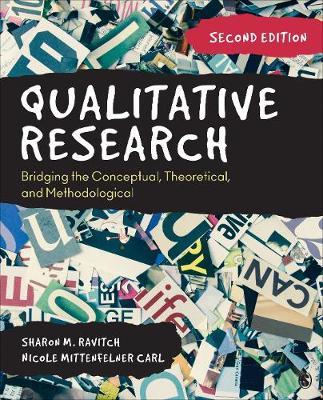
This comprehensive text helps student understand the central concepts, topics, and skills necessary to engage in rigorous, valid, and respectful qualitative research. The authors balance communicating the foundations and processes of qualitative research with clarity and simplicity, while at the same time capturing its complexity and the multiple layers that are central to research. Whether the reader is new to qualitative research or not, the text develops and deepens their understanding of an approach to research that seeks, designs for, and engages criticality in qualitative research. Every chapter begins with an overview and key objectives. Many interdisciplinary and diverse examples illustrate key concepts throughout, along with a wide range of memos, conceptual framework narratives, graphics and much more.
Full Product Details
Author: Sharon M. Ravitch (University of Pennsylvania, USA) ,
Nicole Mittenfelner Carl (University of Pennsylvania, USA) ,
Inc. SAGE Publications
Publisher: SAGE Publications Inc
Imprint: SAGE Publications Inc
Edition: 2nd Revised edition
Weight: 1.000kg
ISBN: 9781544333816
ISBN 10: 1544333811
Pages: 624
Publication Date: 01 May 2020
Audience:
College/higher education
,
Tertiary & Higher Education
Format: Paperback
Publisher's Status: Active
Availability: Available To Order

We have confirmation that this item is in stock with the supplier. It will be ordered in for you and dispatched immediately.
Author Information
Sharon M. Ravitch is a professor of practice at the University of Pennsylvania’s Graduate School of Education. She engages in numerous applied research projects in India, serving as a visiting scholar at the Tata Institute of Social Sciences (TISS) in Mumbai and working as a co-researcher and key resource expert in policy advocacy, professional development, and community-based participatory research related to corporate social responsibility through TISS’s corporate social responsibility hub. She is involved in the design and implementation of assessment and evaluation of statewide performance through mixed-methods research in the Ministry of Human Resource Development’s major policy initiative, Rashtriya Uchchatar Shiksha Abhiyan (RUSA), a countrywide reform initiative aimed to resurrect India’s state public university system. Ravitch is also an expert adviser at the Center for Academic Leadership and Education Management at TISS. The center provides professional development and policy advocacy support to school education leaders across India. Ravitch works in the center’s capacity-building program to collaboratively develop case studies and technology-innovation frameworks for the higher education and K–12 sectors using a participatory approach. She received the prestigious GIAN Scholar Award from the government of India for 2016–2017 and the RUSA Scholar Award for 2017–2018. Ravitch also received a Fulbright Fellowship to engage in research and applied development work in India from 2017 to 2019. Ravitch has published five books: Applied Research for Sustainable Change: A Guide for Education Leaders (with Nicole Carl, 2019); Qualitative Research: Bridging the Conceptual, Theoretical, and Methodological (2nd ed., with Nicole Carl, 2020); Reason and Rigor: How Conceptual Frameworks Guide Research (2012; 2nd ed., with Matthew Riggan, 2016); School Counseling Principles: Diversity and Multiculturalism (2006); and Matters of Interpretation: Reciprocal Transformation in Therapeutic and Developmental Relationships With Youth (with Michael Nakkula, 1998). Nicole Mittenfelner Carl is a postdoctoral fellow in the Teaching, Learning, and Leadership Division at the University of Pennsylvania Graduate School of Education. She received her doctorate in educational leadership from the University of Pennsylvania in 2017. Carl teaches courses related to qualitative research methods, practitioner research for educational leaders, and mentoring strategies for veteran teachers coaching first-year teachers. Carl has been conducting qualitative research for more than a decade, beginning in 2005, when she was awarded a Mellon Fellowship. Since then, she has led and participated in numerous qualitative and mixed-methods research projects. She recently co-authored a text for Harvard Education Press, Applied Research for Sustainable Change: A Guide for Education Leaders, that exemplifies ways for practitioners to use local research as a driver of school change. Carl has also published several articles on students’ experiences with schooling, democratizing schooling, the impacts of educational policies on teachers and leaders, and applied research in peer-reviewed journals. Carl has worked with school leaders, teachers, and students in various settings (public and independent) to consider ways to use research to drive school improvement. She has also led a multiyear, multisite evaluation of the impact of these projects on the schools and individuals involved. She continues to research ways that practitioners can conduct and use research in their schools, and she supports educators in the implementation of these projects.