Overview
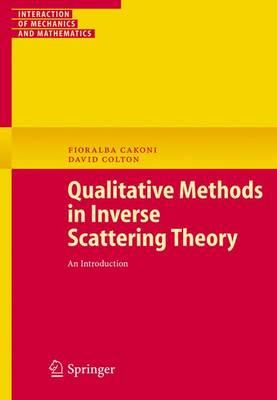
Inverse scattering theory has been a particularly active and successful field in applied mathematics and engineering for the past twenty years. The increasing demands of imaging and target identification require new powerful and flexible techniques besides the existing weak scattering approximation or nonlinear optimization methods. One class of such methods comes under the general description of qualitative methods in inverse scattering theory. This textbook is an easily-accessible ""class-tested"" introduction to the field. It is accessible also to readers who are not professional mathematicians, thus making these new mathematical ideas in inverse scattering theory available to the wider scientific and engineering community.
Full Product Details
Author: Fioralba Cakoni ,
David Colton
Publisher: Springer-Verlag Berlin and Heidelberg GmbH & Co. KG
Imprint: Springer-Verlag Berlin and Heidelberg GmbH & Co. K
Edition: 2006 ed.
Dimensions:
Width: 15.50cm
, Height: 1.20cm
, Length: 23.50cm
Weight: 0.750kg
ISBN: 9783540288442
ISBN 10: 3540288449
Pages: 227
Publication Date: 03 November 2005
Audience:
Professional and scholarly
,
Professional & Vocational
Format: Paperback
Publisher's Status: Active
Availability: In Print

This item will be ordered in for you from one of our suppliers. Upon receipt, we will promptly dispatch it out to you. For in store availability, please contact us.
Reviews
From the reviews: This book presents a qualitative approach to inverse scattering theory for electromagnetic waves, and contains also complementary material for the corresponding direct problems. It consists of 9 chapters, references and an index. The topics are presented at an introductional level, accessible to anyone having a mathematical background only in advanced calculus and linear algebra. ... The book is well-written, and readable at the level of advanced graduate students. (Luis Filipe Pinheiro de Castro, Zentralblatt MATH, Vol. 1099 (1), 2007) This book is an excellent introduction to the newly developed class of methods in inverse scattering theory ... . the authors make a huge pedagogical effort to make the book self-contained and accessible to readers without a strong mathematical background. ... This is definitely the book to start with for anyone who would like to be introduced to this new field in inverse scattering theory. (Houssem Haddar, Mathematical Reviews, Issue 2008 c)
From the reviews: This book presents a qualitative approach to inverse scattering theory for electromagnetic waves, and contains also complementary material for the corresponding direct problems. It consists of 9 chapters, references and an index. The topics are presented at an introductional level, accessible to anyone having a mathematical background only in advanced calculus and linear algebra. ! The book is well-written, and readable at the level of advanced graduate students. (Luis Filipe Pinheiro de Castro, Zentralblatt MATH, Vol. 1099 (1), 2007) This book is an excellent introduction to the newly developed class of methods in inverse scattering theory ! . the authors make a huge pedagogical effort to make the book self-contained and accessible to readers without a strong mathematical background. ! This is definitely the book to start with for anyone who would like to be introduced to this new field in inverse scattering theory. (Houssem Haddar, Mathematical Reviews, Issue 2008 c)
<p>From the reviews: <p> This book presents a qualitative approach to inverse scattering theory for electromagnetic waves, and contains also complementary material for the corresponding direct problems. It consists of 9 chapters, references and an index. The topics are presented at an introductional level, accessible to anyone having a mathematical background only in advanced calculus and linear algebra. The book is well-written, and readable at the level of advanced graduate students. (Luis Filipe Pinheiro de Castro, Zentralblatt MATH, Vol. 1099 (1), 2007)<p> This book is an excellent introduction to the newly developed class of methods in inverse scattering theory . the authors make a huge pedagogical effort to make the book self-contained and accessible to readers without a strong mathematical background. This is definitely the book to start with for anyone who would like to be introduced to this new field in inverse scattering theory. (Houssem Haddar, Mathematical Reviews, Iss
From the reviews: <p> This book presents a qualitative approach to inverse scattering theory for electromagnetic waves, and contains also complementary material for the corresponding direct problems. It consists of 9 chapters, references and an index. The topics are presented at an introductional level, accessible to anyone having a mathematical background only in advanced calculus and linear algebra. a ] The book is well-written, and readable at the level of advanced graduate students. (Luis Filipe Pinheiro de Castro, Zentralblatt MATH, Vol. 1099 (1), 2007) <p> This book is an excellent introduction to the newly developed class of methods in inverse scattering theory a ] . the authors make a huge pedagogical effort to make the book self-contained and accessible to readers without a strong mathematical background. a ] This is definitely the book to start with for anyone who would like to be introduced to this new field in inverse scattering theory. (Houssem Haddar, Mathematical Reviews, Issue 2008 c)