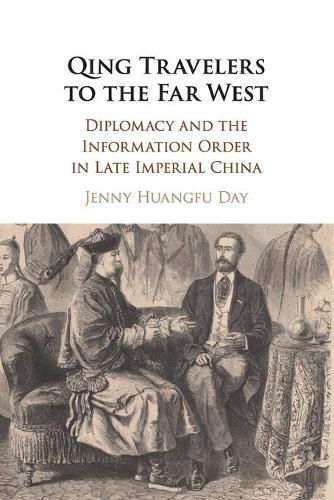
Overview
Prior to the nineteenth century, the West occupied an anomalous space in the Chinese imagination, populated by untamable barbarians and unearthly immortals. First-hand accounts and correspondence from Qing envoys and diplomats to Europe unraveled that perception. In this path-breaking study, Jenny Huangfu Day interweaves the history of Qing legation-building with the personal stories of China's first official travelers, envoys and diplomats to Europe. She explores how diplomat-travelers navigated the conceptual and physical space of a land virtually unmapped in the Chinese intellectual tradition and created a new information order. This study reveals the fluidity, heterogeneity, and ambivalence of their experience, and the layers of tension between thinking, writing, and publishing about the West. By integrating diplomatic and intellectual history with literary analysis and communication studies, Day offers a fundamentally new interpretation of the Qing's engagement with the West.
Full Product Details
Author: Jenny Huangfu Day (Skidmore College, New York)
Publisher: Cambridge University Press
Imprint: Cambridge University Press
Dimensions:
Width: 15.20cm
, Height: 1.50cm
, Length: 22.80cm
Weight: 0.400kg
ISBN: 9781108457729
ISBN 10: 110845772
Pages: 284
Publication Date: 26 March 2020
Audience:
Professional and scholarly
,
Professional & Vocational
Format: Paperback
Publisher's Status: Active
Availability: Manufactured on demand

We will order this item for you from a manufactured on demand supplier.
Reviews
'In this deeply informed and closely argued book, Jenny Huangfu Day rewrites the history of Chinese diplomatic interaction with the West in the late Qing. Since there was no single China or fixed, internally consistent West, Chinese diplomat-travelers found, not surprisingly, that the West they discovered and wrote about closely mirrored the divergent views they themselves represented.' Paul A. Cohen, Fairbank Center for Chinese Studies, Harvard University, Massachusetts 'In Day's rich and readable account, nineteenth-century Chinese intellectuals are no longer one-dimensional monitors of Western wonders, but complex and fully human individuals articulating nuanced understanding of their tradition and the world around them. Her work is certain to change pedagogical practice, and received understanding of nineteenth century Chinese intellectual history.' R. Kent Guy, University of Washington 'This important study offers a tantalizing glimpse of 'the West' seen through the eyes of the Qing dynasty's earliest diplomatic representatives to Europe. Day meticulously reconstructs the rich cognitive universe of these figures and demonstrates that the very act of perceiving 'the other' changed with the emergence of a new information order after 1860.' Stephen Halsey, University of Miami 'In this deeply informed and closely argued book, Jenny Huangfu Day rewrites the history of Chinese diplomatic interaction with the West in the late Qing. Since there was no single China or fixed, internally consistent West, Chinese diplomat-travelers found, not surprisingly, that the West they discovered and wrote about closely mirrored the divergent views they themselves represented.' Paul A. Cohen, Fairbank Center for Chinese Studies, Harvard University, Massachusetts 'In Day's rich and readable account, nineteenth-century Chinese intellectuals are no longer one-dimensional monitors of Western wonders, but complex and fully human individuals articulating nuanced understanding of their tradition and the world around them. Her work is certain to change pedagogical practice, and received understanding of nineteenth century Chinese intellectual history.' R. Kent Guy, University of Washington 'This important study offers a tantalizing glimpse of 'the West' seen through the eyes of the Qing dynasty's earliest diplomatic representatives to Europe. Day meticulously reconstructs the rich cognitive universe of these figures and demonstrates that the very act of perceiving 'the other' changed with the emergence of a new information order after 1860.' Stephen Halsey, University of Miami
'In this deeply informed and closely argued book, Jenny Huangfu Day rewrites the history of Chinese diplomatic interaction with the West in the late Qing. Since there was no single China or fixed, internally consistent West, Chinese diplomat-travelers found, not surprisingly, that the West they discovered and wrote about closely mirrored the divergent views they themselves represented.' Paul A. Cohen, Fairbank Center for Chinese Studies, Harvard University, Massachusetts 'In Day's rich and readable account, nineteenth-century Chinese intellectuals are no longer one-dimensional monitors of Western wonders, but complex and fully human individuals articulating nuanced understanding of their tradition and the world around them. Her work is certain to change pedagogical practice, and received understanding of nineteenth century Chinese intellectual history.' R. Kent Guy, University of Washington 'This important study offers a tantalizing glimpse of 'the West' seen through the eyes of the Qing dynasty's earliest diplomatic representatives to Europe. Day meticulously reconstructs the rich cognitive universe of these figures and demonstrates that the very act of perceiving 'the other' changed with the emergence of a new information order after 1860.' Stephen Halsey, University of Miami 'Elegant both in organization and prose ... demonstrates that the diplomatic endeavors of the Zongli yamen prompted seismic shifts in thinking about places known and unknown.' Emily Mokros, Journal of Chinese History 'Day's careful mining of archives, telegrams, personal correspondence, and newspapers, combined with her nuanced reading of envoy journals, political essays, travel writing, and poetry, offers many critical and original insights into the complex history of the emergence of a professional diplomatic corps and a new information order.' Ke Ren, Journal of Modern Chinese History 'Day conveys the close observations of Europe and America ... with excellent color and immediacy.' Pamela Crossley, The Journal of Interdisciplinary History 'Delightful. Highly recommended. All academic levels.' Kristin Stapleton, Choice
Author Information
Jenny Huangfu Day is Assistant Professor of History at Skidmore College, New York.