Overview
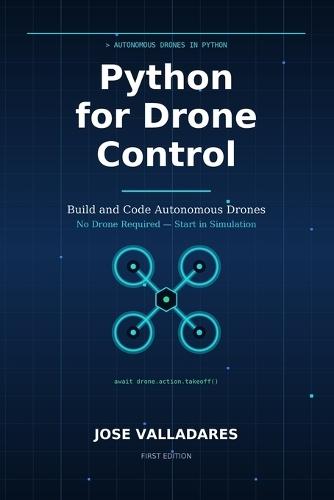
Build a real autonomous drone - without owning a drone.Most drone programming books assume you already own a $1,500 quadcopter, a Pixhawk flight controller, and a workshop full of soldering equipment. This one doesn't. Python for Drone Control teaches you to program autonomous drones from the ground up using PX4 SITL - the same flight control software running on real commercial drones - simulated faithfully on your laptop. You'll write Python scripts that connect to a drone, take off, fly precise routes, see the world through computer vision, make autonomous decisions, and complete real missions. Your code. A real autopilot. A flying machine. By the end of this book, you will be able to: Set up a complete drone development environment (PX4 SITL, Gazebo, MAVSDK) Connect Python code to a drone autopilot and stream live telemetry Fly autonomously - arm, take off, fly precise routes, hover, and land - all from Python Navigate using GPS coordinates with multi-waypoint missions Handle failsafes and recovery correctly (the safety patterns production drones use) Add computer vision with YOLO11 - detect, track, and follow targets Build intelligent state-machine behaviors (the same architecture Skydio and DJI use) Ship three complete projects: an autonomous patrol drone, a search-and-rescue grid scanner, and a delivery drone Move confidently from simulation to real hardware What makes this book different: No drone required. Every chapter runs against a faithful simulator. Buy the book today, code a flying drone tonight. Modern tools that work in 2026. MAVSDK 2.6, Python 3.12, PX4 v1.16, Gazebo Harmonic, YOLO11. No DroneKit. No deprecated APIs. Every version pinned and verified. Code that runs end-to-end. Every script is complete and runnable. A 60-second verification gate at the start of Chapter 9 catches setup problems before they cost you an hour of debugging. Three production-shaped projects. Not toy demos. Real architectures with reusable components, safety patterns, and the design choices commercial drone software actually uses. Visual learning. Publication-quality diagrams illustrate roll/pitch/yaw, motor forces, sensor fusion, the MAVSDK stack, NED coordinates, and the state machines that drive autonomous behavior. Honest about scope. No buzzwords without working code behind them. The ""intelligent behavior"" chapters use rule-based state machines - the same approach production drones use - with a complete patrol-with-avoidance script you can read line by line. What you'll build: Project 1 - Autonomous Patrol Drone: Flies a configurable route, watches for people with YOLO, logs every detection with GPS coordinates Project 2 - Search-and-Rescue Grid Scanner: Generates a serpentine pattern from two GPS corners, covers an area systematically Project 3 - Delivery Drone Simulation: Point-to-point flight with simulated payload, multi-delivery sequencing Who this book is for: Python developers ready to add autonomous systems to their skill set. Robotics enthusiasts graduating from Arduino projects to commercial-grade drone software. Engineering students studying autonomous systems, computer vision, or control theory. Hobbyists who own (or want to own) a drone and need software that actually works. What you need: A laptop running Ubuntu, macOS, or Windows-WSL2. Working knowledge of Python. That's it. No drone hardware required. 337 pages. 27 chapters. 3 appendices. Start tonight.
Full Product Details
Author: Jose Valladares
Publisher: Independently Published
Imprint: Independently Published
Dimensions:
Width: 15.20cm
, Height: 1.80cm
, Length: 22.90cm
Weight: 0.458kg
ISBN: 9798195762902
Pages: 342
Publication Date: 06 May 2026
Audience:
General/trade
,
General
Format: Paperback
Publisher's Status: Active
Availability: Available To Order

We have confirmation that this item is in stock with the supplier. It will be ordered in for you and dispatched immediately.