Overview
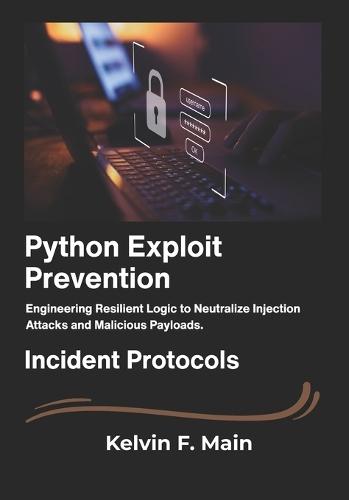
Your Python code is functional. But is it bulletproof? Python's greatest strength, its flexibility is also its most dangerous liability. As developers, we are often taught to trust the interpreter: to rely on dynamic typing, to assume libraries are safe, and to view input as data. In the adversarial reality of modern software engineering, these assumptions are fatal. You cannot ""patch"" your way to true security. If you are relying on scattered if statements to catch SQL injections, or using string replacement to prevent path traversal, you have already lost. The attacker only needs to be right once; you need to be right every time. Python Exploit Prevention rejects the reactive game of ""Whack-a-Mole"" bug hunting in favor of proactive, resilient logic design. This is not a book about basic syntax or entry-level precautions. It is a deep dive into Architectural Hardening, the discipline of structuring your code so that entire classes of vulnerabilities become mathematically impossible. Written for the experienced developer who is ready to move beyond ""making it work,"" this manual bridges the gap between software engineering and offensive security. It treats Python not just as a language, but as a battleground where memory management, serialization protocols, and interpreter logic determine the survival of your application. Inside, you will learn to: Construct the Validation Firewall: Move beyond simple type-checking and weaponize Pydantic to build rigid data models that reject malformed payloads before they ever reach your business logic. Neutralize Injection Vectors: Abandon dangerous habits like os.system and raw SQL. Learn to implement Quarantine Logic that isolates shell commands and enforces strict parameterization across SQL and NoSQL databases. Solve the Deserialization Crisis: Understand why pickle is a remote code execution engine masquerading as a data format, and how to implement secure, cryptographically signed serialization alternatives using JSON and HMAC. Engineer Fail-Safe File Systems: Eliminate path traversal and race conditions (TOCTOU) by utilizing atomic file operations, canonicalization strategies, and binary-level content inspection. Master Identity & State: Implement aggressive Privilege Dropping to minimize blast radius, engineer race-proof rate limiters using Redis, and secure session tokens against fixation and hijacking. Automate the Offense: Don't wait for a breach to find your weak spots. Learn to audit your own code using static analysis (Bandit) and bombard your logic with coverage-guided Fuzz Testing (Atheris and Hypothesis) to discover ""Black Swan"" edge cases. Security is not a feature you add at the end; it is the foundation you build upon. Whether you are building high-frequency trading bots, enterprise web APIs, or data processing pipelines, this book will transform the way you think about trust, data, and the Python interpreter itself. Stop writing code that can be exploited. Start engineering logic that fights back.
Full Product Details
Author: Kelvin F Main
Publisher: Independently Published
Imprint: Independently Published
Dimensions:
Width: 17.00cm
, Height: 1.30cm
, Length: 24.40cm
Weight: 0.399kg
ISBN: 9798275300192
Pages: 248
Publication Date: 20 November 2025
Audience:
General/trade
,
General
Format: Paperback
Publisher's Status: Active
Availability: Available To Order

We have confirmation that this item is in stock with the supplier. It will be ordered in for you and dispatched immediately.