Overview
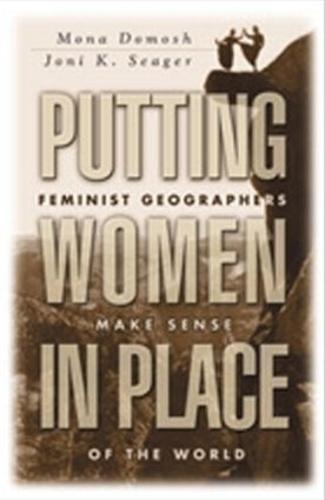
Why do women and men tend to work in different jobs, in different ways, and in different spaces? Which is more ""masculine""--the city or the suburbs? Why is nature often represented in feminine form? This thought-provoking book uses the lens of gender to provide an illuminating new perspective on the geography of everyday life. Seager and Domosh illuminate how notions of maleness and femaleness have influenced our built environment, the locations in which we invest meaning, and the ways we live, work, travel, and explore. From the arrangement of furniture in Victorian homes to the movements of refugees over contemporary borders, the book explores gender patterns and roles across cultures and historical periods. It is lavishly illustrated with line drawings, photographs, and maps.
Full Product Details
Author: Mona Domosh ,
Joni Seager
Publisher: Guilford Publications
Imprint: Guilford Publications
Dimensions:
Width: 17.40cm
, Height: 1.50cm
, Length: 24.60cm
Weight: 0.544kg
ISBN: 9781572306684
ISBN 10: 1572306688
Pages: 216
Publication Date: 26 July 2001
Audience:
College/higher education
,
Professional and scholarly
,
Undergraduate
,
Professional & Vocational
Format: Paperback
Publisher's Status: Out of Print
Availability: Awaiting stock

Reviews
'From single women as homesteaders on the American frontier, to lady Victorian explorers finding freedom and release through travel, to super-moms in the suburbs carrying out their multiple roles, Seager and Domosh offer a compelling account of how definitions of femininity are forged in space.' - M. Christine Boyer, School of Architecture, Princeton University 'A lively and well-illustrated overview of the geography of women. Treating both historical and contemporary issues, Seager and Domosh provide a feminist perspective on space and gender. For many years, I have wanted to be able to assign a book like this. I recommend it for graduate and undergraduate courses in geography, history, architecture, and urban studies.' - Dolores Hayden, Yale University; author of The Grand Domestic Revolution 'For too long, Anglophone geography has lacked a comprehensive introductory text on gender issues. Putting Women in Place answers this need.' - Sallie Marston, Department of Geography and Regional Development, University of Arizona
'From single women as homesteaders on the American frontier, to lady Victorian explorers finding freedom and release through travel, to super-moms in the suburbs carrying out their multiple roles, Seager and Domosh offer a compelling account of how definitions of femininity are forged in space.' - M. Christine Boyer, School of Architecture, Princeton University 'A lively and well-illustrated overview of the geography of women. Treating both historical and contemporary issues, Seager and Domosh provide a feminist perspective on space and gender. For many years, I have wanted to be able to assign a book like this. I recommend it for graduate and undergraduate courses in geography, history, architecture, and urban studies.' - Dolores Hayden, Yale University; author of The Grand Domestic Revolution 'For too long, Anglophone geography has lacked a comprehensive introductory text on gender issues. Putting Women in Place answers this need. ' - Sallie Marston, Department of Geography and Regional Development, University of Arizona
Author Information
Mona Domosh is Professor of Geography at Dartmouth College. She is the author of Invented Cities. Joni Seager is Associate Professor and Chair of Geography at the University of Vermont. She is the author of The State of Women in the World, The New State of the Earth Atlas, and Earth Follies. Her articles and reviews have appeared in The New York Times, the Village Voice, and other publications.