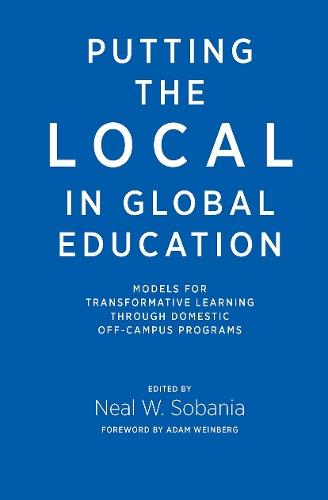
Full Product Details
Author: Neal W. Sobania ,
Neal W. Sobania
Publisher: Taylor & Francis Inc
Imprint: Stylus Publishing
Dimensions:
Width: 15.20cm
, Height: 3.00cm
, Length: 22.90cm
Weight: 0.666kg
ISBN: 9781620361672
ISBN 10: 1620361671
Pages: 392
Publication Date: 08 May 2015
Audience:
Professional and scholarly
,
Professional & Vocational
Format: Hardback
Publisher's Status: Active
Availability: In Print

This item will be ordered in for you from one of our suppliers. Upon receipt, we will promptly dispatch it out to you. For in store availability, please contact us.
Reviews
"""Putting the Local in Global Education reminds us of how important it is to focus more on what students are learning than where they are studying. By linking complex questions of local and global impact, identity, power, and justice, the authors contribute to critical conversations about how we might more broadly define global learning. As a result, this book will encourage curricular and pedagogical experimentation and, I hope, lead to new ways that faculty and students may come to recognize the global in their communities and deepen their appreciation for the complexities of their interconnected lives."" Kevin Hovland, Senior Director, Academic Programs NAFSA ""The time has come for all international educators to consider more seriously how we actively bridge global learning with the local, domestic context. Putting the Local in Global Education is a critical read for those educators who seek to ensure that global learning is accessible for all students – not just those who are able to study abroad."" Gayle Woodruff, Director, Curriculum and Campus Internationalization University of Minnesota ""This text adds valuable and necessary perspective to the field of global learning. The framing chapters and case studies contained within this volume provide practical guidance as well as a deep examination of how domestic off-campus study away programs align with initiatives around intercultural competence, diversity, community engagement, and social justice. With discussion of pedagogical strategies, assessment, policies, and risks, this book is a must-read for anyone involved with domestic study-away in higher education."" Stephanie Stokamer, Ed.D., Director & Assistant Professor, Center for Civic Engagement Pacific University ""For over 100 years, we have used geographically marked terms—like distant lands, overseas study, education abroad, and international education—to mark a global education. The learning models assembled in this volume help us to see that the ‘global’ is no longer somewhere ‘out there’; it is right here, at our doorstep, touching all of our lives, and inviting a new generation of 'rooted cosmopolitans' to help create the kind of world we want and need."" Richard Slimbach, Azusa Pacific University “Simply put, the chapters in this volume are interesting and important. They are grounded in existing programs, giving us real examples of what is possible. And they are theoretically challenging, raising questions about the construction of key concepts in ways that could and should encourage us to examine institutional practices. As a volume, there is clearly a call to embrace domestic Study Away as a legitimate practice and strategy that should be more central to higher education, especially our efforts at internationalization. Count me in as one college president who is ready to shift his thinking.” Adam Weinberg, President, Denison University “For decades, community engagement and international education faculty and staff have been spinning hypotheses about how the local can be global; how the processes for quality engagement through community-based learning and study abroad are fundamentally parallel – if not the same. Finally, a group of scholars and practitioners have gathered the wisdom of these discrete fields in one location, sharing systematic program models, pedagogical approaches, and evaluation methods that clarify the full potential of domestic global learning.” Eric Hartman, Ph.D., Assistant Professor, Staley School of Leadership Studies Kansas State University"
This text adds valuable and necessary perspective to the field of global learning. The framing chapters and case studies contained within this volume provide practical guidance as well as a deep examination of how domestic off-campus study away programs align with initiatives around intercultural competence, diversity, community engagement, and social justice. With discussion of pedagogical strategies, assessment, policies, and risks, this book is a must-read for anyone involved with domestic study-away in higher education. --Stephanie Stokamer, Ed.D., Director & Assistant Professor, Center for Civic Engagement (3/1/2015 12:00:00 AM) For decades, community engagement and international education faculty and staff have been spinning hypotheses about how the local can be global; how the processes for quality engagement through community-based learning and study abroad are fundamentally parallel - if not the same. Finally, a group of scholars and practitioners have gathered the wisdom of these discrete fields in one location, sharing systematic program models, pedagogical approaches, and evaluation methods that clarify the full potential of domestic global learning. --Eric Hartman, Ph.D., Assistant Professor, Staley School of Leadership Studies Simply put, the chapters in this volume are interesting and important. They are grounded in existing programs, giving us real examples of what is possible. And they are theoretically challenging, raising questions about the construction of key concepts in ways that could and should encourage us to examine institutional practices. As a volume, there is clearly a call to embrace domestic Study Away as a legitimate practice and strategy that should be more central to higher education, especially our efforts at internationalization. Count me in as one college president who is ready to shift his thinking. --Adam Weinberg, President, Denison University Putting the Local in Global Education reminds us of how important it is to focus more on what students are learning than where they are studying. By linking complex questions of local and global impact, identity, power, and justice, the authors contribute to critical conversations about how we might more broadly define global learning. As a result, this book will encourage curricular and pedagogical experimentation and, I hope, lead to new ways that faculty and students may come to recognize the global in their communities and deepen their appreciation for the complexities of their interconnected lives. --Kevin Hovland, Senior Director, Academic Programs (4/1/2015 12:00:00 AM) For over 100 years, we have used geographically marked terms--like distant lands, overseas study, education abroad, and international education--to mark a global education. The learning models assembled in this volume help us to see that the 'global' is no longer somewhere 'out there'; it is right here, at our doorstep, touching all of our lives, and inviting a new generation of 'rooted cosmopolitans' to help create the kind of world we want and need. --Richard Slimbach, Azusa Pacific University The time has come for all international educators to consider more seriously how we actively bridge global learning with the local, domestic context. Putting the Local in Global Education is a critical read for those educators who seek to ensure that global learning is accessible for all students - not just those who are able to study abroad. --Gayle Woodruff, Director, Curriculum and Campus Internationalization (4/1/2015 12:00:00 AM)
Simply put, the chapters in this volume are interesting and important. They are grounded in existing programs, giving us real examples of what is possible. And they are theoretically challenging, raising questions about the construction of key concepts in ways that could and should encourage us to examine institutional practices. As a volume, there is clearly a call to embrace domestic Study Away as a legitimate practice and strategy that should be more central to higher education, especially our efforts at internationalization. Count me in as one college president who is ready to shift his thinking. --Adam Weinberg, President, Denison University For decades, community engagement and international education faculty and staff have been spinning hypotheses about how the local can be global; how the processes for quality engagement through community-based learning and study abroad are fundamentally parallel - if not the same. Finally, a group of scholars and practitioners have gathered the wisdom of these discrete fields in one location, sharing systematic program models, pedagogical approaches, and evaluation methods that clarify the full potential of domestic global learning. --Eric Hartman, Ph.D., Assistant Professor, Staley School of Leadership Studies This text adds valuable and necessary perspective to the field of global learning. The framing chapters and case studies contained within this volume provide practical guidance as well as a deep examination of how domestic off-campus study away programs align with initiatives around intercultural competence, diversity, community engagement, and social justice. With discussion of pedagogical strategies, assessment, policies, and risks, this book is a must-read for anyone involved with domestic study-away in higher education. --Stephanie Stokamer, Ed.D., Director & Assistant Professor, Center for Civic Engagement (03/01/2015) The time has come for all international educators to consider more seriously how we actively bridge global learning with the local, domestic context. Putting the Local in Global Education is a critical read for those educators who seek to ensure that global learning is accessible for all students - not just those who are able to study abroad. --Gayle Woodruff, Director, Curriculum and Campus Internationalization (04/01/2015) Putting the Local in Global Education reminds us of how important it is to focus more on what students are learning than where they are studying. By linking complex questions of local and global impact, identity, power, and justice, the authors contribute to critical conversations about how we might more broadly define global learning. As a result, this book will encourage curricular and pedagogical experimentation and, I hope, lead to new ways that faculty and students may come to recognize the global in their communities and deepen their appreciation for the complexities of their interconnected lives. --Kevin Hovland, Senior Director, Academic Programs (04/01/2015) For over 100 years, we have used geographically marked terms--like distant lands, overseas study, education abroad, and international education--to mark a global education. The learning models assembled in this volume help us to see that the 'global' is no longer somewhere 'out there'; it is right here, at our doorstep, touching all of our lives, and inviting a new generation of 'rooted cosmopolitans' to help create the kind of world we want and need. --Richard Slimbach, Azusa Pacific University
Simply put, the chapters in this volume are interesting and important. They are grounded in existing programs, giving us real examples of what is possible. And they are theoretically challenging, raising questions about the construction of key concepts in ways that could and should encourage us to examine institutional practices. As a volume, there is clearly a call to embrace domestic Study Away as a legitimate practice and strategy that should be more central to higher education, especially our efforts at internationalization. Count me in as one college president who is ready to shift his thinking. --Adam Weinberg, President, Denison University For decades, community engagement and international education faculty and staff have been spinning hypotheses about how the local can be global; how the processes for quality engagement through community-based learning and study abroad are fundamentally parallel - if not the same. Finally, a group of scholars and practitioners have gathered the wisdom of these discrete fields in one location, sharing systematic program models, pedagogical approaches, and evaluation methods that clarify the full potential of domestic global learning. --Eric Hartman, Ph.D., Assistant Professor, Staley School of Leadership Studies This text adds valuable and necessary perspective to the field of global learning. The framing chapters and case studies contained within this volume provide practical guidance as well as a deep examination of how domestic off-campus study away programs align with initiatives around intercultural competence, diversity, community engagement, and social justice. With discussion of pedagogical strategies, assessment, policies, and risks, this book is a must-read for anyone involved with domestic study-away in higher education. -- (03/01/2015) Putting the Local in Global Education reminds us of how important it is to focus more on what students are learning than where they are studying. By linking complex questions of local and global impact, identity, power, and justice, the authors contribute to critical conversations about how we might more broadly define global learning. As a result, this book will encourage curricular and pedagogical experimentation and, I hope, lead to new ways that faculty and students may come to recognize the global in their communities and deepen their appreciation for the complexities of their interconnected lives. -- (04/01/2015) The time has come for all international educators to consider more seriously how we actively bridge global learning with the local, domestic context. Putting the Local in Global Education is a critical read for those educators who seek to ensure that global learning is accessible for all students - not just those who are able to study abroad. -- (04/01/2015) For over 100 years, we have used geographically marked terms--like distant lands, overseas study, education abroad, and international education--to mark a global education. The learning models assembled in this volume help us to see that the 'global' is no longer somewhere 'out there'; it is right here, at our doorstep, touching all of our lives, and inviting a new generation of 'rooted cosmopolitans' to help create the kind of world we want and need. --Richard Slimbach, Azusa Pacific University
Author Information
Neal W. Sobania is the Executive Director of the Wang Center for International Programs and Professor of History at Pacific Lutheran University, Tacoma, WA. As a teacher he has taught a wider range of courses in African history and African studies, and as an international educator has held many elected positions at both the regional and national level. He has been involved with Ethiopia for nearly forty years, first as a U.S. Peace Corps Volunteer, then a staff member, and now as an active scholar.