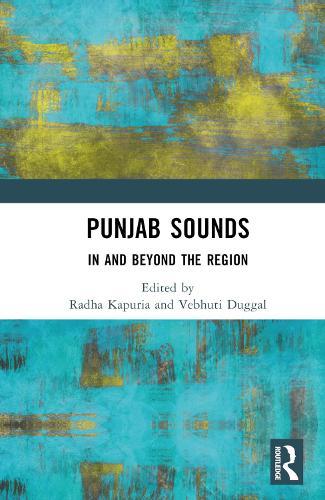
Full Product Details
Author: Radha Kapuria (University of Sheffield, UK) ,
Vebhuti Duggal
Publisher: Taylor & Francis Ltd
Imprint: Routledge
Weight: 0.453kg
ISBN: 9781032525181
ISBN 10: 1032525185
Pages: 242
Publication Date: 13 December 2024
Audience:
College/higher education
,
Undergraduate
,
Postgraduate, Research & Scholarly
Format: Hardback
Publisher's Status: Active
Availability: In Print

This item will be ordered in for you from one of our suppliers. Upon receipt, we will promptly dispatch it out to you. For in store availability, please contact us.
Reviews
This sonically textured study of Punjab goes beyond a circulation of stereotype and defies monolithic notions of history, region, topology, gender, and human expression. Radha Kapuria and Vebhuti Duggal compile an original set of thoughtful essays where a sensory engagement with the region is infused with deeply vibrant, intertextual narratives that bring a new nuance to our larger understanding of how sound shapes territories and identities. –Gurminder K. Bhogal, Catherine Mills Davis Professor in Music, Wellesley College, Massachusetts. Can Punjab as a region be heard, felt, touched, and seen simultaneously through scholarship that focusses on soundscapes and sound studies? Spanning across the historical to the contemporary on YouTube, this interdisciplinary collection of fine and original essays shows us the way and how to do it. Punjab Sounds has much to offer and is a gift to the wider field of enquiry. –Rajinder Dudrah, Professor of Cultural Studies and Creative Industries, Birmingham City University. Suturing the mythic and the historic, the devotional and the divided, this cross-disciplinary volume attunes us to the worlding possibility of sound. It is also a pioneering performance that refigures region – Punjab in this case – via its translocally audible and creaturely forms. –Omar Kasmani, Guest Lecturer in Social and Cultural Anthropology, Freie Universität Berlin. Punjab Sounds is a seminal contribution that reframes debates on region formation within South Asia, unravels some of the conceptual straitjackets, and suggests the potential for rethinking the region through sonic practices and affects. Spanning several key developments across colonial and post-colonial South Asia and exploring myriad themes, technologies, sound objects and musical forms, each chapter provides substantive methodological insights into researching sound practices and region formation. It brings into colloquy the fields of ethnomusicology, sound studies, film and media studies, performance studies, history, and religious studies. The book will be an undeniably valuable resource for students and scholars of these fields and will appeal to a wide range of readers in higher education and the general public alike. –Bindu Menon, Associate Professor in Media Studies, Azim Premji University, Bengaluru. This sonically textured study of Punjab goes beyond a circulation of stereotype and defies monolithic notions of history, region, topology, gender, and human expression. Radha Kapuria and Vebhuti Duggal compile an original set of thoughtful essays where a sensory engagement with the region is infused with deeply vibrant, intertextual narratives that bring a new nuance to our larger understanding of how sound shapes territories and identities. Gurminder K. Bhogal, Catherine Mills Davis Professor in Music, Wellesley College, Massachusetts. Can Punjab as a region be heard, felt, touched, and seen simultaneously through scholarship that focusses on soundscapes and sound studies? Spanning across the historical to the contemporary on YouTube, this interdisciplinary collection of fine and original essays shows us the way and how to do it. Punjab Sounds has much to offer and is a gift to the wider field of enquiry. Rajinder Dudrah, Professor of Cultural Studies and Creative Industries, Birmingham City University. Suturing the mythic and the historic, the devotional and the divided, this cross-disciplinary volume attunes us to the worlding possibility of sound. It is also a pioneering performance that refigures region – Punjab in this case – via its translocally audible and creaturely forms. Omar Kasmani, Guest Lecturer in Social and Cultural Anthropology, Freie Universität Berlin. Punjab Sounds is a seminal contribution that reframes debates on region formation within South Asia, unravels some of the conceptual straitjackets, and suggests the potential for rethinking the region through sonic practices and affects. Spanning several key developments across colonial and post-colonial South Asia and exploring myriad themes, technologies, sound objects and musical forms, each chapter provides substantive methodological insights into researching sound practices and region formation. It brings into colloquy the fields of ethnomusicology, sound studies, film and media studies, performance studies, history, and religious studies. The book will be an undeniably valuable resource for students and scholars of these fields and will appeal to a wide range of readers in higher education and the general public alike. Bindu Menon, Associate Professor in Media Studies, Azim Premji University, Bengaluru.
This sonically textured study of Punjab goes beyond a circulation of stereotype and defies monolithic notions of history, region, topology, gender, and human expression. Radha Kapuria and Vebhuti Duggal compile an original set of thoughtful essays where a sensory engagement with the region is infused with deeply vibrant, intertextual narratives that bring a new nuance to our larger understanding of how sound shapes territories and identities. –Gurminder K. Bhogal, Catherine Mills Davis Professor in Music, Wellesley College, Massachusetts. Can Punjab as a region be heard, felt, touched, and seen simultaneously through scholarship that focusses on soundscapes and sound studies? Spanning across the historical to the contemporary on YouTube, this interdisciplinary collection of fine and original essays shows us the way and how to do it. Punjab Sounds has much to offer and is a gift to the wider field of enquiry. –Rajinder Dudrah, Professor of Cultural Studies and Creative Industries, Birmingham City University. Suturing the mythic and the historic, the devotional and the divided, this cross-disciplinary volume attunes us to the worlding possibility of sound. It is also a pioneering performance that refigures region – Punjab in this case – via its translocally audible and creaturely forms. –Omar Kasmani, Guest Lecturer in Social and Cultural Anthropology, Freie Universität Berlin. Punjab Sounds is a seminal contribution that reframes debates on region formation within South Asia, unravels some of the conceptual straitjackets, and suggests the potential for rethinking the region through sonic practices and affects. Spanning several key developments across colonial and post-colonial South Asia and exploring myriad themes, technologies, sound objects and musical forms, each chapter provides substantive methodological insights into researching sound practices and region formation. It brings into colloquy the fields of ethnomusicology, sound studies, film and media studies, performance studies, history, and religious studies. The book will be an undeniably valuable resource for students and scholars of these fields and will appeal to a wide range of readers in higher education and the general public alike. –Bindu Menon, Associate Professor in Media Studies, Azim Premji University, Bengaluru.
Author Information
Radha Kapuria is Assistant Professor of South Asian History at Durham University, UK, and the author of Music in Colonial Punjab: Courtesans, Bards, and Connoisseurs, 1800–1947. Vebhuti Duggal is Assistant Professor in Film Studies at the School of Culture and Creative Expressions, Ambedkar University Delhi, and Associate Editor of the journal BioScope: South Asian Screen Studies.