Overview
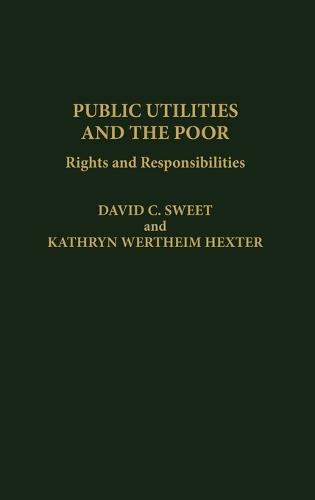
Public Utilities and The Poor examines an often-neglected aspect of utility policy: the development of new policy directions for utility assistance to the low-income and the elderly. It focuses on the shift in utility assistance policy-making from the federal to the state, local, and neighborhood levels and on the resulting opportunity among private utilities for leadership in developing local programs. In addition, the authors propose that steps be taken to open up the policy-making process to make sure that all groups with a stake in the outcome are included.
Full Product Details
Author: Katheryn W. Hexter ,
David C. Sweet
Publisher: Bloomsbury Publishing Plc
Imprint: Praeger Publishers Inc
Dimensions:
Width: 15.60cm
, Height: 1.20cm
, Length: 23.40cm
Weight: 0.459kg
ISBN: 9780275925727
ISBN 10: 0275925722
Pages: 197
Publication Date: 17 November 1987
Recommended Age: From 7 to 17 years
Audience:
College/higher education
,
Undergraduate
,
Postgraduate, Research & Scholarly
Format: Hardback
Publisher's Status: Active
Availability: Manufactured on demand

We will order this item for you from a manufactured on demand supplier.
Reviews
"?This study covers a decade of development in the energy policy arenas at the federal, state, and local levels--a period of time during which the nation experienced dramatic upsurges in energy costs, policy debates and conflicts among utility regulators, utility executives, state and federal lawmakers, and a variety of other stakeholders--most notably the low and fixed income households confronted with paying their steadily rising utility bills. . . . An alternative to the adversarial approach to policymaking is delineated here, along with recommendations for improved policy directions.?-SAGE ""This study covers a decade of development in the energy policy arenas at the federal, state, and local levels--a period of time during which the nation experienced dramatic upsurges in energy costs, policy debates and conflicts among utility regulators, utility executives, state and federal lawmakers, and a variety of other stakeholders--most notably the low and fixed income households confronted with paying their steadily rising utility bills. . . . An alternative to the adversarial approach to policymaking is delineated here, along with recommendations for improved policy directions.""-SAGE"
?This study covers a decade of development in the energy policy arenas at the federal, state, and local levels--a period of time during which the nation experienced dramatic upsurges in energy costs, policy debates and conflicts among utility regulators, utility executives, state and federal lawmakers, and a variety of other stakeholders--most notably the low and fixed income households confronted with paying their steadily rising utility bills. . . . An alternative to the adversarial approach to policymaking is delineated here, along with recommendations for improved policy directions.?-SAGE
Author Information
DAVID C. SWEET is Dean of the College of Urban Affairs, Cleveland State University. KATHRYN WERTHEIM HEXTER is a Consumer and Education Affairs Representative at East Ohio Gas Co.