|
|
|||
|
||||
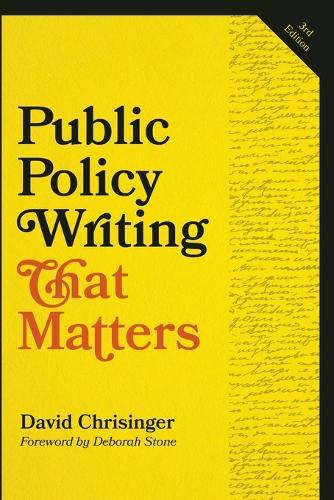
OverviewThe trusted guide to honing your public policy writing skills and making a significant impact on the world, thoroughly updated and expanded. Effective policy writing holds the transformative power to inspire action, shape public opinion, and influence outcomes. In the third edition of Public Policy Writing That Matters, communications expert David Chrisinger, who directs the Harris Writing Workshop at the University of Chicago and worked in the US Government Accountability Office for nearly a decade, continues to demystify the art of writing persuasively about public policy. Effective public policy writing is a catalyst for meaningful societal change. Chrisinger argues that by mastering the craft of clear, concise, and compelling communication, writers can elevate their ability to influence decision-makers, mobilize communities, and drive lasting and positive change. The book combines practical advice, insightful analysis, and hands-on exercises to provide a comprehensive guide for readers who want to improve their policy-writing skills. Offering real-world examples and cautionary tales, it offers a step-by-step approach to crafting impactful policy analysis, leveraging evidence, and framing arguments persuasively. Aimed at helping students and professionals overcome their default impulses to merely ""explain,"" this book reveals proven tips for writing sophisticated and persuasive policy analysis that is also easy to understand. For anyone interested in planning, organizing, developing, writing, and revising accessible public policy, Chrisinger offers a step-by-step guide that covers everything from the most effective presentation methods to the best ways to write a sentence. Full Product DetailsAuthor: David Chrisinger (Communications Analyst) , Deborah StonePublisher: Johns Hopkins University Press Imprint: Johns Hopkins University Press Edition: third edition Dimensions: Width: 15.20cm , Height: 1.70cm , Length: 22.90cm Weight: 0.354kg ISBN: 9781421454306ISBN 10: 1421454300 Pages: 248 Publication Date: 02 June 2026 Audience: College/higher education , Tertiary & Higher Education Format: Paperback Publisher's Status: Forthcoming Availability: Not yet available This item is yet to be released. You can pre-order this item and we will dispatch it to you upon its release. Table of ContentsTable of Contents Foreword by Dr. Deborah Stone, Author of Policy Paradox Introduction Step 1: Clarify Your Thinking before You Write 1. Generating an Effective Research Statement 2. Moving from a Research Statement to Strong Policy Research Questions Step 2: Identify the Four Elements of a Persuasive Policy Recommendation 3. Advocating for Reform with the Four Elements of a Persuasive Policy Recommendation 4. Making More Impactful Recommendations Using the Importance/Difficulty Matrix 5. Understanding the Landscape of Reform with Stakeholder Mapping 6. Writing to Meet the Unique Needs of Your Reader Step 3: Choose the Most Valuable Method to Deliver Your Message 7. Telling What You Know: Policy Memos, Briefs, and Reports 8. Framing Your Message More Effectively with the Moral Foundations Theory 9. Showing What's True: Policy Reform Narratives 10. Creating and Delivering Impactful Presentations Step 4: Revise Your Paragraphs and Sentences for Coherence, Clarity, and Concision 11. Improving Paragraph Coherence with Deductive Structure 12. Strengthening Sentence Cores to Improve Clarity 13. Pruning Needless Words for Clearer, More Effective Writing 14. More Strategies for Being Your Own Best Editor Step 5: Share Your Work with the World 15. Mastering the Art of the Pitch: Op-Eds and Longform Journalism 16. Leveraging Digital Communication Tools for Policy Advocacy Conclusion: Making Your Policy Writing Matter Mastering the Craft: Essential Tips for Effective Writing about Public Policy Suggestions for Further Reading Index Acknowledgements About the AuthorReviewsAuthor InformationDavid Chrisinger is the director of the policy writing program at the University of Chicago's Harris School of Public Policy. He is the author of Stories Are What Save Us: A Survivor's Guide to Writing about Trauma and the co-author of Because Data Can't Speak for Itself: A Practical Guide to Telling Persuasive Policy Stories. Tab Content 6Author Website:Countries AvailableAll regions |
||||