Overview
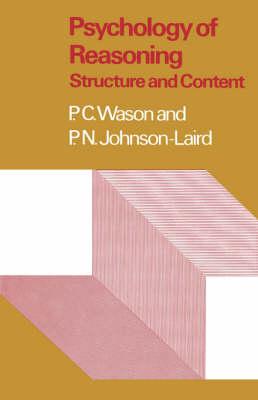
'Is there any other point to which you would wish to draw my attention?' 'To the curious incident of the dog in the night-time.' 'The dog did nothing in the night-time.' 'That was the curious incident, ' remarked Sherlock Holmes. The quotation from A. Conan Doyle with which this book begins, is a delightfully appropriate summation of the authors' point of view garnered from their fifteen years of experiments on the psychology of reasoning. Dr. Wason and Dr. Johnson-Laird are intrigued by the extent to which most individuals can be considered naturally rational thinkers. They present here the surprising results of their comprehensive investigations of how humans draw explicit conclusions from evidence. Given a set of assertions, the authors write, to what extent can the individual appreciate all that follows from them by virtue of logic alone, and remain unseduced by plausible, but fallacious conclusions? We are not concerned with whether these assertions are true or false, nor with whether the individual holds them among his beliefs, nor with whether they are sane or silly. At the core of the Psychology of Reasoning is a vigorous discussion that incorporates various illustrations--some of them humorous, all of them fascinating--of the use of reason under a wide variety of different conditions. Particular emphasis is placed on the difficulties involved in dealing with negatively marked information that must be combined and used with other information for reaching conclusions. Thorough treatment is given as well to the search for plausible contexts that will render anomalous or ambiguous statements sensible. The authors have strived to isolate the components of inference, the basic steps of any kind of deductive activity, in order to determine the psychological processes involved in them. What has been the outcome of this research? Dr. Wason and Dr. Johnson-Laird conclude, our research has suggested that the individual's logical competence may be either enhanced or limited by performance variables. And, of these, content has turned out to be vitally important for revealing, or obscuring structure. At best, we can all think like logicians; at worst, logicians all think like us.
Full Product Details
Author: P. C. Wason ,
P.N.Johnson Laird
Publisher: Harvard University Press
Imprint: Harvard University Press
Edition: New edition
Dimensions:
Width: 13.50cm
, Height: 1.40cm
, Length: 21.00cm
Weight: 0.317kg
ISBN: 9780674721272
ISBN 10: 0674721276
Pages: 272
Publication Date: 01 January 1972
Audience:
College/higher education
,
Professional and scholarly
,
Undergraduate
,
Postgraduate, Research & Scholarly
Format: Paperback
Publisher's Status: Out of Print
Availability: Awaiting stock

Author Information
Dr. Wason is Reader in Psycholinguistics at the University College London.