Overview
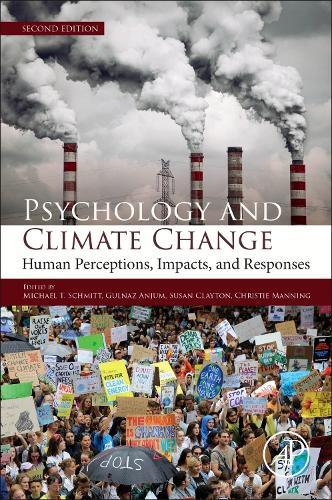
Psychology and Climate Change: Human Perceptions, Impacts, and Responses, Second Edition offers an updated exploration on the intricate relationship between human psychology and the pressing global climate crisis. With new content and research insights, this new edition delves into the latest advancements in climate psychology, emphasizing key areas such as perceptions, communication strategies, collective identity, and activism. It investigates psychological impacts on well-being, community resilience, coloniality, and climate justice, taking into account diverse cultures and communities worldwide. New chapters cover topics such as emotional responses to climate change and their impact on behavior, the dynamics of collective identity in climate change responses, the strategic role of climate activism in promoting mitigation and adaptation, the psychological implications of climate injustice, and an ecofeminist approach to understanding the psychology of climate change. Serving as an essential resource for both education and professional use, this revised edition provides readers with the knowledge and strategies needed to drive meaningful action and policy change at various levels.
Full Product Details
Author: Michael T. Schmitt, PhD (Simon Fraser University, Canada) ,
Gulnaz Anjum, Phd (University of Oslo, Norway) ,
Susan Clayton, Phd (College of Wooster, USA) ,
Christie Manning, PhD (Macalester College, USA)
Publisher: Elsevier Science Publishing Co Inc
Imprint: Academic Press Inc
Edition: 2nd edition
Weight: 0.450kg
ISBN: 9780443341625
ISBN 10: 0443341621
Pages: 325
Publication Date: 01 June 2026
Audience:
College/higher education
,
Undergraduate
Format: Paperback
Publisher's Status: Forthcoming
Availability: Not yet available

This item is yet to be released. You can pre-order this item and we will dispatch it to you upon its release.
Reviews
Review of the previous edition: ""This workbook provides a tremendous resource for helping new behavior analysts work through commonly encountered ethical dilemmas.This will be a great asset in ethics courses and in preparation for the exam."" --Linda A. LeBlanc, PhD, BCBA-D, LeBlanc Behavioral Consulting, Golden, Colorado ""A Workbook of Ethical Case Scenarios in Applied Behavior Analysis is a goldmine for instructors in search of case studies for teaching ethical decision-making and makes a significant and timely contribution to the field of behavior analysis."" --Matthew T. Brodhead, PhD, BCBA-D, Assistant Professor, Michigan State University, East Lansing, Michigan
Author Information
Dr. Michael T. Schmitt received his MA and PhD from the University of Kansas, where worked with Nyla Branscombe on the psychological implications of group-based privilege and disadvantage. After two years at Purdue University, Michael has worked at Simon Fraser University where he is now a professor of social psychology. He is a White settler grateful to live and work on the unceded territories of the Tsleil-Waututh (səl̓ilw̓ətaʔɬ), Kwikwetlem (kʷikʷəƛ̓əm), Squamish (Sḵwx̱wú7mesh Úxwumixw) and Musqueam (xʷməθkʷəy̓əm) Nations. Michael’s current work applies critical psychology perspectives and a social identity lens to climate change and environmental activism. Dr. Gulnaz Anjum (she/her) is a Researcher in the Department of Psychology at the University of Oslo (Norway). Her research and teaching focus on climate justice and Global South perspectives. Dr. Anjum examines how climate change, gendered vulnerability, and displacement intersect to shape health and psychosocial wellbeing in marginalised communities across South Asia, Africa, Latin America, and migrant contexts in the Global North. Drawing on feminist, decolonial, and community-based approaches, she investigates how structural inequalities and environmental stressors constrain agency, repair, and adaptive capacity, while also advancing frameworks for equitable climate governance. Dr. Anjum’s research and collaborations have been supported by major international funders, including the International Development Research Centre (IDRC, Canada), UK Research and Innovation (UKRI), and the Higher Education Commission of Pakistan (HEC). Dr. Susan Clayton is the Whitmore-Williams Professor of Psychology at the College of Wooster in Ohio. Her PhD, in social psychology, is from Yale University. Dr. Clayton’s research examines people’s relationship with the natural environment, how it is socially constructed, and how it is affected by changing environmental conditions; she is co-author of the widely used Climate Change Anxiety Scale. A fellow of the American Psychological Association and the International Association of Applied Psychology, she was a lead author on the Sixth Assessment Report of the Intergovernmental Panel on Climate Change. She continues to research the ways in which climate change is affecting people’s lives and well-being. Dr. Christie Manning, PhD, is a cognitive and biological psychologist who teaches in the interdisciplinary Environmental Studies Department at Macalester College in Minnesota. Her research explores how climate storytelling influences the psychological antecedents of community-level climate action, and how climate injustice impacts human well-being. Her recent co-authored books include Fostering Sustainability in Higher Education, and the academic textbook, Psychology for Sustainability, 6e. Dr Manning is a Fellow of the American Psychological Association.