Overview
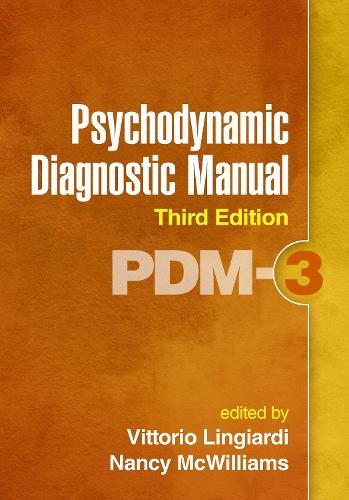
Fully updated and restructured with 70% new material, PDM-3 presents important advances in multiaxial mental health diagnosis from a psychodynamic perspective, in dialogue with neuroscientific and cognitive-behavioral perspectives. Used worldwide, this authoritative manual offers an empirically based, clinically useful alternative or supplement to DSM and ICD descriptive and symptom-oriented diagnoses. PDM-3 guides the practitioner to develop a multilayered dimensional understanding of each patient, leading to a rich case formulation and flexible treatment plan. Leading international experts systematically address personality functioning, mental capacities, and symptomatic impairment in infancy, childhood, adolescence, adulthood, and old age, including jargon-free descriptions and clinical examples. The companion website provides additional, in depth case illustrations and five downloadable and reproducible PDM-derived rating scales. New to This Edition Restructured to follow development chronologically. Conceptual refinements, updated assessment tools, and expanded case material. Chapters on the transition from infancy to childhood and from adolescence to adulthood. Chapters on psychological experiences throughout the lifespan that are not captured by a diagnosis, but may require clinical attention. Supporting associations include the International Psychoanalytical Association, Division 39 of the American Psychological Association, the American Psychoanalytic Association, the International Association for Relational Psychoanalysis & Psychotherapy, the American Association for Psychoanalysis in Clinical Social Work, and other organizations. PDM-2 won the American Board and Academy of Psychoanalysis Book Prize (Clinical Category)
Full Product Details
Author: Vittorio Lingiardi (Sapienza University of Rome , Italy) ,
Nancy McWilliams (""Rutgers University, United States"")
Publisher: Guilford Publications
Imprint: Guilford Press
Edition: 3rd edition
Weight: 1.840kg
ISBN: 9781462558711
ISBN 10: 1462558712
Pages: 1058
Publication Date: 17 February 2026
Audience:
Professional and scholarly
,
Professional & Vocational
Format: Paperback
Publisher's Status: Active
Availability: Out of stock

The supplier is temporarily out of stock of this item. It will be ordered for you on backorder and shipped when it becomes available.
Reviews
“Psychoanalysis is often akin to a Tower of Babel, with so many ways to describe a patient but without a unifying language that lets analysts around the world share and learn from each other’s experiences. PDM offers a creative solution to this dilemma and an essential guiding frame for those learning the craft. It also offers a creative functional counterpoint to the push for categorical diagnoses, which too often overlook the rich nuance in an individual patient’s struggles and needs. That PDM is now in its third edition speaks to how essential a role it already plays in sustaining and growing psychoanalytic practice around the world.”--Linda C. Mayes, MD, Arnold Gesell Professor of Child Psychiatry, Pediatrics, and Psychology and Chair, Yale Child Study Center, Yale School of Medicine “The PDM is far more useful in clinical practice than the DSM or ICD. Psychopathologies simply cannot be adequately conceptualized in purely nomothetic terms; to ignore the idiographic is to ignore the most essential feature of the mind--namely, that it is subjective. The inclusion of some neuropsychoanalytic constructs in this edition is a particularly welcome development.”--Mark Solms, PhD, Co-Chair, International Neuropsychoanalysis Society “A landmark achievement. Fully revised, PDM-3 offers a comprehensive lifespan framework that captures the complexity of human functioning through a dimensional, person-centered lens. It integrates contemporary research--from neuroscience and outcome studies to cultural and developmental psychology--while remaining grounded in core psychodynamic traditions such as object relations, ego psychology, and relational theory. PDM-3 adds vital clinical nuance to classification by emphasizing subjective experience, developmental context, and therapeutic relevance, and by incorporating both nomothetic and idiographic perspectives. Ideal for graduate training in diagnosis and assessment, PDM-3 is clinically meaningful and empirically grounded, revitalizing psychodynamic assessment for today’s mental health landscape.”--Peter Lilliengren, PhD, Department of Psychology, Stockholm University, Sweden “PDM-3 is an extraordinary collaborative achievement, with chapter editors and consultants who are among the most talented people in our profession. The volume champions psychodynamic thinking, including ego psychology, object relations, self psychology, and relational psychoanalysis. With sensitivity to developmental phases, culture, context, and diversity, PDM-3 makes diagnosis clinically meaningful beyond the narrow categories of the DSM, and includes dialogue with cognitive science and neuroscience. The third edition is easy to read, is organized chronologically beginning with infancy, and includes more recent empirical literature. This book is an invaluable resource for researchers as well as clinicians.”--Beatrice Beebe, PhD, Clinical Professor, Columbia University Medical Center, New York State Psychiatric Institute-The depth is impressive….Recommended. Upper-level undergraduates through professionals/practitioners. (on the second edition)--Choice Reviews, 11/1/2017Æ’Æ’No matter what your theoretical framework, this book and its ideas will work for you. Truly a mind-opening experience, and one which makes clinicians stop and think about their current therapeutic orientation. A must read for open-minded clinicians willing to go beyond the confines of the current diagnostic models. *****! (on the second edition)--Doody's Review Service, 7/28/2017
“PDM-3 is far more useful in clinical practice than DSM-5 or ICD-10. Psychopathologies simply cannot be adequately conceptualized in purely nomothetic terms; to ignore the idiographic is to ignore the most essential feature of the mind--namely, that it is subjective. The inclusion of some neuropsychoanalytic constructs in this edition is a particularly welcome development.”--Mark Solms, PhD, Co-Chair, International Neuropsychoanalysis Society “A landmark achievement. Fully revised, PDM-3 offers a comprehensive lifespan framework that captures the complexity of human functioning through a dimensional, person-centered lens. It integrates contemporary research--from neuroscience and outcome studies to cultural and developmental psychology--while remaining grounded in core psychodynamic traditions such as object relations, ego psychology, and relational theory. PDM-3 adds vital clinical nuance to classification by emphasizing subjective experience, developmental context, and therapeutic relevance, and by incorporating both nomothetic and idiographic perspectives. Ideal for graduate training in diagnosis and assessment, PDM-3 is clinically meaningful and empirically grounded, revitalizing psychodynamic assessment for today’s mental health landscape.”--Peter Lilliengren, PhD, Department of Psychology, Stockholm University, Sweden “Psychoanalysis is often akin to a Tower of Babel, with so many ways to describe a patient but without a unifying language that lets analysts around the world share and learn from each other’s experiences. PDM offers a creative solution to this dilemma and an essential guiding frame for those learning the craft. It also offers a creative functional counterpoint to the push for categorical diagnoses, which too often overlook the rich nuance in an individual patient’s struggles and needs. That PDM is now in its third edition speaks to how essential a role it already plays in sustaining and growing psychoanalytic practice around the world.”--Linda C. Mayes, MD, Arnold Gesell Professor of Child Psychiatry, Pediatrics, and Psychology and Chair, Yale Child Study Center, Yale School of Medicine-The depth is impressive….Recommended. Upper-level undergraduates through professionals/practitioners. (on the second edition)--Choice Reviews, 11/1/2017Æ’Æ’No matter what your theoretical framework, this book and its ideas will work for you. Truly a mind-opening experience, and one which makes clinicians stop and think about their current therapeutic orientation. A must read for open-minded clinicians willing to go beyond the confines of the current diagnostic models. *****! (on the second edition)--Doody's Review Service, 7/28/2017
“PDM-3 is far more useful in clinical practice than DSM-5 or ICD-10. Psychopathologies simply cannot be adequately conceptualized in purely nomothetic terms; to ignore the idiographic is to ignore the most essential feature of the mind--namely, that it is subjective. The inclusion of some neuropsychoanalytic constructs in this edition is a particularly welcome development.”--Mark Solms, PhD, Co-Chair, International Neuropsychoanalysis Society “A landmark achievement. Fully revised, PDM-3 offers a comprehensive lifespan framework that captures the complexity of human functioning through a dimensional, person-centered lens. It integrates contemporary research--from neuroscience and outcome studies to cultural and developmental psychology--while remaining grounded in core psychodynamic traditions such as object relations, ego psychology, and relational theory. PDM-3 adds vital clinical nuance to classification by emphasizing subjective experience, developmental context, and therapeutic relevance, and by incorporating both nomothetic and idiographic perspectives. Ideal for graduate training in diagnosis and assessment, PDM-3 is clinically meaningful and empirically grounded, revitalizing psychodynamic assessment for today’s mental health landscape.”--Peter Lilliengren, PhD, Department of Psychology, Stockholm University, Sweden “Psychoanalysis is often akin to a Tower of Babel, with so many ways to describe a patient but without a unifying language that lets analysts around the world share and learn from each other’s experiences. PDM offers a creative solution to this dilemma and an essential guiding frame for those learning the craft. It also offers a creative functional counterpoint to the push for categorical diagnoses, which too often overlook the rich nuance in an individual patient’s struggles and needs. That PDM is now in its third edition speaks to how essential a role it already plays in sustaining and growing psychoanalytic practice around the world.”--Linda C. Mayes, MD, Arnold Gesell Professor of Child Psychiatry, Pediatrics, and Psychology and Chair, Yale Child Study Center, Yale School of Medicine “PDM-3 is an extraordinary collaborative achievement, with chapter editors and consultants who are among the most talented people in our profession. The volume champions psychodynamic thinking, including ego psychology, object relations, self psychology, and relational psychoanalysis. With sensitivity to developmental phases, culture, context, and diversity, PDM-3 makes diagnosis clinically meaningful beyond the narrow categories of the DSM, and includes dialogue with cognitive science and neuroscience. The third edition is easy to read, is organized chronologically beginning with infancy, and includes more recent empirical literature. This book is an invaluable resource for researchers as well as clinicians.”--Beatrice Beebe, PhD, Clinical Professor, Columbia University Medical Center, New York State Psychiatric Institute-The depth is impressive….Recommended. Upper-level undergraduates through professionals/practitioners. (on the second edition)--Choice Reviews, 11/1/2017Æ’Æ’No matter what your theoretical framework, this book and its ideas will work for you. Truly a mind-opening experience, and one which makes clinicians stop and think about their current therapeutic orientation. A must read for open-minded clinicians willing to go beyond the confines of the current diagnostic models. *****! (on the second edition)--Doody's Review Service, 7/28/2017
Author Information
Vittorio Lingiardi, MD, is a psychiatrist and psychoanalyst. He is Full Professor of Dynamic Psychology and past Director of the Clinical Psychology Specialization Program in the Faculty of Medicine and Psychology, Sapienza University of Rome, Rome, Italy. He is Senior Research Fellow in the Sapienza School for Advanced Studies and runs the Sapienza Counseling Hub for professors and administrative staff. Dr. Lingiardi’s research interests include diagnostic assessment and treatment of personality disorders, process–outcome research in psychotherapy and psychoanalysis, and gender identity and sexual orientation. He is the author of several books and many articles published in leading international journals of psychiatry, psychotherapy, and psychoanalysis. Dr. Lingiardi has served as president (2020–2024) of the Society for Psychotherapy Research–Italy Area Group. He is the recipient of the Ralph Roughton Paper Award from the American Psychoanalytic Association, the Cesare Musatti Award from the Italian Psychoanalytic Society, the Research Award from the Society for Psychoanalysis and Psychoanalytic Psychology (Division 39 of the American Psychological Association), the Sigourney Award for Distinguished Contributions to Psychoanalysis, and the Scientific Dissemination Award from the Italian Psychological Association. Nancy McWilliams, PhD, ABPP, is Visiting Professor Emerita at the Graduate School of Applied and Professional Psychology at Rutgers, The State University of New Jersey, and has a private practice in Lambertville, New Jersey. She is author or editor of acclaimed books, including Psychoanalytic Diagnosis, Second Edition, and has published widely in professional journals. Dr. McWilliams is a past president of the Society for Psychoanalysis and Psychoanalytic Psychology, Division 39 of the American Psychological Association (APA). She is the recipient of honors including the Gradiva Award from the National Association for the Advancement of Psychoanalysis, the Erikson Scholar Award from the Austen Riggs Center, the Goethe Scholarship Award from the Section on Psychoanalytic and Psychodynamic Psychology of the Canadian Psychological Association, the Rosalee Weiss Award from the Division of Independent Practitioners of the APA, the Laughlin Distinguished Teacher Award from the American Society of Psychoanalytic Physicians, the Hans H. Strupp Award from the Appalachian Psychoanalytic Society, and the International, Leadership, and Scholarship Awards from APA Division 39. She is an honorary member of the American Psychoanalytic Association, the Institute for Psychoanalytic Psychotherapy of Turin, Italy, and the Warsaw Scientific Association for Psychodynamic Psychotherapy. Dr. McWilliams’s writings have been translated into more than 20 languages.