Overview
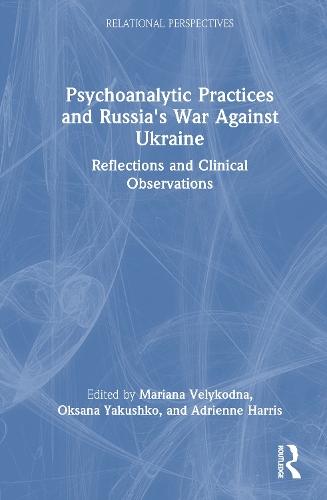
This book looks at the impact of multigenerational trauma, severe psychopathology, and ethical struggles through the lens of Ukrainian psychoanalysts working amidst the Russian invasion. The contribution examines psychoanalytic responses to Russia’s aggression against Ukraine, including via lived experiences of Ukrainian psychoanalysts who practice under conditions of continued threat. The book offers analytic observations and exploration of psychoanalytically informed care with Ukrainians who are experiencing profound distress and war trauma. Contributors describe their work with diverse Ukrainian groups, including children and adolescents, war refugees, individuals experiencing severe physical and psychological crises, Ukrainian Jewish community, and Ukrainian diaspora. This will be a valuable resource for readers interested in understanding and responding to impact of wars, specifically genocidal wars. They are invited to witness the profound challenges, creativity, courage, human and professional dilemmas, and pain that are witnessed and responded to by psychoanalytically informed practitioners.
Full Product Details
Author: Mariana Velykodna ,
Oksana Yakushko ,
Adrienne Harris
Publisher: Taylor & Francis Ltd
Imprint: Routledge
Weight: 0.650kg
ISBN: 9781032660240
ISBN 10: 1032660244
Pages: 250
Publication Date: 29 April 2026
Audience:
College/higher education
,
Professional and scholarly
,
Tertiary & Higher Education
,
Professional & Vocational
Format: Hardback
Publisher's Status: Active
Availability: Not yet available

This item is yet to be released. You can pre-order this item and we will dispatch it to you upon its release.
Reviews
‘This book should be required reading for all therapists. Its contributors put words to the unspeakable and bear witness to the unbearable. No human being can fully represent the horrors and continuing psychological depredations of war, and yet these essays manage to capture the precariousness and preciousness of our existence, the power of our feelings about place, and the critical role of our moral center of gravity in the face of evil. With clarity, passion, and brilliance, these authors help us see that although war-adapted psychotherapies can help only in modest ways, they matter profoundly.’ Nancy McWilliams, PhD, ABPP, visiting professor Emerita, Rutgers Graduate School of Applied & Professional Psychology The urgency of this book, both for those who live under conditions of war and for psychoanalysis itself, cannot be overstated. In this volume’s efforts to un-silence, in real time, the consequences of the ongoing Russian effort to annihilate individuals, culture and country and is a quintessential antidote to war’s dehumanizing force and demanding of us that we embrace the possibilities inherent in our profession. The valuable opportunity this volume provides melds theory, practice and personal experience to expand our clinical, conceptual and moral capacities to counter the violent occupation that so much of our world is seemingly authorized by fascism’s rise to perpetuate. There is a testimony here to the isomorphic interchange between psychic and large-group catastrophe, but there is also, in this series of essays, much hope and inspiration in the authors’ persistence in speaking psychoanalytically-informed truth, to which it behooves us to listen, despite all. Nancy Burke, PhD, ABPP, clinical professor, Northwestern University; Chicago Center for Psychoanalysis
‘This book should be required reading for all therapists. Its contributors put words to the unspeakable and bear witness to the unbearable. No human being can fully represent the horrors and continuing psychological depredations of war, and yet these essays manage to capture the precariousness and preciousness of our existence, the power of our feelings about place, and the critical role of our moral center of gravity in the face of evil. With clarity, passion, and brilliance, these authors help us see that although war-adapted psychotherapies can help only in modest ways, they matter profoundly.’ Nancy McWilliams, PhD, ABPP, Visiting Professor Emerita, Rutgers Graduate School of Applied & Professional Psychology The urgency of this book, both for those who live under conditions of war and for psychoanalysis itself, cannot be overstated. In this volume’s efforts to un-silence, in real time, the consequences of the ongoing Russian effort to annihilate individuals, culture and country and is a quintessential antidote to war’s dehumanizing force and demanding of us that we embrace the possibilities inherent in our profession. The valuable opportunity this volume provides melds theory, practice and personal experience to expand our clinical, conceptual and moral capacities to counter the violent occupation that so much of our world is seemingly authorized by fascism’s rise to perpetuate. There is a testimony here to the isomorphic interchange between psychic and large-group catastrophe, but there is also, in this series of essays, much hope and inspiration in the authors’ persistence in speaking psychoanalytically-informed truth, to which it behooves us to listen, despite all. Nancy Burke, PhD, ABPP, Clinical Professor, Northwestern University; Chicago Center for Psychoanalysis
Author Information
Mariana Velykodna is a EuroPsy-registered psychologist, psychoanalytic psychotherapist certified by the European Confederation of Psychoanalytic Psychotherapies, an associate professor and Head of Psychoanalytic Psychotherapy Department at Ukraine Sigmund Freud University in Ukraine. Oksana Yakushko is a licensed psychologist, psychoanalyst, and Ukrainian immigrant. She is a faculty at the George Washington University and a psychoanalytic practitioner in California and Washington, DC. Adrienne Harris is a faculty and supervisor in the New York University Postdoctoral Program in Psychotherapy and Psychoanalysis, Faculty and Training analyst at the Psychoanalytic Institute of Northern California, and serves on Editorial Boards of several psychoanalytic journals.